

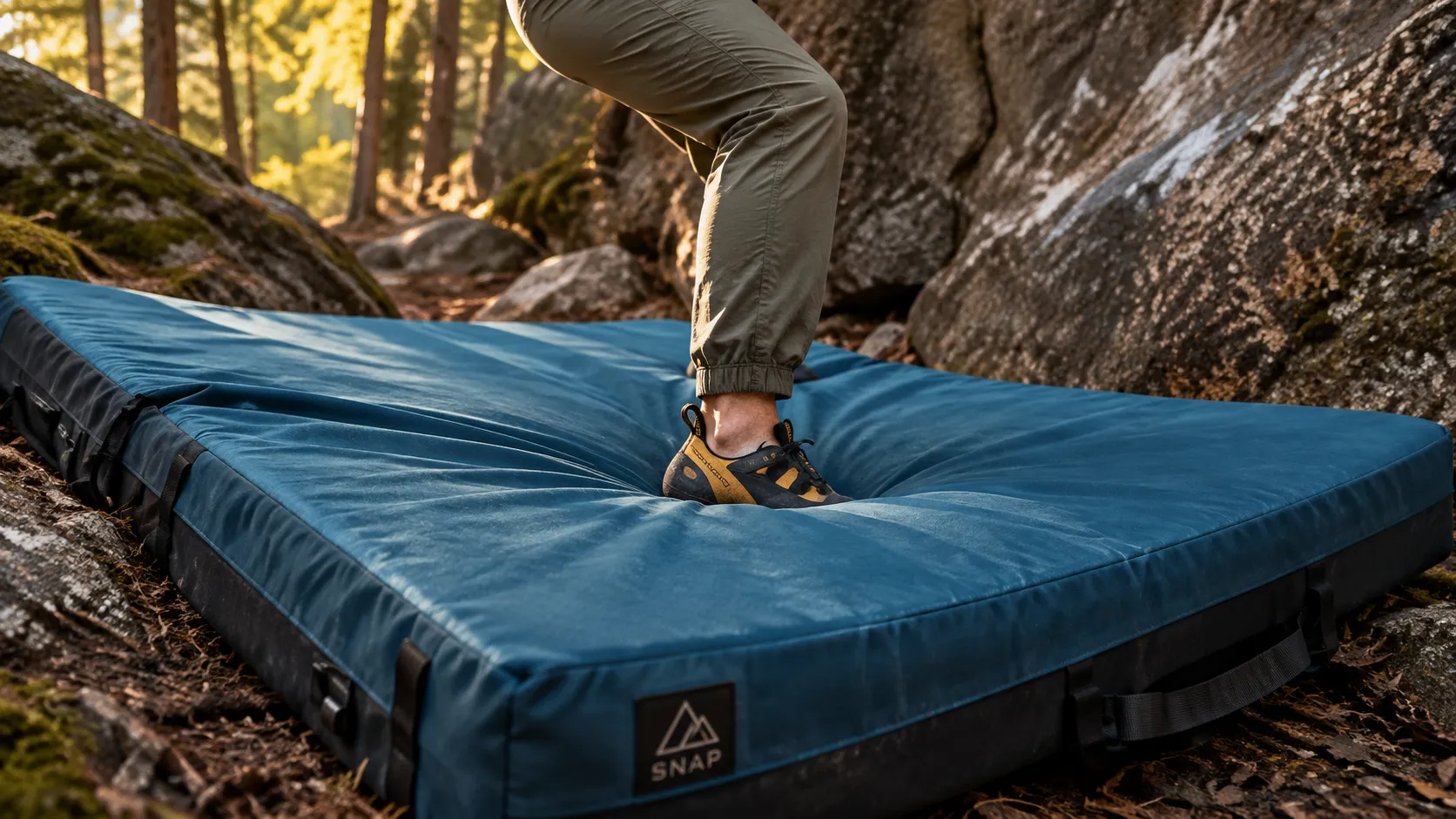
Guts Wavy Technology: what are the advantages of block scaling?
As a group, injuries often come from the receiving position: a study on fall scenarios reports that ankle sprains are the most common injury (eighty-eight percent). In this context, the Guts Wavy Technology does not concern a rope-based insurance system, but a Variable shock absorber system integrated into the Snap crash pads, designed to smooth the impact according to height and the dynamics of the fall. In this article, you will understand what this technology really changes on the rock, how to exploit it, and where it does not replace the fundamentals. To locate the range and uses, you can also browse our selection of crash pads.
The essentials in thirty seconds
Guts Wavy Technology aims for progressive cushioning: softer impact on small bumps, firmer support as energy increases.
The most significant improvement in terrain performance: more readable receptions, less rebound, and better stability of the hips and ankles.
She does not correct a bad drop zone: placement of the pads, stance, and receiving technique remain decisive.
To choose, think in terms of drop profile (height, lateral displacement, terrain) rather than in terms of “more flexible pad = safer”.
After these benchmarks, let’s return to the real needs in modern climbing, especially in the external boulder.
Why modern climbing requires a more progressive amortization
Current needs of control and fluidity
The current block combines dynamic movements, landings away from the center of gravity, and sometimes high kicks. The result: receiving is no longer just “absorbing an impact”; it’s to maintain control To avoid ankle twisting and secondary falls. A good crash pad must therefore offer a clear transition between a feeling of welcome (so as not to “slip” on a deck) and a feeling of support (so as not to sink in and roll over).
This search for progression is also applied outside the ring: well-structured training reduces fatigue and errors. Although it is not the same subject, cycles on beams (examples: beastmaker, Nature Climbing) help some climbers stabilize their placements, provided they manage the load on their backs. fingers climb and avoid the injury by an excess of zeal.
“Diameter/dynamic type” constraints: the equivalent in crash pad
When climbing with a rope, we talk about diameter and type of rope. In the block, the equivalent is read in the structure of the foams Closed cells for stability, open cells for absorption, and different densities to prevent “rolling” on a steeper descent. This is precisely where variable damping becomes interesting: you’re looking for a response that changes with the energy, without turning the pad into a trampoline.
Weight differences between a climber and an “insurer”: what really changes
Overall, the critical variable is your weight, but also your vertical speed and horizontal displacement. Two people can fall from the same height and create very different stresses on their ankles. The brace does not “stop” a fall like an insurance adjuster, but it orientate : basin towards the pad, head protected, limited rotation. A progressively cushioned pad becomes more readable for the diver, because the reception is less “surprising”.
Crowne expectations versus the big road: where Wavy Technology makes sense
With a sturdy construction and excellent performance, the cushioning depends mainly on the cord, the points, and the lacing system. The Guts Wavy Technology primarily aims to improve the’block escalation and the management of the landing. The right framing is simple: if your main risk is a crash on a crash pad, the technology has a direct interest. If your main risk is an insurance error, it makes no difference.
Common misconceptions about braking and comfort
Common misconception: “the more soft, the more sure.” In reality, too much softness can accentuate the asymmetric sinking, therefore the torsion. Conversely, too much firmness can dissipate energy and cause a rebound. The goal is not the perceived comfort when held in hand, but rather Stability at landing, Especially on uneven terrain.
A “safe” crash pad is not just thick: it must remain stable when the fall is imperfect.
Think “controlled reception” before “soft foam”.
The padding and the placement of the pads are part of the cushioning system.
Once the need is clarified, you can understand the operational definition of this technology.
Guts Wavy Technology: a useful definition, not marketing
Internal wave principle and path of energy
The logic is that of a Alveolar intermediate layer which deforms first, then gradually “locks” when the alvéoles arrive at the end of the run. The energy is not absorbed all at once: it is dissipated in stages, which improves the reading of the reception. On the field, this translates into less dry reception on small drops and more reassuring support when you fall higher.
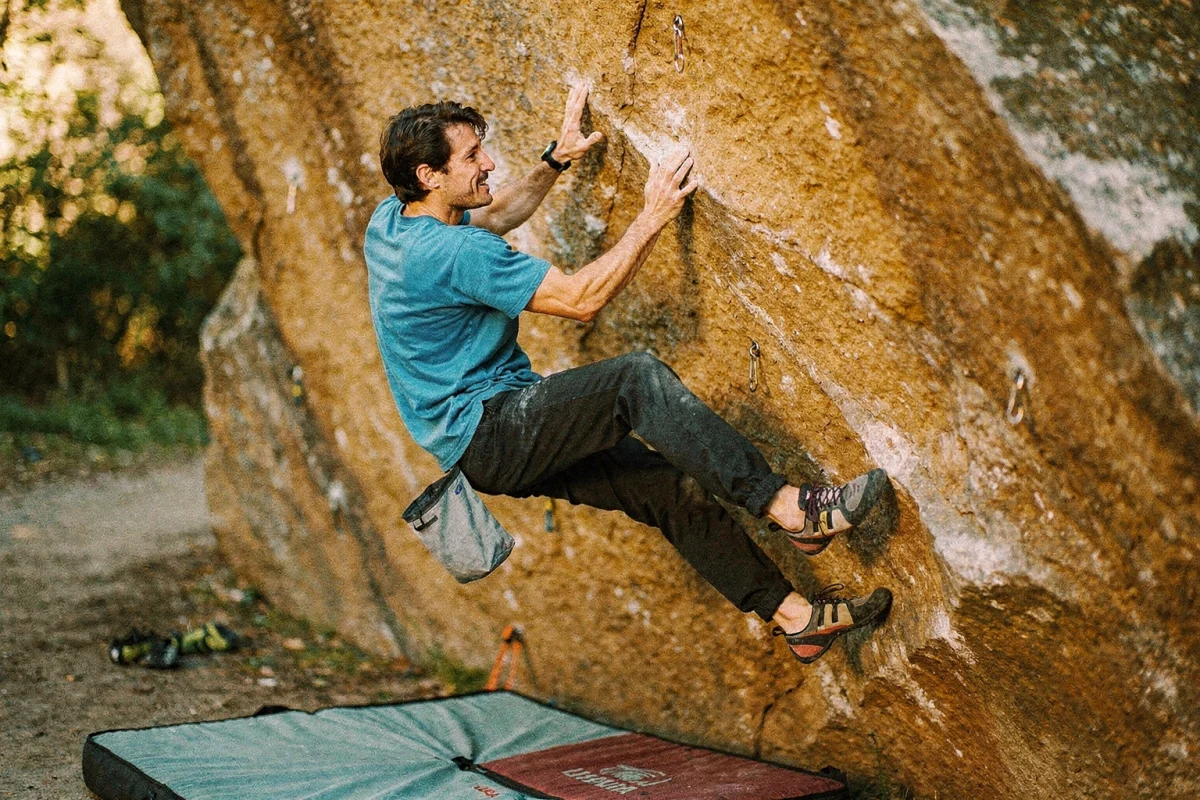
Effect on “progressive friction” and jamming
Here, the “friction” is not that of a cord, but the internal friction of the cells and the controlled deformation of the foams. The “locking” corresponds to the moment when the intermediate foam has worked enough that the lower layer takes over. This transition is the key element: it limits the sagging, without making the entire structure stiff from the first contact.
Flux: fall → upper foam (stability) → alveolate layer (deformation and dissipation) → lower foam (support) → ground (terrain, roughness, slope).
Typical compatibility with receiving systems
A variable-damping crash pad works even better if you manage the terrain’s “compatibility”: well-joined pads, hollow areas filled in, an enlarged receiving surface, and a bumper that accompanies the rotation. The technology does not replace a good “architecture” of pads, especially when you combine several models.
Express definition: Guts Wavy Technology refers to a variable damping system based on an alveolar intermediate layer that softens small impacts and provides more support when the impact increases.
Look for the transition: welcome first, support later.
The interest is maximized when your reception is not perfectly vertical.
Compatibility depends primarily on the terrain and placement, not on a promised product.
Now that the definition is clear, let’s look at what happens mechanically at the moment of impact.


What technology changes in shock mechanics and biomechanics
Distribution of load over the contact zones
A “clean” landing distributes the load across the entire foot, then moves up towards the knees and hips. A “dirty” landing focuses the load on one edge of the foot, with rotation. Progressive cushioning helps by reducing the initial peak: the body has an extra micro-second to align the ankle, knee, and hip. It’s not spectacular, but that’s often where the difference lies between a controlled landing and a foot that comes off.

Modulation of dissipation according to speed
The higher the rate of descent, the more foam must dissipate without collapsing too quickly. The alveoli play a role as the “first layer,” then the lower foam provides the support reserve. This modulation is relevant when you perform a series of jumps: you maintain a more constant sensation despite a variety of jumps.
Reduction of impacts during short falls
On a small drop, a too-firm crash pad sometimes dissipates part of the energy, which stiffens the ankles. Conversely, a softer landing reduces the impact and facilitates coordinated flexion. It also builds confidence: you dare to “drop” more gracefully, rather than straining to catch up at all costs.
Effects on hand fatigue and tension
The link is indirect but real: if you anticipate a hard reception, you will tighten more. This tension parasitizes the movement and increases errors. A more readable damping reduces mental load and unnecessary contractions. It is a climbing comfort, not just a comfort on the ground.
Influence on mou management and “evaluation”: the useful comparison
When climbing with a rope, we’re talking about giving in and swallowing. In a block, the equivalent is your ability to accept the fall without gesturing: releasing at the right moment, orienting your hips, and letting the pad do the work. Your fall technique is a complete protocol, just like the choice of holds.
The main benefit is the reduction of the “peak” and the improvement of reception stability.
The technology helps especially when the fall is imperfect, not when it is perfect.
Less tension can also improve your performance on the movements involved.
These mechanisms translate into observable and comparable gains on the ground.
Observable performance gains in the field (and how to compare them)
Concrete indicators: control, regularity, stability
You can evaluate a crash pad with simple indicators: foot stability (less twisting), no rebound, ease of “standing up” after a landing, and consistency between attempts. The most honest comparison is to replicate controlled falls (low heights, then a little higher) on similar terrain, with the same shoes.

Test scenarios in the real world: what it really measures
In backcountry skiing, a crash pad is primarily used to protect a kick, a low turn, or a fall across the edge. Here, the main benefit is stability on a shifted landing, not the absorption of a big fall. The progressive design helps to avoid the “walk” effect when you arrive on the edge of a pad or on a junction.
“Large-scale road” test scenarios: realistic use
While the crash pad is a major component of the safety system, it is not its core function. Realistic uses involve approaches, take-offs, or very low-adhesion landings. If you are looking for an “insurance” effect, you are comparing different things.
| Model (example) | Open format | Thickness | Weight | Useful reading |
|---|---|---|---|---|
| Snap Guts Black (Wavy) | 150 × 100 cm | 14 cm | 8.9 kg | Good balance of stability / hospitality |
| Snap Big Phatty (Wavy) | 150 × 120 cm | 12 cm | 10 kg | Large surface, useful for high-altitude outings |
User profiles versus expected gains
| Profile | What you earn the most | What remains a priority |
|---|---|---|
| Dynamic climbers | More “posh” receptions despite the speed | Drop technique, padding, pad connections |
| Heavy build | More consistent support as the impact increases | Multiplying pads over hard areas and relief blocks |
| Breaking ground (rocks, roots) | Better tolerance to roughness under the pad | Alignment, hole sealing, overall stability |
Measurement limits and frequent biases
The classic bias is to judge by hand or on a perfect fall. However, what matters is the imperfect fall: foot that comes in at an angle, reception on the edge, or landing in a dip. Another bias: confusing “thick” with “better”. The best choice is the one that corresponds to your variety of real falls, not the one that impresses upon unpacking.
Micro-action: note three real falls (height, terrain, rotation) and choose your pad based on these three factors, not on a sensation you feel in the store. Also find Thermoformed mousse on our website.
Compare with realistic scenarios: junctions, edges, irregular terrain.
The “best” crash pad is the one that corresponds to your typical falls.
A useful comparison always includes the placement and role of the parure.
Speaking about performance without talking about security would be incomplete: let’s address load management and human errors.
Security: What the variable amortisation does, and what it will never do
Behaviour on low to medium falls
On low to medium slopes, progressive damping improves grip especially well and limits rebound. This helps to maintain balance, thus preventing secondary falls off the pad. But the pad does not “catch” a landing on a rock or a reception on a locked heel.
Risks from poor posture or bad padding
The priority risk is uncontrolled rotation: head, neck, shoulders. A poorly positioned brace can worsen the situation by pushing laterally. The rule is simple: follow the hip and guide it towards the central area of the pad, without pulling the arms.
Interaction with “assisted braking” and devices
Overall, “assisted braking” does not exist: it is your technique and the ground setup that count. On the other hand, you can create a real margin by combining several pads, connecting them, and managing the gaps. The eyelets and attachment systems mentioned on some models facilitate this continuity.
Tolerance for errors and perceived safety margin
Variable damping technology can increase tolerance on a slightly off-center hit. It can also create overconfidence. Keep an objective benchmark: if the landing zone is uncertain, lower the impact, even with a high-end pad.
Safety rules, short version: center of the pad, no-hole junctions, attentive monitoring, and stopping sessions when lucidity declines.
The pad improves reception, not the decision to engage.
Overconfidence is the most costly mistake.
Without a finish or proper placement, the best foam loses its sense.
Once the security is in place, the next question is simple: does it hold up over time?
Materials, durability and recent developments
Surface wear and maintaining performance
The performance of a crash pad declines especially when the liner tears, when the edges become fragile, or when the foams compress in an asymmetrical manner. Designs that limit exposed seams and protect the underside improve lifespan on abrasive rock.
Behaviour under dust, humidity and freezing
Dust reduces the grip of the slippers, not just the grips on the floor. An integrated mat helps to maintain a constant grip and prevents unnecessary falls. Moisture requires a bottom that is easy to clean, and a cover that does not absorb moisture.
Interview: useful cleaning and visual checks
Check the corner areas, the closures, and the hinge. Clean the underside after a muddy session to prevent gravel from becoming “points” under the foam. And make sure the pads stay flat once placed, without any slumping.
Material choice: impact weight and durability
We are seeing more and more polyester recycled covers and assembly parts designed to limit plastic. For example, a product description highlights metal loops and a polyester recycled cover, as well as a triple-density foam advertised as recycled. The compromise is clear: the more robust it is, the heavier it is to carry far away.
Perspectives: design and standardization
The trend is towards more modular pads (fasteners, eyelets, cleaner junctions) and a more eco-friendly design. On the ground, what matters remains simple: durability is determined by both the use (folding, carrying, storage) and the material.
Durability depends on the edges, the bottom, and the padding of the foams.
Take care especially of what touches the ground: that’s where it all starts.
A durable crash pad is often a bit more demanding to wear.
Understanding the subject matter is not enough: the real difference lies in the implementation.
How to exploit it according to your practice (room, cliff, outdoor block)
Gesture settings for smoother receptions
Aim for a parallel foot landing if possible, with flexible knees, then absorption by the hips. If you land in rotation, try to “round out” the fall by rolling rather than planting a foot. Pad progression helps, but only if you let the body absorb, without locking in.
Adaptation according to the state of the “support”
A crash pad reacts differently depending on the terrain: sand, rock, roots. Setting the pad down is sometimes more important than adding a pad. The right approach: stabilize first, then thicken.
Routine chaos: quick departures and quick returns
On a hard start, place the pad for the most likely landing, not for your ideal spot. If you have coordination skills, anticipate the lateral trajectory. A good routine is to do a “blank” test of controlled descent before committing to a hard landing.
Large route routine: low transitions
For a floor section, place only one well-fitted pad instead of two poorly attached pads. If you need to move the pad, clearly announce this. Safety here depends more on communication than on the foam.
Checklist before use
- Cleared area for landing: stones and branches removed.
- Fixed pad: no slanting, no “empty” area at an angle.
- Unique connections: no gaps between two pads.
- Positioned diver: guided basin, head protected.
- Evaluated fatigue: if lucidity decreases, you lower the commitment.
Micro-action: take a photo of your installation before the key test, then correct one detail (alignment, junction, or trajectory).
The technology works better when the pad is stable and centered on the likely trajectory.
Your falling technique is a training exercise, not a magic reflex.
A simple and clean installation beats a complex and cumbersome installation.
With these routines, you already avoid most of the pitfalls, but there are still limits and frequent errors.
Limits, common mistakes, and quick shortcuts
Compatibility errors “cord/device”: the equivalent in a crash pad
Overall, compatibility depends on the pad and the terrain: the relief, the slope, the receiving position. The classic mistake is to place the pad “where you would like to fall,” not “where you are going to fall.” Another mistake is neglecting the orientation of the fold, which can create a less stable area if it falls on the axis of impact.
Overconfidence and a lack of vigilance
A comfortable pad can encourage you to try higher, faster, with fewer pads. That’s the wrong calculation. The best practice: increase the engagement only if you have increased the quality of the installation (alignment, connections, pad).
Confusion with cam-driven systems and jamming
“Technology” should not be confused with a blocking mechanism: it does not stop anything; it cushions the impact. Control remains human: reading the movement, choosing an attempt, and managing fatigue.
| Common problem | Consequence | Quick solution |
|---|---|---|
| Pad that tilts | Unstable reception, torsion | Cale with a thin pad, a vest, or move over a flatter area |
| Hole between two pads | An ankle that “dives” | Partial overlap, or link pad at the center |
| Exposed edges | Reception in a closed area | Turn the pad, refocus, enlarge the area |
Criteria for abandonment and return to a classic method
If the terrain is too chaotic, if you don’t have a reliable belayer, or if fatigue prevents you from descending properly, you lower the height, change the route, or return to a lower pass. Knowing to give up is also part of performance.
The best improvement is often a better placement, not a different pad.
The major risk is overconfidence after a few good receptions.
Abandoning at the right time protects your season and your progress.
Before concluding, let us answer the concrete questions that come up most frequently.
Guts Wavy Technology FAQ
For which fall profiles is it optimal?
This is optimal when alternating between small and large receptions, or when the fall is sometimes off-center. Progressive cushioning is relevant to limit the sudden impact upon contact and to provide support. On identical and perfectly vertical falls, the difference is less pronounced than on real terrain, with lateral movements and junctions.
What is the real difference compared to a “classic” crash pad?
The difference mainly lies in the reception-support transition. A “classic” pad can be very good, but it is often more uniform: either it seems firm everywhere, or it crumbles too quickly. The Wavy logic seeks a more readable progression. On the field, this translates into less bounce and better stability when you don’t get perfectly centered.
Is it relevant to start in the theater?
Yes, but that’s not the priority. In the gym, you gain more quickly by working on footwork and foot placement, because the mats are already there. The crash pad becomes relevant especially outdoors. To start, the best investment is often a class, suitable shoes, and a little variety in practice.
What impact does this have on the wear of the equipment and the foams?
Wear depends primarily on the underside (abrasion) and the edges (crevices). Designs that protect the underside and limit exposed seams improve lifespan, especially in aggressive areas. A product description also highlights the importance of robust elements (metal loops, recycled cover) to absorb impacts and rocks.
Which practices should be avoided first (the number one risk)?
Avoid overconfidence: attempting higher up without improving the setup. The second trap is the gap between pads, especially when you climb tired. Finally, avoid neglecting quality straps and mounts during your movement reading: a foot that zips on a dirty strap creates more “twisted” falls than a straightforward one.
You now have a complete overview: mechanism, gains, limitations, and implementation.
Summary: The key benefits and how to choose without making a mistake
Key benefits: control, fluidity, comfort
The most useful land benefit is the Progressivity : a softer reception on small slopes and firmer support when energy increases. You gain in fluidity of reception, therefore in control. This stability reduces “surprises” in receptions and improves your confidence in the efforts undertaken.
When technology brings the most
It’s most useful if you climb frequently outdoors, on uneven terrain, with a variety of descents. It’s also relevant if you’re prone to heel pain or if you climb dynamically. It becomes a real plus when you assemble several pads and are looking for a consistent area.
When a classic solution is still sufficient
If your blocks are low, your falls are infrequent, and your terrain is flat, a simpler crash pad may suffice. The right choice may then be a more affordable model, at the best price, provided that the stability and quality of the cover are not sacrificed.
Decision points according to level and context
Decide based on three criteria: your level of commitment, the nature of the terrain (flat or chaotic), and your frequency of outings. Don’t be fooled by the one-size-fits-all nature of a marketing argument: your context dictates the choice, not a universal promise. And if your goal is performance, don’t forget that technical work and training (including on straps, inclines, and solid wood for certain beams) remain the primary drivers, the crash pad being your safety net.
Express decision: If your riding conditions are varied, the uneven terrain, and your riding style involve variable damping, the variable damping system has a clear advantage. If one of these criteria is missing, prioritize installation first, then model selection.
The bottom line is simple: the Guts Wavy Technology is a smart answer to a common block problem: unpredictable receptions. It improves shock absorption and stability, but does not replace the pad, placement, or landing technique. If you want to progress without getting hurt, first make an honest assessment of your actual falls and your setup, then choose a crash pad that remains consistent across the spectrum. Your most useful feedback will come from the ground, not from pressing your fingers against the foam.
 Français
 English (UK)


