

Escalation skincare oil: why to use it (and how to choose it properly)
Do your hands slip before your forearms? Between 2014 and 2023, an analysis of emergency room visits in the United States estimates 47,251 injuries related to the escalation, and recalls that 50% to 82% Climbers report at least one injury per year.
The good news: most skin problems are manageable with a simple, regular strategy that is adapted to your practice. In this article, you will understand: when apply a climbing care oil, what looking at the formula, and How avoid the “hand that slides” effect. To choose your accessories and structure your routine, also find the Useful accessories for climbers.
The essentials in 30 seconds
A well-chosen oil protects the skin barrier and limits microcracks without “greasing” your contact with the outlets.
The goal is not a soft skin: it is a supple, solid, and non-overly thick skin that tears.
Apply especially after a session, on clean skin, focusing on red areas, folds and cuticles.
Avoid oil just before climbing: you lose grip and confidence.
Before we talk about oil, we need to understand why climbing so quickly damages the skin, even among regular climbers.
Hands become increasingly slippery: what causes you to lose grip
Soiling and moisture: a loss of adhesion that sets in
Sweat is not just an inconvenience. It changes your sensations, increases readjustments, and multiplies the micro-movements. The result: more “bumps” on the skin, more friction, and a burning skin. It’s a classic cycle, where the contact is brutal and repetitive.
This point is also important for climbers, who often face thinner skin and areas of shearing that quickly show through. Proper care should not be “hydrating to hydrate.” It should stabilize the surface, so that your grip-to-the-tool connection remains legible.
Magnification and dehydration: the skin barrier becomes fragile
Magnium is useful… but it dries out. And that’s not just an impression. A study on the use of “chalk” (magnesium carbonate) explains that the product It dries the skin and modifies the friction, in addition to depositing a granular layer.
In a busy week, you pile on magnesium, washing, rubbing, and dry air (ventilated room or weather). Without care, the skin barrier loses its ability to seal. The skin becomes “paper-like,” then breaks down.
Repeated rubbing: cracks, blisters, crevices
The escalation creates a directional friction: you pull, you lock, you pivot. On abrasive pitches, the skin polishes itself, then cracks. On rock, the grain and micro-edges do the rest. A crack in the wrong place changes your grip, and degrades your technique.
Do not underestimate the impact on injuries: even if they are not “medical” injuries in the strict sense, they cause you to change your grip, shorten your session, or avoid certain movements.
Thick calluses: detachment and local pain
A useful callus is fine and uniform. A thick callus creates a tread. This tread clings to a arch, then tears off. You end up with missing skin, local pain, and forced stopping. This is typical of climbers who climb without light padding, and compensate with more magnesium.
Good care aims for a compromise: enough material to protect, not enough to “stick”.
Skin recovery: a direct impact on your next session
Skin recovery is not a luxury. A skin that heals poorly will cost you sessions, or make you end up “on the bone.” And the more you struggle, the harder you hit. The goal is simple: performance recovery: comfortable skin, no active scarring, no plaque ready to go.
Skin that sweats and gets hot deteriorates more quickly, even with magnesium.
Excessively thick callosity is a factor of tearing, not a protective factor.
Skin recovery directly influences the quality of your contact lens from the moment it is heated.
Once these mechanisms are understood, oil becomes a precise tool: not a “cosmetic” product, but a maintenance gesture to climb more often.
Escalade skincare oil: the benefits that really matter
Creating a protective film without suffocating
A well-formulated oil forms a fine film that limits mechanical irritation. Specifically, it reduces the sensation of “sticking and breaking” skin, especially on folds and cuticles. This is useful when you’re coming out of a very abrasive indoor session, or after a windy day on the cliff.
This film is not there to make things look smooth. It serves to stabilize the surface so that the skin can recover instead of breaking up.
Softening the horn to reduce the tearing
The problem is not the horn. The problem is the rigid and raised horn. Oil helps to soften these areas, to avoid the “sharp break” at the edge of the callus. Coupled with light sanding, this is the most effective approach for keeping a smooth and controlled surface.
Speeding up comfort between two sessions
When your skin pulls, you compensate by opening the grip or releasing it too early. The oil aims first and foremost at comfort: fewer tugs, fewer areas that burn during washing, and better tolerance the next day. This point is often the real impact, especially during a training cycle.
Relieve inflammation after aggressive treatments
After a session on sharp points, the skin may remain red and “hot”. Some vegetable oils and botanical extracts provide a sense of comfort. The goal is not to mask abnormal pain, but to soothe surface irritation so that you can recover better.
Flux: stressed skin (friction + magnetism) → weakened barrier (irritation, redness) → fine application of oil (film + flexibility) → fewer microcracks → better contact tolerance the next session.
A useful oil protects especially the areas of rupture: folds, edges of calluses, cuticles.
It helps to keep a flexible horn, therefore less “fragile”.
The main benefit is seen between sessions: comfort and continuity of training.
Do you want a routine that lasts? Keep the oil for after-shave, and build your routine around short steps.
The next step is to choose the right ingredients and texture; otherwise, you will end up with either a sticky hand or a product that is too light.


Assets and textures: what works for climbers
“Dry” oils: rapid absorption, no residue
A so-called “dry” oil is primarily a matter of touch: it penetrates quickly, leaves less film, and limits the slippery effect. This is the simplest choice if you climb frequently, and if you want to avoid the feeling of grease when touching objects (phone, steering wheel, drive-in connectors).
More rich oils: intense nutrition for very dry skin
When the skin cracks, a richer oil can be useful, especially at night. It lasts longer and protects better at night. In return, it requires more discipline: applying a thin layer and then washing if you need to handle equipment.
It is often the right option in winter, on a cliff, or when you accumulate magnesium and frequent washings.
Arnica and plants: a sensation of local decongestion
Certain extracts (such as arnica) are sought for their decongestant effect. This is not a substitute for overall recovery, nor a treatment for deep sports injuries. However, after aggressive treatments, the “soothing” effect can help restore more neutral sensations to the touch.
Compatible humectants: water also counts
Dry skin not only needs “fatty” ingredients. It needs water retained in the corneal layer. Humectants like hyaluronic acid work better when they are integrated into a balanced formula (or combined with a lightweight emulsion). Otherwise, you are lubricating an already dehydrated skin without any real regeneration.
Trend 2026: textures compatible with grip
In 2026, many skincare products aim for thinner, less shiny, and more tolerable textures in everyday use. This is the most relevant direction for scaling up: a minimal film that is durable and does not transfer onto objects. On the “barrier” front, a review of moisturizers reminds that some occlusive fats reduce the trans-epidermal water loss (TEWL), and indicates, for example, that mineral oils can reduce it by about 30%.
The right compromise for climbing: prioritize touch and tolerance, rather than “thick layer”.
| Texture | For what skin condition | Ideal moment | Warning point |
|---|---|---|---|
| Dry oil | Normal to slightly dry skin, maintenance | After the session, during the day | Too light if the skin is cracked |
| Rich oil | Very dry skin, cracking, winter | Evening, before going to sleep | Fat transfer if over-application |
| Oil + Humectants (hybrid formula) | Dehydrated skin that draws out | After washing, skin remains supple | Tolerance: prioritize simple INCI |
The “good” touch factor: if it sticks, you’ll use less of it.
A balanced formula manages both flexibility and water, not just the greasy film.
Modern textures seek a fine protection that is compatible with everyday contact.
Once the texture is targeted, you can adapt it according to your terrain: room, cliff, fissure, or reactive skin.
Choose your oil based on your routine (and your skin)
Indoor block: strong magnetism, skin that heats up
In the salon, the magnetism is often more pronounced, the applications are repeated, and the skin heats up quickly. Look for an oil that penetrates quickly; otherwise, you’ll feel like you’re “soiling” everything you touch. Your goal: limit microcracks without changing your sensations on the panel.
Rockway: rock abrasion and changing weather
Outdoors, the skin suffers from the grit of the rock, the wind, and sometimes the cold. A more protective oil in the evening can make a difference, especially on the thumbs and index fingers. Use a thin application to avoid disrupting the contact pattern the next day.
Cracks and trauma: crushed skin, microcuts
With fissures, you’re not just “in friction.” You’re in compression. The microcracks appear in the areas that bend, and on the sides of the fingers. Here, the priority is tolerance and the absence of irritants. If you already follow fissure-specific sports advice, you know that the skin must be resistant, not shiny.
Atopic skin: tolerance first, INCI minimal
If you react easily (redness, tingling), opt for products without fragrance and with few ingredients. Test it on a small area first before making it a habit. The quality of a routine is repetition without irritation.
| Climber profile | Type of oil recommended | Ideal frequency | Objective |
|---|---|---|---|
| Regular block in the classroom | Dry oil, non-sticky touch | After each session | Limit fissures and skin that heats up |
| Falaise and dry weather | Oil richer in the evening | Afternoon sessions, more rest | Comfort and lasting flexibility |
| Cracks / tradition | Maximum oil tolerance, without perfume | At night, targeted on compressed areas | Limit micro-ruptures and friction |
| Reactive/atopic skin | Short formula, preliminary test | Progressive, according to tolerance | Avoid irritation and overheating |
The same care does not work everywhere: the room and the rock do not deteriorate at the same rate.
In fissure, tolerance and simplicity prevail over the perceived “power”.
Your best routine is the one you maintain, even during a busy week.
Now that your choice is clear, the difference lies in timing and dosage.
Routine before and after a session: the right gesture at the right time
Before a session: avoid excess and the slippery effect
Just before climbing, oil is almost always a bad idea. You lose grip, you fear of “greasing” the holds, and you change your grip technique. If you need comfort before, prioritize a routine the night before, or a very light treatment that is well absorbed long before.
Your goal before a session is simple: clean skin, stable surface, clear sensations.
After a session: the ideal window
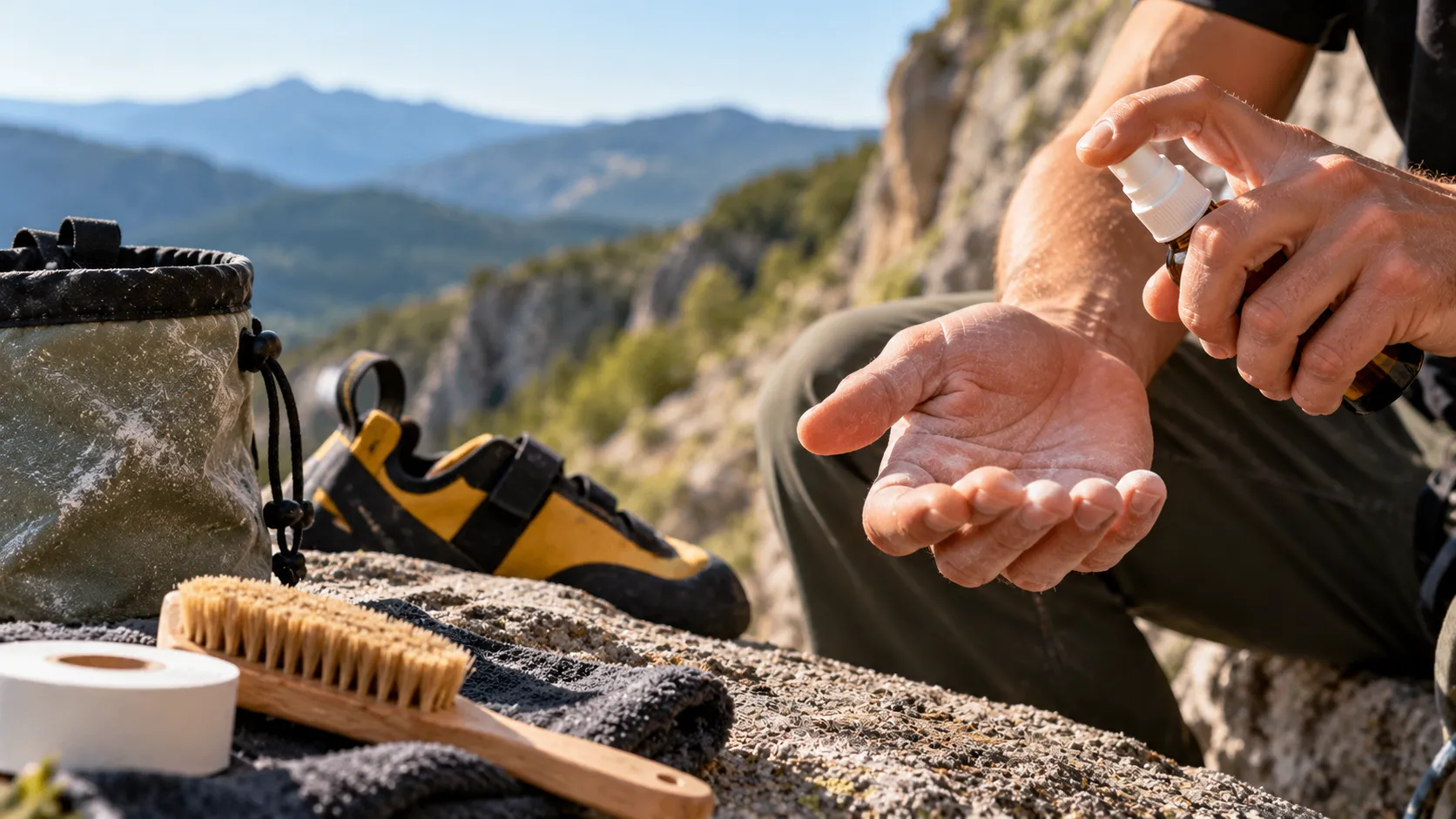
After that, that’s when the oil becomes useful. The skin has been exfoliated, the magnesium has dried out, and the post-session wash often leaves a feeling of tightness. A fine, targeted application helps to restore comfort without overloading.
- Wash your hands, then dry them without rubbing too hard.
- Warm up a small amount between your palms.
- Insist on pulp, pleats, cuticles, and red areas.
- Finish with a brief massage of the edges of calluses.
- Allow to penetrate before touching magnetism, plugs, or textiles.
Targeted gestures: where the skin breaks
The key areas are rarely “in the center”. These are the cornel edges, the folds of the phalanges, the contour of the nails, and the thumb. Target these points, because they are the ones that crack and disrupt your contact. This precision avoids over-application and improves the sensations.
Before a session: avoid oil; maintain reliable sensations when handling the grips.
After a session: a fine, targeted application is better than a thick layer.
Precision (pleats, cuticles, edges) limits the slippage and improves the smoothness.
If you want to perform your next climb, bet on short, repeated movements, rather than on occasional “bandaging” applications.
An effective oil does not replace hygiene: it is the combination of washing, sanding and regeneration that solidifies the skin.
Hygiene and skin preparation: the cornerstone that makes the difference
Pre- and post-session washing: not too much, not too little
Before a session, a simple wash removes the residual grease and improves the grip on the grips. After a session, the wash removes magnesium and impurities. Avoid too-abrasive soaps if you climb often; otherwise, you’ll dry out even more.
This point may seem basic, but it conditions everything: an oil applied to glued magnesia ends up as paste, and you lose comfort.
Scraping of calluses: smooth and controlled surface
Light sanding is used to remove the “scars”. It is not used to return to a new skin. A smooth surface reduces tearing and makes the horn more stable. Do it after the shower, when the skin is softened, then apply your care product.
Overall hydration: sleep, water, regeneration
The skin recovers better when you sleep properly and are hydrated. Without recovery, you’re putting your already fragile barrier under strain. If you’re looking for “real impact,” start there: sleep, rest, then care.
Cream compatibility: alternating oil and emulsion
Oil provides lipids and a film. A cream (emulsion) often provides water + humectants. Alternating can be more suitable for dehydrated skin. Keep a simple logic, especially if you are testing several products.
- Before: clean hands, no greasy film.
- After: gentle washing, drying, targeted care.
- Every week: a light sanding to check the horn.
- During a busy schedule: a short routine is better than a “big catch-up”.
Hygiene + light sanding = less tearing, therefore fewer stops.
Oil applied to clean skin works better and is easier to dose.
Overall hydration and sleep support skin regeneration.
The biggest trap, then, is to overdo it: too much oil, too much perfume, or bad timing.
Mistakes to avoid: slipping, irritation and false good ideas
Over-application: loss of grip and loss of confidence
Too much oil = shiny hands, imprecise contact, and fear of getting dirty. In climbing, confidence comes from the consistency of the sensations. Over-application breaks this consistency. If you feel a film, that’s already too much.
Open wounds: burn, maceration, slow recovery
On an open crack, some formulas will sting. And if you apply too much, you’ll end up scratching. In that case, stop applying the oil to the open area. Keep the skin clean, let it dry, then resume when the surface is covered again.
Allergies and perfumes: test them first
Perfumes and some plant extracts can be irritating. Test it on a small area. If you have sensitive skin, opt for a short-lasting formula. A product that irritates you wastes time, and sometimes sessions.
Homemade mixtures: be careful with essential oils
Homemade blends “made with feel” create surprises: uncertain dosages, reactions, and sometimes photosensitivity. If you enjoy DIY projects, stay minimalist. And if you’re looking for sports-oriented products, also check out pre-formulated sports packs.
| Symptom on the hand | Probable cause | Routine adjustment |
|---|---|---|
| Skin that “slides” even on good catches | Application too close to the session, or too much product | Reserve the oil for the evening; measure it more finely; clean your hands before climbing. |
| Skin that peels off in patches | Raised corns + abrasion + washing | Light regular sanding + targeted oil on edges |
| Itching, redness after application | Perfume, irritating extract, skin too damaged | Simpler formula, local testing, pause on open areas |
| Recurrent lacerations in the same place | Callus formation + directional rubbing | Smooth the callus, strengthen the flexibility of the edges, reduce excess magnetism |
Terrain note: between sports blog events and press news, you see some grooming hacks being passed around. Keep a simple filter: if it makes you slip or irritate, it’s not suitable for climbing.
And if you see the term RGTA innovation in sports-oriented products, keep in mind the main intention: to support repair. Don’t change ten formulas at once.
Over-application is the number one mistake: it ruins contact and grip.
On an open wound, prioritize cleanliness and drying before resuming greasy care.
A simple routine always beats a complex homemade mixture.
You have the logic. Here are the answers to the most common questions, to make decisions quickly and act justly.
FAQ: Repairing oil for climber's hands
What ideal frequency according to my training volume?
Apply after your sessions, then adjust according to the actual condition of the skin. If you climb frequently, a fine and regular application is preferable to irregular “heavy doses”. The simple indicator: the skin should not pull during washing, and the edges of calluses should remain supple when touched.
Oil or cream: which to choose for the skin?
Choose oil if you want to soften and protect the surface, with a thin film. Choose a cream if your skin is dehydrated and “drinks” everything, as water and moisturizers help more. Many climbers alternate: light cream on some nights, targeted oil after a session.
Does magnesia cancel the effect of the treatment?
Yes, if you apply it to a hand that is still loaded with magnesium: you are creating a paste. The oil should be applied to clean skin, otherwise you will lose the benefit. In a session, magnesium remains an effective tool, but avoid overdoing it: the more you dry out, the more fragile your skin barrier becomes.
Can we put it on just before climbing?
Avoid it. You risk a slippery film, a loss of sensation, and a drop in confidence in contact. If you want a good pre-care, do it long before the session, or the night before. The goal before climbing: clean skin, stable surface, predictable grip.
What to do if the skin peels off despite the oil?
Most often, it’s a problem of texture: a callus that’s too thick peels off in flakes. Add a light, regular sanding, then target oil on the edges. Also check your cleansing routine: too stripping, it encourages desquamation. If redness persists, simplify the formula and test for tolerance.
You don’t need a complicated routine. You need a rhythm and control of the horn, in service of your climbing.
Durable routine: strong hands, no excess thickness
Objective: solid, flexible, regular
Your goal is not to have “soft” hands. It’s to have skin that resists, without being too thick and tearing. It’s a balance between abrasion (inevitable), control (grinding), and care (oil or emulsion). It’s also a question of personal sustainability: fewer blisters, fewer forced breaks, more continuity.
Weekly routine: scaling, exfoliation, care, rest
Maintain a simple routine: after each session, apply a light coat of polish; when a crack appears, apply a light sanding; rest when a crack becomes noticeable. It’s this routine that ensures quality. And it’s this routine that brings you closer to your goals, without sacrificing your sensations.
Warning signs: pain, fissure, persistent redness
If an area remains red, painful, or a fissure opens during each session, stop “compensating.” Reduce the aggressiveness (strokes, volume, magnetism), treat on clean skin, and resume when contact returns to neutral.
Golden rule: less product, more regularity
One too many drops makes you stop everything. A fine, repeated application makes you go up. That applies whether you’re in the gym, on a cliff, or in the mind of Snap, born in Chamonix, between style, mountains, and the culture of French street life. And if you buy online, check the categories, the composition, and only then the payment.
The winning routine: regular care + smooth calluses + simple hygiene.
Excess thickness = tearing. Controlled flexibility = continuity.
As soon as the pain changes your grip, you lose movement and confidence.
An climbing care oil is not a “bonus”. It is a concrete way to protect your skin barrier, to limit skin tearing, and to maintain reliable grip on holds. Choose a texture that you can tolerate on a daily basis, apply it especially after a session, and pair it with a light sanding to avoid callus marks. Your skin does not become perfect: it becomes regular, therefore effective. It is this regularity that allows you to climb more, better, and longer.

 Français
 English (UK)


