

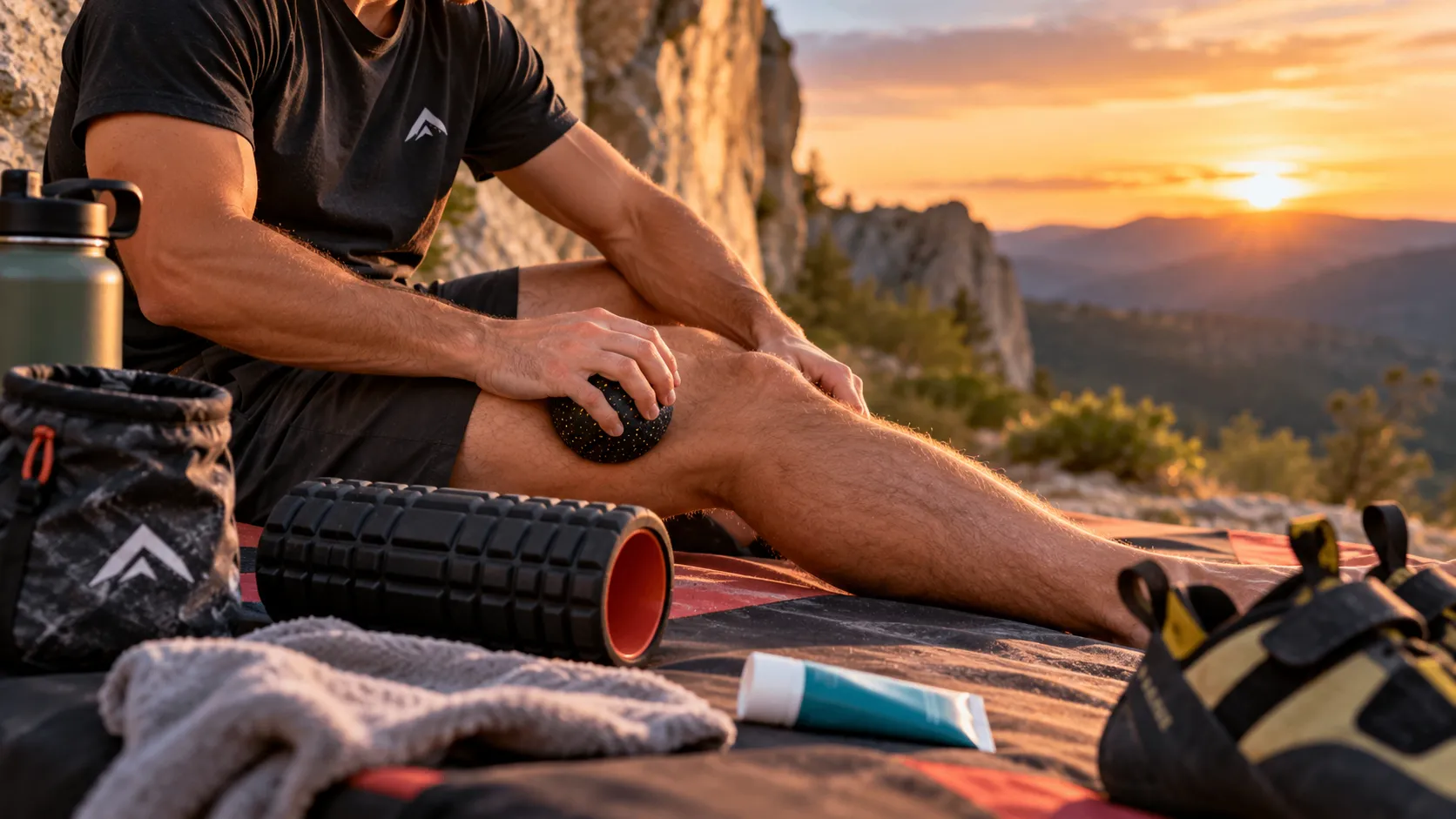
Care of muscles after climbing: complete protocol
Around 4.2 injuries per 1,000 hours Climbing techniques are reported in the literature for adult climbers, making it a sport where recovery is just as important as the session itself. The good news: you can reduce residual fatigue, protect your muscles, and maintain maximum strength for longer with a short, repeatable routine adapted to your practice (climbing, via ferrata, via ferrata, long routes). In this practical article, you’ll get started with a concrete method that can be tested immediately after your next last route. To get ready without getting distracted, take a look at a selection of’useful climbing accessories which simplify your post-session experience.
The essentials in 30 seconds
1) After the climb, avoid a sudden stop: 5 to 10 minutes of walking + breathing lowers the metabolic load and relaxes the forearms.
2) First mobilize, then stretch: prioritize the shoulders, the thorax, the hips, then gentle stretches without pain.
3) Also recover through the diet: proteins + carbohydrates + hydration structure muscle repair and energy for the following workouts.
4) Plan for recovery: adjust the load over 24 to 72 hours based on your signals, not your motivation.
Before starting the routine, set up a simple framework: it is he who makes your efforts effective and quick.
Setting the prerequisites for truly effective muscle care
What you want at your fingertips (without turning the bag into a pharmacy)
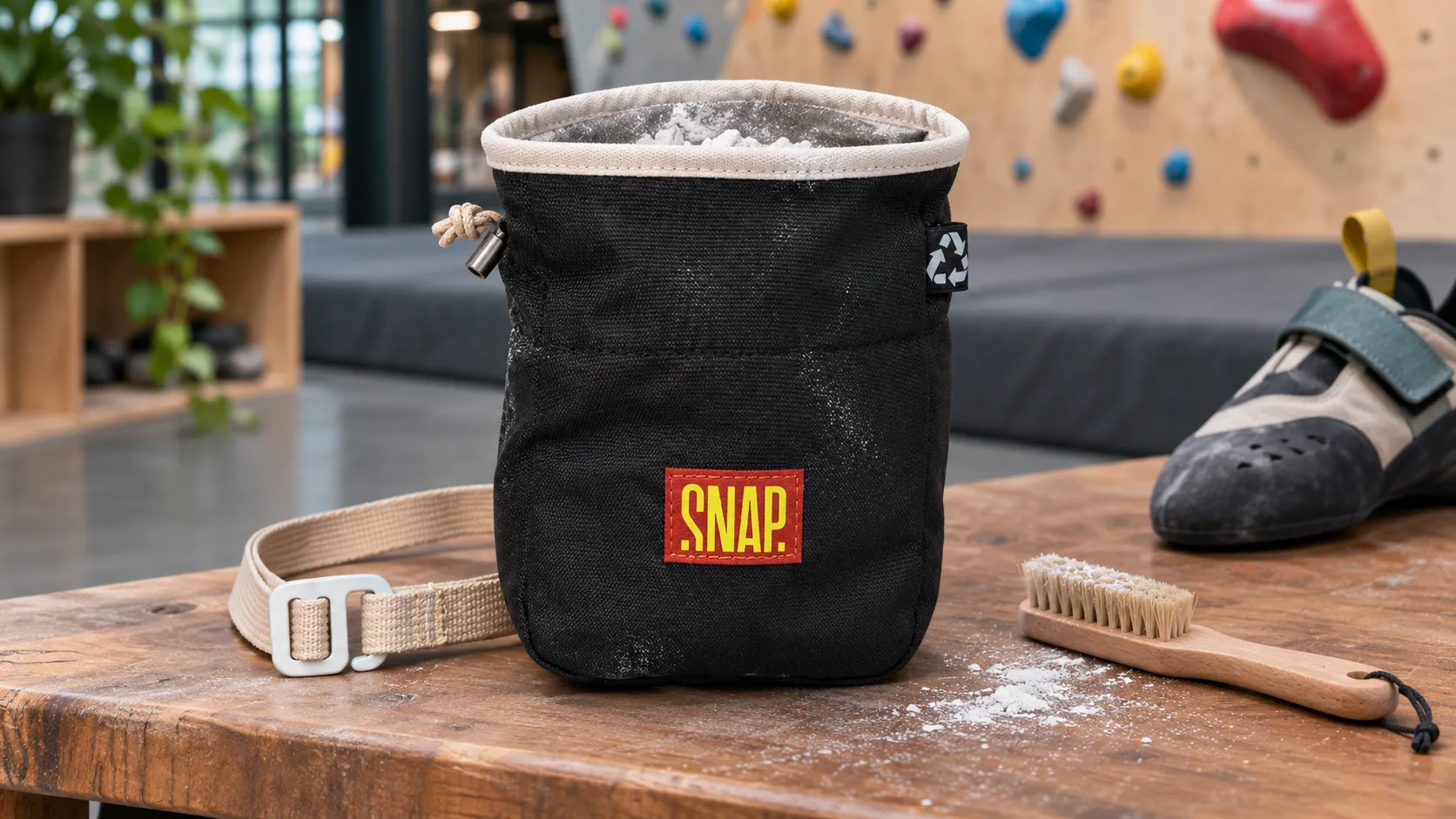
Your goal is not to add gadgets, but to remove friction. The simpler it is, the more you will do it, and perseverance always wins over perfect routine that is never applied. In a climbing bag, keep:
- A canteen (ideally graduated) to quantify hydration after exercise.
- A small towel It changes everything for self-massage and taking control of skincare oils.
- A bullet (type hard ball) to work the forearms and sensitive areas.
- A mini care oil tolerated by your skin (non-sticky texture, discreet scent) for massaging without irritation.
If you climb often, think about a strengthening routine outside of climbing as well: pull-ups, squats, abs, and some exercises with dumbbells can support your muscle strength and endurance, provided you respect your recovery.
Realistic total time based on intensity (and your discipline)
The classic trap is to aim too long, then do nothing. Aim short, precise, then lengthen if you have energy. Here is a useful guideline based on the intensity of the session and the type of dominant movement.
| Type of session | Expected signals | Post-session recommended |
|---|---|---|
| Intense block (few lanes, tough testing) | Stiff forearms, shoulders «high», tension | Return to calm + shoulder/wrist mobility + simple nutrition |
| Path / ridge (volume, continuity) | High pitched breath, heavy legs, tightness in the chest | Back to calm + overall mobility + structured hydration |
| Breading / full training (strength + volume) | Diffuse fatigue, loss of technical precision | Mobility + light self-massage + plan 24/48/72 h |
| Long trails / day on the cliff | Stiff back and hips, sensitive feet, nervous fatigue | Mild degreasing + hydration/electrolytes + priority sleep |
Checklist: Your body signals before you start
Before stretching or massaging, take a quick scan. The idea is to distinguish between «normal fatigue» and «alert signal». The more precise you become, the more you recover without overdoing it.
- Breathing: are you able to breathe out long and calmly without blocking?
- Forearm: feeling of congestion, tingling, loss of finger mobility?
- Shoulders/neck: hard trapezium, shoulders close to the ears, shoulder blades fixed?
- Wrist/elbows: localized pain at the precise point, or simple diffuse stiffness?
- Back/hips: «locked» curvature, restricted pelvis, or fatigue from maintaining a position?
An old camper will tell you: it’s these details that avoid the «work around the clock» weeks spent dealing with a pain that settles in.
Practical setting: room, cliff, return to the house
In the gym, you have space and often a stable floor. Take advantage of it to walk, breathe, and then mobilize. In the canyon, first secure the logistics (arranging equipment, hydration, heat) and do the minimum effective on-site. At home, you can complement with a more gentle self-massage, a warm shower, and a structured snack.
Finally, keep an eye on the information and rules of your structure (and their legal mentions) if you use stretching areas, showers, or common spaces: it’s basic, but it avoids unpleasant surprises.
Keep your post-session feasible in less than a quarter of an hour on busy days.
Read your signals before applying a recipe.
Regularity protects your progress better than the heroic session.
Once this framework is in place, the first victory consists of bringing the system down, not of shooting at the fabric.

Reversing the metabolism: the return to calm that changes everything
Walk + guided breathing: the simple and effective version
After the climb, many people stop abruptly. This is a common mistake, especially after a final «climbing block». Your body then remains in high-intensity mode, and you carry that tension into the evening. Instead, do the following:
- Slow march a few minutes: release the jaw, lower the shoulders.
- Breathing : breathe in through the nose, exhale longer than you breathe out, without forcing.
- Unlocking Open your hands, shake your fingers gently, release the grip.
If you have been sweating, avoid leaving hydration to «chance». The ACSM position on hydration recommends avoiding a body mass loss greater than 2 % during the exercise, because performance can be compromised. Even if your session isn’t a marathon, this benchmark reminds you of a key idea: recovering also means rebalancing water and salts.
- Walk with your shoulders low and your eyes looking far away.
- Breathe out long, as if to «blow off the tension» from the forearms.
- Open and close your hands slowly.
- Make two gentle rotations of the wrists in each direction.
- Drink in small sips, then set them down without rushing.
Congested forearms: managing the immediate situation without worsening it
The «inflated» forearms come from a combination: local effort, blood flow, and nerve tension. You are trying to circulate the blood, not to stretch it too much. Two simple actions:
- Active relaxation : Brace the arm along the body, open the hand, then close it without squeezing, in rhythm with the breathing.
- Brief elevation Hold your hands above your head for a few seconds, then come back down and shake them gently.
Avoid ending up with «for show» pull-ups if you still have strength left. You add fatigue to a fabric that’s already loaded, and you pay for it the next day.
Don't stop abruptly after the last path: keep walking and breathing.
In traffic jams, look for circulation, not aggressive stretching.
Structured hydration: you recover better than with «feel-good» techniques.
When the breath returns and the forearms deflate, you can restore movement where the climb has come to a standstill.
Recovering mobility without forcing it: joints first, muscles later
Shoulders, shoulder blades, thorax: your anti-cracking trio
When you climb, you often accumulate rolled shoulders and poorly mobile obliques. The result: the movement loses fluidity, the technique deteriorates, and your endurance drops faster during long sequences. Work gently:
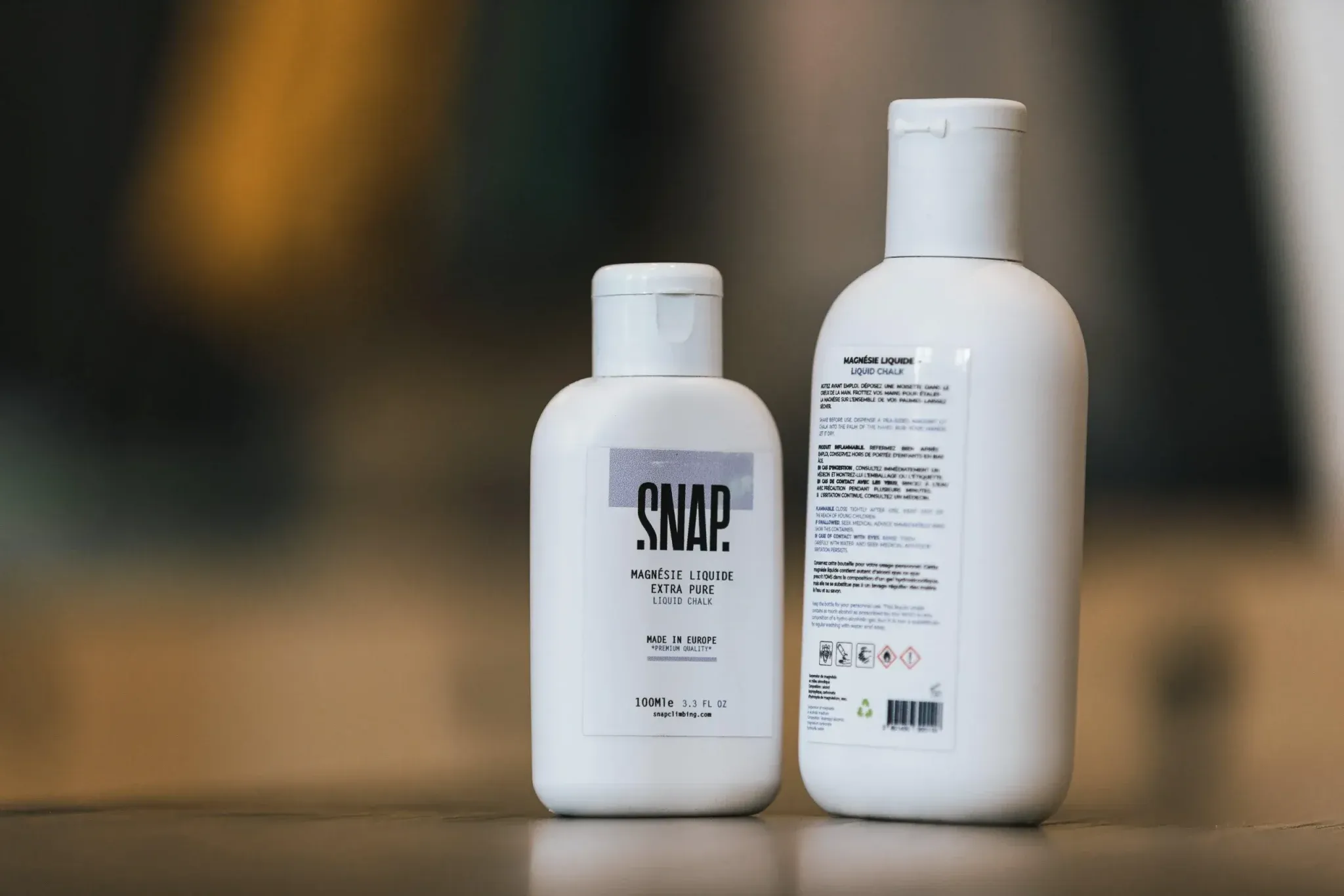
- Retraction/Prolongation shoulder blades: arms extended in front of you, advance then back down without lifting the shoulders.
- Thoracic opening Hands behind the head, shoulders that open without bending too much.
- External rotation : elbows pressed against the body, forearms opening like a door.
You are not looking for maximum amplitude; you are looking for the proper, repetitive movement that makes the shoulder silent.
Hams, calves, spine: get back to the «normal» walk»
After a session, especially if you have done a lot of crocheting, tucking, or locking in compression, the posterior chain tightens. Add:
- Hanches Short stride, neutral stride, slight back and forth movement.
- Hips : knee that moves above the foot, heel on the ground, without pain.
- Column : slow unwinding/winding up, vertebra by vertebra, without seeking performance.
Why so much emphasis on softness? Because climbers’ injuries are often overuse injuries. The journal Frontiers recalls a scale of approximately 4.2 injuries per 1,000 hours in climbers, with a significant part related to overwork. Mobilizing without aggression is part of this logic: you give the game back, you don’t «overload» an already loaded area.
Flux: slow breathing → shoulder blades (front/back) → opening of the chest → hips (short gap) → ankles (knee forward) → twisting/unwinding of the spine → release of the hands
Mobilize the joints before you want to «relax» the muscles.
Look for a smooth movement, not a record amplitude.
Your best prevention is gentle repetition after each climb.
Once mobility is restored, stretching becomes a fine-tuning adjustment, not an attempt at repair.
Targeted stretches: gain relaxation without losing strength
Shoulders, back, big round: open the climber's posture
The muscles that close the shoulder take a heavy toll in terms of effort, strain, and dynamic movements. Stretch short and precise:
- Shoulders : Place the forearm on a ledge (or a wall), turn the torso gently, breathing calmly.
- Thick and large round : keep your hands on a high support, move your hips back, look for an extension on the side of your back.
- Cou : Slight inclination, without having to pull on the hand lever to unload the trapezes.
Maintain an intensity without pain. If you are looking to «win quickly», you are most likely at risk of being irritated. The goal is to make the next session smoother, not to break a flexibility record.
Forearm: relieve without stretching too much
Flexors and extensors are overused in climbing, and intense stretching can be counterproductive when the tissue is already sensitized. Choose:
- Light position : gentle wrist extension, relaxed elbow, slow breathing.
- Active alternative Open/close the hand, then turn the forearm palm up/down.
- Dosage : little, often, rather than long and violent.
One point of caution: if you are extremely relaxed, do not overextend yourself. First stabilize your position, especially around the shoulder blade. If you are stiff, progress gradually with micro-doses, and let mobility (the previous section) do the heavy lifting.
Short, targeted stretches without pain: you protect maximum strength.
On the forearms, prioritize active relaxation over strong stretching.
Hyperlaxity: stabilize. Stiffness: repeated micro-doses.
Then comes what speeds up recovery reliably: what you drink and what you eat after the climb.
Post-effort nutrition: recover better, climb more refreshed
Hydration and electrolytes: after sweating, structure
After exercise, hydration is not just a detail: it affects your feeling the evening after and your muscle availability the next day. The ACSM position on hydration emphasizes the importance of avoiding a loss greater than 2 % Body mass, associated with reduced performance. Specifically, if you have been sweating a lot, add salt through your diet, and split your water intake into several sips.
Simple tip: if your urine remains very dark for a long time after the session, it’s a practical sign that you’re probably under-hydrated.
Proteins + carbohydrates: the simplest combination to keep
You don’t need to complicate things. You need consistency. The ISSN indicates that a total daily intake of protein in a range of 1.4 to 2.0 g/kg/day It is sufficient for the majority of people who train to optimize adaptations. After the climb, aim for a portion of protein and easily digestible carbohydrates, especially if you are doing a series of workouts in a week.
- A source of protein (eggs, Greek yogurt, tofu, fish, legumes).
- Carbohydrates (rice, pasta, bread, potatoes, fruits) to replenish energy.
- Vegetables for micronutrients, without looking for the perfect plate.
- Some water, then a salty meal if you have been sweating.
To avoid: late alcohol consumption and under-eating. Alcohol often disrupts sleep, and you recover first during the night. Under-eating, on the other hand, takes its toll over the week: a decrease in endurance strength, a feeling of heaviness, and less precise movements.
Do you want to apply this method right from your next session? Prepare your bag with a jug, a ball, and a skincare oil that you like to use.
Hydrate in a structured way, especially after a session that causes you to sweat.
Proteins + carbohydrates: the most profitable base for recovery.
What you do after the climb conditions your next session.
Once the interior is managed, you can treat the exterior: release the fabrics without damaging them, with or without care oils.
Self-massage and myofascial release: safe, useful, without excess
Skin care oils: how to choose and use them without getting irritated
A skincare oil doesn’t «repair» a tendon by magic. However, it makes regular massage easier, improves comfort, and helps you lower your stress level. Choose a oil:
- Simple Few ingredients, texture that allows you to massage without rubbing too hard.
- Accepted If your skin reacts, change it. The best protocol is the one you follow.
- Practical Small size, clean cap, usable for home use.
Avoid applying it to damaged skin (scratches, open blisters). And keep a towel handy: that’s what makes the procedure hygienic, especially if you climb stairs in a gym.
Key areas: trapezius, dorsal, pectoral, forearm
Work in sections, without seeking pain. On the trapezius and pectorals, use the opposite hand and apply slow pressure. On the backs, a roller is useful if you control it. On the forearms, the ball is often more precise:
- Forearm Place the forearm on a table, with the ball underneath; roll slowly.
- Dorsaux Roll on the side of your back, without crushing the lower back.
- Shoulders Mild pressure near the shoulder, slow breathing.
One point of caution: if you develop bruises, if the pain increases, or if you experience unusual numbness, you have gone too far. Post-climb massage should leave you more mobile and calmer, not «broken».
Remember: climbing is a sport of precision. Your recovery is also a matter of precision.
The care oil is used to massage better and more regularly, not to promise the impossible.
Slow pressure, weak pain: the relaxation is building up.
Blue, pain that rises, numbness: stop, you are overdosing.
The best self-massage does not compensate for a lack of planning. Recovery also depends on the days that follow.
Rest and recovery: plan the load over the week, not on the whim
Sleep: your most reliable recovery accelerator
You can have the best skincare products and the best exercises. If you don't sleep well, you won't recover well. In athletic teenagers, sleeping on average less than eight hours was associated with a risk of injury multiplied by 1.7 Compared to those who sleep at least eight hours. Even if you are an adult, the practical message remains valid: sleep is a major determinant of your signals (pain, motivation, coordination).
Simple routine: time to turn off screens, warm shower, room cooler, and a sufficient dinner. The goal is to make your sleep onset predictable.
Simple rules for twenty-four, forty-eight, and sixty-two hours
Rather than deciding everything «in the morning», use rules. They protect your goals and your technique.
- If fatigue is low The next day can be an easy technical session, without seeking maximum strength.
- If average fatigue : prioritize active recovery (walking, mobility, a little stretching), no hard pan.
- If fatigue is high Allow two to three days to pass before recharging the fingers and shoulders.
Add a weekly micro-deload if you climb often: a shorter, less intense session, or one focused on proper movement. You maintain your endurance without getting tired.
Sleep controls your signals and coordination as well as your muscles.
Decide the charge with simple rules, not with today’s ego.
A weekly micro-deload protects your regularity.
Now that the structure is in place, the upper level consists of customizing it according to your signals and your climbing style.
Adjust according to your signals: curves, pain, objectives and climbing style
Normal bruises vs injury alert: concrete landmarks
Diffuse, bilateral cramps that decrease when you warm up are often compatible with active recovery. Pain:
- Occasional (a specific point),
- growing at each session,
- which changes your gesture (compensation),
- or who wakes up at night,
Merits immediate load reduction. As the intensity increases, fatigue can mask the pain during the session, then amplify it the next day. Your discipline (explosive block, continuous path, large volume pan) changes the dominant tissues, therefore the risks.
Hot or cold: choose according to your current priority
If you feel stiff and «closed,» warmth and mobility often take priority. If you experience acute, localized inflammation after a specific movement, cold can provide temporary comfort. Don’t turn it into a systematic reflex. Your compass remains the signal: more mobility, less pain, better control of movement.
Follow-up 2026: sensors, HRV and real-time terrain
In 2026, many climbers will monitor their fatigue using sensors (sleep quality, heart rate, variability). Use this information as a three-color light, not as an absolute truth. If the data says «red» but you feel fine, do at least one light session. If the data says «green» but your fingers and shoulders are sore, respect your body: your technique is worth more than a graph.
Localized and progressive pain: reduce the workload, even if motivation is high.
Warm for stiffness, cold rather for the comfort of a local peak, without any automatism.
The sensors help, but your signals remain the final decision.
To know if your protocol is working, you need simple indicators that are monitored over several days.
Validate your recovery: indicators and self-score over a week
Check mobility, strength and freshness (without heroic testing)
Validation is what transforms a routine into a method. Three quick tests, no equipment required:
- Mobility Can you raise your arms above your head without bending them and without pain?
- Freshness Is your coordination for easy movements clear or fuzzy?
- Useful force : On a comfortable grip, do you feel a grip that is «full» or already fragile?
Avoid «testing» with max pull-ups or a project block when you suspect fatigue. It doesn't validate anything: it just loads you up.
Self-score over seven days: fatigue, pain, sleep
Every night, note three items from zero to ten: general fatigue, local pain, quality of sleep. As you progress, this one-week view is more informative than the one-day experience. If the pain increases while the training volume does not decrease, you have a clear direction: ease off, then gradually increase again.
| Post-climber symptom | Probable interpretation | Adapted action | What you avoid |
|---|---|---|---|
| Hard and «full» forearms» | Congestion + local fatigue | Return to calm + hand opening/closing + light ball | Strong stretches + pull-ups at the end of the session |
| High shoulders, straight neck | Crispation + frozen shoulder blades | Shoulder mobility/thorax + gentle pectoral massage | Forcing the amplitude or «crashing» on the roller |
| Localized pain in the finger, which increases | Overcharge alert | Reduced load + easy-to-reach plug technology | Recharge using the panel «to check» |
| Heavy legs after long runs | Overall fatigue + water/energy deficit | Soft walk + full meal + sleep | Undernutrition + late bedtime |
Warning thresholds: when to reduce or consult
If the pain becomes more precise and intense over several sessions, if your movement changes, or if you lose strength in unusual ways, reduce the intensity. Consult if you have any serious doubts, especially about fingers, shoulder, or elbow. It is better to adjust early than to lose a season.
Validate with simple tests, not with an «ego test».
Track three scores over seven days: fatigue, pain, sleep.
If the pain becomes specific and progressive, lower the load quickly.
You have the method; here are the answers to the questions that come up most often after a climbing session.
Muscle recovery after climbing FAQ
When to stretch after an intense climbing session?
After breathing deeply and stretching for a few minutes. Start with gentle mobility (shoulder blades, thorax, hips), then add short, targeted stretches. Avoid vigorous arm stretches immediately after a very intense session: first seek circulation and active relaxation.
How much protein after the climb to recover?
Aim for regularity throughout the day. A reference often cited by athletes is a daily total between 1.4 and 2.0 g/kg/day According to the ISSN. After the session, a protein and carbohydrate snack is a simple and effective option if you have other workouts in the week.
How to avoid recurring forearm cramps during climbing?
Reduce the abrupt stop at the end of the session, dose the volume better, and work on your relaxation through movement (breathing, lower shoulders, less tight grip). Add some wrist mobility and active recovery the next day. If the pain becomes localized and progressive, lower the load and review the planning.
Should I massage if the muscle is painful after the climb?
Yes, but gentle and short, and only if it reduces pain and improves mobility. A massage oil can help massage without rubbing. Avoid seeking out severe pain, bruises, or pressure that triggers numbness. In case of very localized pain that increases, prioritize rest and load adjustment.
When to resume climbing after severe leg or back strains?
Resume when the pain is clearly reduced and your easy movements are back to normal. You can do a light technical session before recharging. If your back remains stiff and forces you to compensate, choose an active recovery (walking, mobility) and sleep more. Keep your goals in mind: To progress quickly, you must first endure the hard work.
Your post-climb recovery doesn’t need to be long: it should be consistent. Follow with a calm return to activity, mobility, gentle stretches, then hydration and a simple meal. Add a measured self-massage with a soothing oil if it helps you stay regular. Finally, plan your recovery according to your signals over the week, not by the excitement of the day. With this routine, you protect your muscles, technique, and long-term progress.
Also maintain a minimum level of administrative rigour when you are training in shared spaces: internal regulations, posted information, and legal mentions associated with access. It’s not glamorous, but it saves time.
 Français
 English (UK)


