

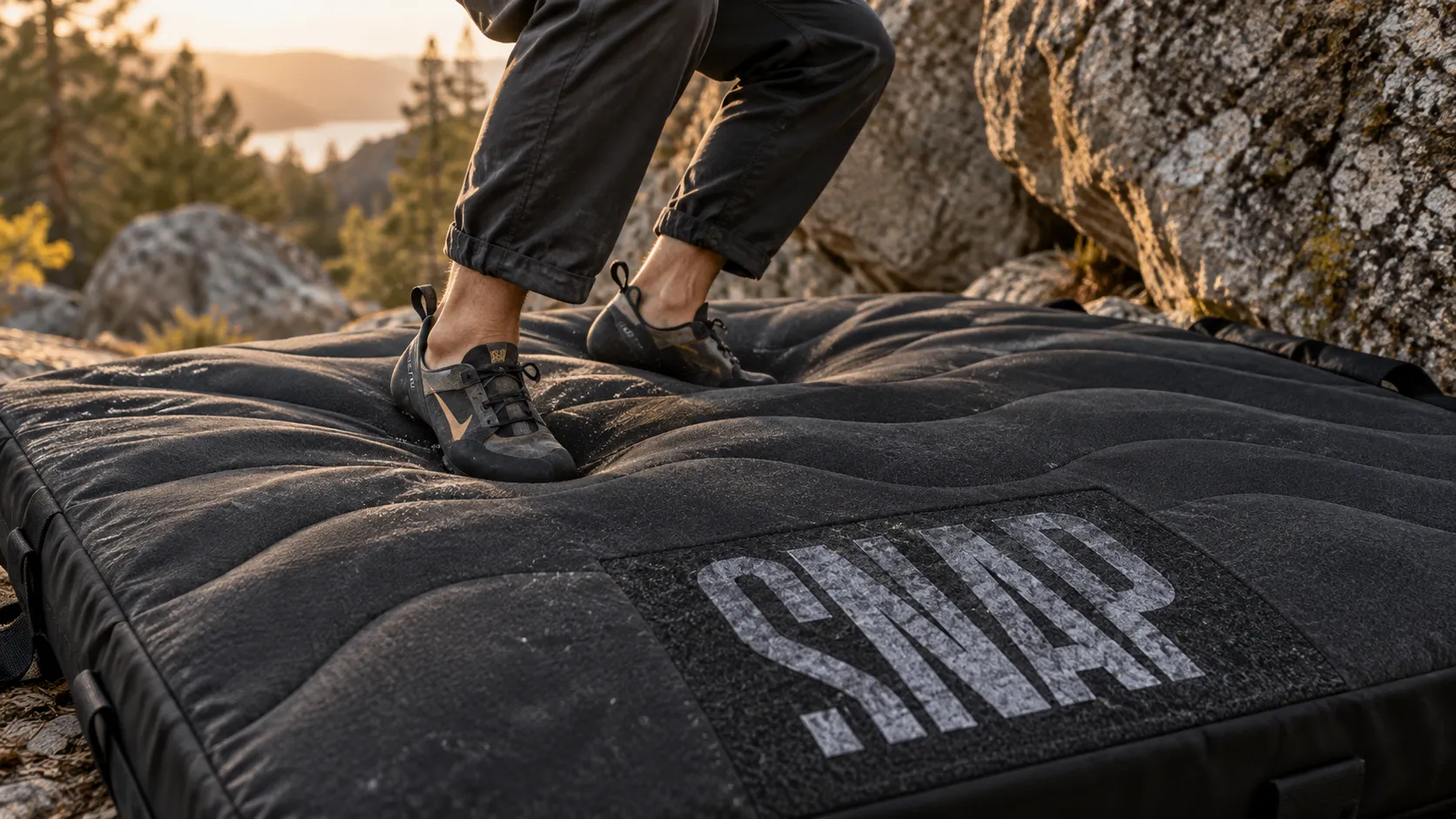
Wavy Technology: innovation and safety of crash pads
You stumble upon a «good pad»... until the day when a misaligned reception reminds you that cushioning isn't everything. In a block set and in highball, safety depends as much on the internal structure as on the usable surface area, stability, and energy management. This article explains the wavy technology (wavy architecture) with concrete criteria for selection and testing, in the spirit of Snap Climbing: technical, understated, practical. To compare formats before buying, see our crash pads.
The essentials in thirty seconds
The wavy technology aims for a more gradual absorption thanks to an internal structure with waves (crests, channels, alveoli).
The real gain often comes from the stability of the receiving surface (torsion, rebound, lateral ejection), not just from the thickness.
The performance is validated in the field with simple tests, and then maintained through appropriate use and maintenance.
The right choice depends on your actual receiving area, your approaches, and your stacking habits.
Before diving into the structure, let’s clarify the problem: the wavy technology primarily addresses frequent reception scenarios.
Reducing the risk in a single go: what your crash pads must accept
Typical block and highball accidents
In general, acute injuries often result from an improper landing: rotation of the hip, foot that «stabs,» heel that breaks, knee that collapses. A study focused on scenarios of falling in a block reports that the majority of injuries affect the lower limb (seventy-seven percent) and that ankle sprains emerge as the dominant injury, placing the quality of landing at the center of safety.
With highball, the stakes are raised: the trajectory of the fall is less «recoverable» by the spot, and the landing surface becomes an area to secure like a small construction site. The crash pad no longer serves only to cushion, it serves to stabilize the landing and to avoid a rebound that projects onto a rock, a root, or a edge.
Constraints of portability and long approaches
The longer the approach march, the greater the temptation to reduce the volume and weight. However, a crash pad that is too compact can reduce the usable surface area and increase the precision required at reception. In mountaineering and alpine climbing, the transport constraint is combined with the irregular terrain: crevasses, slopes, boulders, holes. An internal structure that limits torsion can increase confidence without necessarily «bulking up» the pad.
Limits of conventional multi-layer foams
Conventional multi-layer constructions (firm foam on top, more flexible foam below, or the opposite depending on the school) work well in a centered and vertical reception. The weak point appears in the off-center reception: the energy is not distributed uniformly, the surface deforms into a bowl, then returns with a lateral rebound. The wave structure aims to break this scenario by imposing more controlled deformation paths.
User expectations: stability and trust
Confidence comes when you can engage a movement without «thinking about the ground». It is built through a stable surface, progressive contact under your feet, and a receiving that doesn’t carry you towards a edge. It is also a matter of ergonomics: zippers that don’t rattle, hinges that don’t create a hard bridge, and closures that don’t turn into an aggressive element.
Key indicators: thickness, surface area, weight
When choosing, consider your actual conditions: available landing area, soil quality, frequency of landings, style (dynamic, compression, thrown), and transport requirements. Thickness helps, but does not compensate for a too small landing area or unstable landing.
| Indicator | What it changes at the reception | Ground alert signal |
|---|---|---|
| Useful thickness | Progressivity, risk of going «off the rails» on a heavy fall | Shoe that hits the ground, sharp pain even in a clean reception |
| Ground surface | Tolerance to misalignment and asymmetric receptions | You «look for» the pad when you fall, panicking while spotting |
| Weight and carrying | Number of pads transported, fatigue, quality of installation | Pad placed quickly, setup neglected, sloppy surface |
Safety is often determined by the stability of the reception, not just by the thickness.
Your actual landing area (terrain + installation) is as much as the product sheet says it is.
The carrying over influences the quality of the installation: a cumbersome pad is less comfortable to put on.
Once the need is clarified, we can understand what wavy technology changes in the internal architecture.
Understanding the wavy technology: an internal architecture that guides deformation
Internal geometry: channels, ridges, alveoli
The wavy technology refers to an internal structure that is wavy: an alternation of ridges and channels, sometimes combined with alveoli. The idea is not decorative. This geometry creates zones that compress early (contact) and then zones that take over (braking), instead of a uniform compression. Upon reception, this can reduce the «peak» of pressure under a heel or toe, and smooth the transition between the impact surface and the base.
Compatible materials: EVA, PU, hybrids
Wavy geometry is combined with different materials: EVA (often more stable and «dry»), PU (often more flexible, sometimes more sensitive to aging), or hybrid assemblies. Manufacturers play on density and hardness depending on the area. A structure can be excellent on paper but bad if the densities are not matched well or if the bonding is inaccurate.
Pressure distribution: reduced peak zones
When the landing is not perfect, the body tries to dissipate the energy by rolling. If the surface of the crash pad sinks too quickly on one side, you lose the axis. A well-designed undulating structure acts as a «deformation guide»: it distributes the impact, limits the areas that collapse instantly, and maintains a more readable surface under the feet.
Flux: foot impact → pre-compression of the ridges → transfer to the channels → controlled lateral dissipation → final braking by the base layer → limited elastic return to stabilize the reception
Manufacturing tolerances: bonding, densities, cutting
Wavey technology is more demanding to produce than a simple pile: the cut must respect the geometry, the crests must fall in the right place, and the bonding must remain continuous. A deviation of a few millimeters can create «soft» areas and «hard» areas, which impairs the reception. On absorption materials, the impact tests used in other fields remind us why repeatability matters: the standards for cushioning surfaces employ threshold criteria such as a HIC of less than one thousand and a resulting acceleration of less than two hundred g, which illustrates the importance of a stable and comparable measurement.
The wavy technology is a geometry: its effectiveness depends on the combination of shape, density and bonding.
The goal is to smooth out the pressure peaks and stabilize the receiving surface.
A more complex construction requires stricter quality control.
A wavy architecture is only of interest if it actually transforms the absorption at reception. Let’s look at the mechanisms.

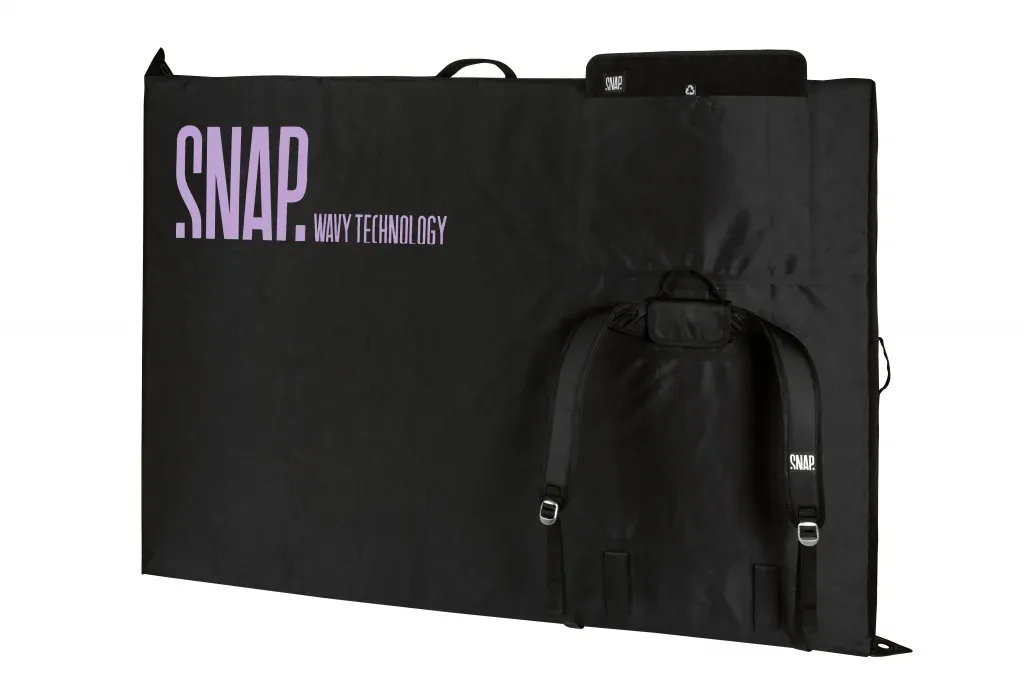

Damping without ejecting: what waves change with absorption
Progressivity: pre-compression followed by damping
On a good crash pad, you first feel a firm contact that «puts you down,» then a damping that slows the descent. The wave-like structure can favor this progression: the crests come into play quickly, then the channels collapse later, which increases the useful run. Upon reception, this helps avoid two extremes: a pad that is too hard (shock) or too soft (instability).
This point is directly related to ankle injuries: the literature on accidents highlights the prevalence of sprains, and even quantifies the ankle sprain as the most common injury (eighty-eight percent) in an analyzed sample, which makes sense given a gradual absorption rather than a sudden impact.
Controlled rebound: limit the lateral ejection
Rebound is not your friend if you fall near a block, a tree, or a hole. A pad that rebounds too quickly can «throw you back» towards the edge. With a wave-shaped geometry, the elastic return can be hindered, because the foam does not bounce from a single block: some areas regain their shape before others. When set properly, this keeps the reception more centered and slower.
Stability in torsion on uneven ground
The reception is not made on a room floor. Outdoors, the base rests on rough surfaces. The undulating structure can improve torsional stability: it opposes a directional resistance, which reduces the «hammock» effect on uneven terrain. For climbers who combine climbing and long approaches (or even mountaineering), this element sometimes outweighs the pure shock absorption gain.
Types of waves depending on their use: the simple matrix
| Wave type (logical) | What it favors | Typical usage | Receiving vigilance |
|---|---|---|---|
| Large waves | Progressivity and comfort | Long sessions, circuits | Risk of «blurring» if surface too flexible |
| Tight waves | Stability and controlled return | Engaged block, precise reception | Risk of hard areas if poorly glued |
| Directional waves | Deformation guidance | Highball, slopes | Orientation optimized according to reception area |
Wear: Stiffening, memory, delamination
The structure does not live outside time. With repeated falls, the foam can flatten, lose its memory, or peel off. A simple sign: you feel a «flat» reception, then a more dry rebound. The ridges can crash first, changing the progression. If you have to modify your way of falling to «protect the ankle,» that’s no longer a detail.
The wavy technology aims for a more readable progression in reception and a less ejecting rebound.
Torsion stability is just as important as vertical damping off-road.
Watch for wear: a worn corrugated structure changes the appearance before it is «seen».
Now, let’s talk about the real trap: even with a good crash pad, some receptions remain at risk.
Managing energy at reception: where do the real risks lie?
Asymmetrical falls: heel, toe, knee
The «perfect» reception (two feet, basin aligned, rolled) is the exception. Asymmetrical landings place a heavy load on a single support. This is where the distribution of pressure is decisive. A wave structure can help, but it does not replace a proper landing zone and a stable surface.
The cost of a poor reception is not anecdotal: the study on blockfall scenarios reports a median cessation of practice of ninety days after injury, with durations that can be much longer.
Stacking of crash pads: interference and hard decks
Stacking two crash pads increases the margin, but creates a risk: the hard bridge between pads (fold, strap, seam, hinge) and the «stepped» effect between two heights. The reception becomes unpredictable if the surfaces slide over each other. On uneven terrain, add chamfers to prevent migration.
Wave orientation according to landing zones
On some pads, the waves have a dominant direction. Orient them according to your most likely receiving area. If you often fall forward (dynamic), an orientation that slows the ejection forward can help. If your falls are lateral, look for a surface that maintains consistency at the edges.
Checklist: Safe reception in six points
- Clean the landing surface: stones, branches, apparent roots.
- Stabilise the crash pad: adjust the base if the terrain is rough.
- Avoid hard spots: check for hinges, joints, and straps.
- Predict the trajectory: place the largest surface where you will really fall.
- Coordinate the spot: guide the basin, not catch the shoulders.
- After receiving: drive and get out of the pad; do not fight against the energy.
Common mistakes: soft surface, dangerous edge
Common mistake: looking for «more soft» for more comfort. A too soft surface increases the twisting of the ankle upon contact. Another mistake: neglecting the edges. Many accidents occur on a half-foot outside. The best internal technology does not compensate for poorly protected edges.
Asymmetrical slopes are the norm: prepare a stable and wide surface.
Stacking increases the useful height, but can create hard bridges and slips.
Orient and position your pads according to your actual receiving trajectory.
Do you want to apply this method? Create a laying routine that is identical for each block: this reduces the risk of forgetting something.
Once the area is set up, there is still one final step: validating the performance without a laboratory.
Validating a wave pad: simple and reliable field protocols
Simple measures: height, mass, repetitions
You don’t need a test bench to compare two crash pads. Keep three constants in mind: the same drop height, the same mass (your own), and the same number of repetitions. You’re looking for repeatability in the reception. If the pad changes with each impact, that’s a sign. In impact testing, standardized masses are used; for example, an EN method for playground surfaces mentions a mass of four point six kilograms for the hemispherical impactor, which reminds us of the importance of a stable protocol even when used at home.
Home tests: drop test and footprint
Simple test: drop a loaded bag (even full every time) onto the target area. Observe the imprint and the stability of the surface. On a wavy structure, you should see a more «structured» deformation and less deep indentation. Repeat on several points: center, edge, fold area. Note what changes.
Second test: controlled reception. Jump from a small height, feet parallel, then with a slight offset. Look for the lateral rebound. The right pad will brake you without throwing you off.
Field tests: progressive highball mastered
On a high block, increase the engagement progressively: first the lower movements, then the middle zone, then only the part that exposes you. This protocol gives you dozens of «useful» receptions before the heaviest fall. The wavy technology must remain predictable: same sensation, same braking, same surface stability.
Matrix: symptoms → field actions → corrective actions
| Symptom upon receipt | Probable cause | Corrective action |
|---|---|---|
| Rebound that projects forward | Too elastic surface, poorly fitted pad | Refinish, add a stabilization pad, change the direction of the waves |
| Feeling of a «hole» in the same place | Local deformation, delamination | Move the receiving area, consider repair or replacement |
| Foot that leaves the board | Insufficient usable surface, unstable edges | Increasing the surface area (second pad), securing edges and junctions |
| Hard bridge between two pads | Hinges, pleats, straps, poor sealing | Reorganize the pile, cover the junction, move the folds out of the area |
Criteria for stopping: pain, instability, weakness
Stop if you feel a clear pain at reception, if the surface becomes unstable, or if a dip appears after a few impacts. The goal is not to «deal with it»; the goal is to maintain a reliable system. Repeated questionable reception costs more than a change of placement.
Compare to constant protocol: same height, same area, same repetitions.
A wavy structure should remain predictable in the center, edges, and fold areas.
The symptoms upon arrival dictate simple actions: repainting, reorienting, expanding the surface.
Once the performance has been validated, it remains to choose the right format and incorporate it into your climbing style.
Choosing and integrating: compatibility, comfort, mobility, durability
Compatibility: folding, tacos, hinges
The wavy technology can be found in several crash pad architectures: hinged folding models (hinges), «taco» models (one large fold), or hybrids. The choice depends on your terrain. A folding model is easier to set up, but the junction must be controlled. A taco limits the hard bridge, but may be less convenient to transport and set up on a broken surface.
Useful comparison: what you really gain
To be concrete, compare what you experience at the reception: stability, progressivity, rebound, and useful surface area. Serious manufacturers describe the internal structure, but you need to translate that into field behavior, with your shoes, your climbing style, and your most likely falls.
| Construction | Strengths at the reception | Typical weaknesses | For which climber |
|---|---|---|---|
| Classic multi-layer | Simple, readable, good compromise | Pressure peaks in the deflected receiving position, sometimes with a sharp rebound | Versatile, first-class pad |
| Wavy structure (wavy technology) | Progressivity, stability, and a better controlled rebound | More sensitive to quality control (bonding, densities) | Engaged block, highball, uneven terrain |
| Alveolar / cut | Directional dissipation, good surface adhesion | Risk of hard areas if localized wear occurs | Technical climber, controlled falls |
Selection based on profile: traveler, local, highball
Traveler profile: prioritize transport and versatility, with enough surface area to set up quickly. Local profile: optimize total surface area and stability by combining multiple crash pads. Highball profile: look for progression, a stable surface, and a stacking strategy without hard edges.
To place the subject in a broader context, data from hospital emergency departments show that climbing accidents are widespread: an analysis over ten years estimates that there were forty-seven thousand two hundred and fifty-one cases of climbing-related injuries treated in emergency departments in the United States between the years of two thousand fourteen and two thousand twenty-three.
Outlook for 2026: eco-design and AI
Product trends are emerging around three axes: reducing the material footprint, traceability of foams, and helping with quality control. AI is not intended to replace field experience, but it can help detect variations in density, bonding, or cutting, thus reducing discrepancies from one series to the next. On the brand side, Snap Climbing also brings a universe where clothing and equipment follow a logic of durability and freedom of movement, rather than the race to effects.
Maintenance: drying, storage, textile cleaning
After use, air dry in the shade, open the closure. Store flat if possible, without permanent compression. Clean the fabric with a soft brush and mild soap. If you need to modify your routine, do so to preserve its structure: it is this structure that determines its performance over the seasons.
Choose according to your profile: total surface area and stability take precedence over theory.
The wavy technology is interesting if it remains constant in the center, edges, and junctions.
Maintain for the sake of maintaining the progression: drying, storage, textiles.
Ground tip: Create a mental «portal» of preparation (zone, alignment, junctions) and repeat it. Routine is better than an improvised placement.
A technology is only useful if you know how to interpret it quickly. Let’s move on to a reception-oriented FAQ.
FAQ: Wave-shaped absorption system for crash pads
Does the wavy structure really change the damping?
Yes, if executed properly. The structure guides the deformation, which can make the reception more progressive and limit lateral rebound. The gain is especially noticeable on asymmetrical receptions, where an overly «crescent-shaped» surface destabilizes the ankle and knee. Validate by repetitions on the center and edges, not on a single fall.
What direction are the waves taking under your feet?
Orient your stance according to the most likely trajectory of your reception. If you often fall forward, look for an orientation that prevents the forward ejection. If your falls are lateral, prioritize a stance that keeps the surface uniform on the edges. A simple rule: place the most stable area where your first contact with the ground occurs most often.
Can two wavy pads be stacked together?
Yes, but the stacking must avoid hard spots. Relocate the hinges and remove straps and folds from the receiving area. On uneven terrain, the main risk is slipping between surfaces. Stabilize by bracing and placing them in a logical order. The goal is a continuous surface, not two surfaces working against each other.
How to identify a tired wavy foam?
You feel it at reception before seeing it. Signs: area that always sinks in the same place, rebound more dry, feeling of «hole», or instability in torsion. On a wavy structure, the crests can crush first and break the progression. If you adjust your descent to avoid an area, consider repair or replacement.
How many crash pads are needed to secure a highball?
It depends on the landing area, the slope, and the possible dispersion of the reception. Aim for an area that covers the lateral error, not just the ideal point. When the area is complex, several well-positioned pads are better than one thick pad that is poorly positioned. Coordinate spotter placement to guide the basin towards the safest area.
What is the biggest risk: too soft or too hard?
The most treacherous trail is often «too soft» on an unstable surface: the reception becomes blurred and increases ankle twisting. Too hard, the risk is a sharp shock. Look for a compromise: firm contact, progressive cushioning, controlled rebound. And don’t forget the terrain: a good structure doesn’t compensate for rocks, holes, and dangerous edges.
After the FAQ, the next step is to turn all this into simple decisions in your actual practice.
Summary: Decide quickly, make better decisions, and land more safely
Deciding: needs, terrain, frequency of falls
Decide based on your typical falls. If you often fall awkwardly, prioritize stability and a wide surface. If you travel a lot, optimize transportation without sacrificing usable surface area. If you do highball climbing, build a system: several crash pads, belay, controlled junctions, disciplined spot placement. A good pad increases confidence, therefore the quality of movement in climbing.
Prioritize: stability, progressiveness, and continuity
Priority one: stable reception on real ground. Priority two: progression (contact then cushioning), without bouncing off the ground. Priority three: carrying, because a pad you hate to carry ends up poorly positioned. Finally, maintain a shared logic within the group: who carries what, who fouls, who spots. These are simple functions, but they make the difference.
Your best security: a stable surface, well positioned, adapted to the actual reception.
The wavy technology is especially valuable thanks to its progressive nature and controlled rebound in the case of a dislocated stance.
Test, observe, then modify only one parameter at a time.
You don’t buy a crash pad to mark off a technical specification, but to secure imperfect receptions time and again. The wavy technology can provide more gradual absorption and a more stable surface, provided it is well designed and placed correctly. Do your field tests, monitor wear, and organize your receiving area as a routine. To remain consistent, also keep in mind your reading and related article comparison habits: an identical local link and clear references are better than vague promises. And if your browser stores cookies on a shopping portal, the main thing remains on the rock: your reception.
In this logic, avoid confusing catalog data with the reality on the ground: neither wikidata nor a text license replaces a proper design. If you need to change your choice, do so based on observable criteria: surface, stability, progression, and consistency of stacking.

 Français
 English (UK)


