
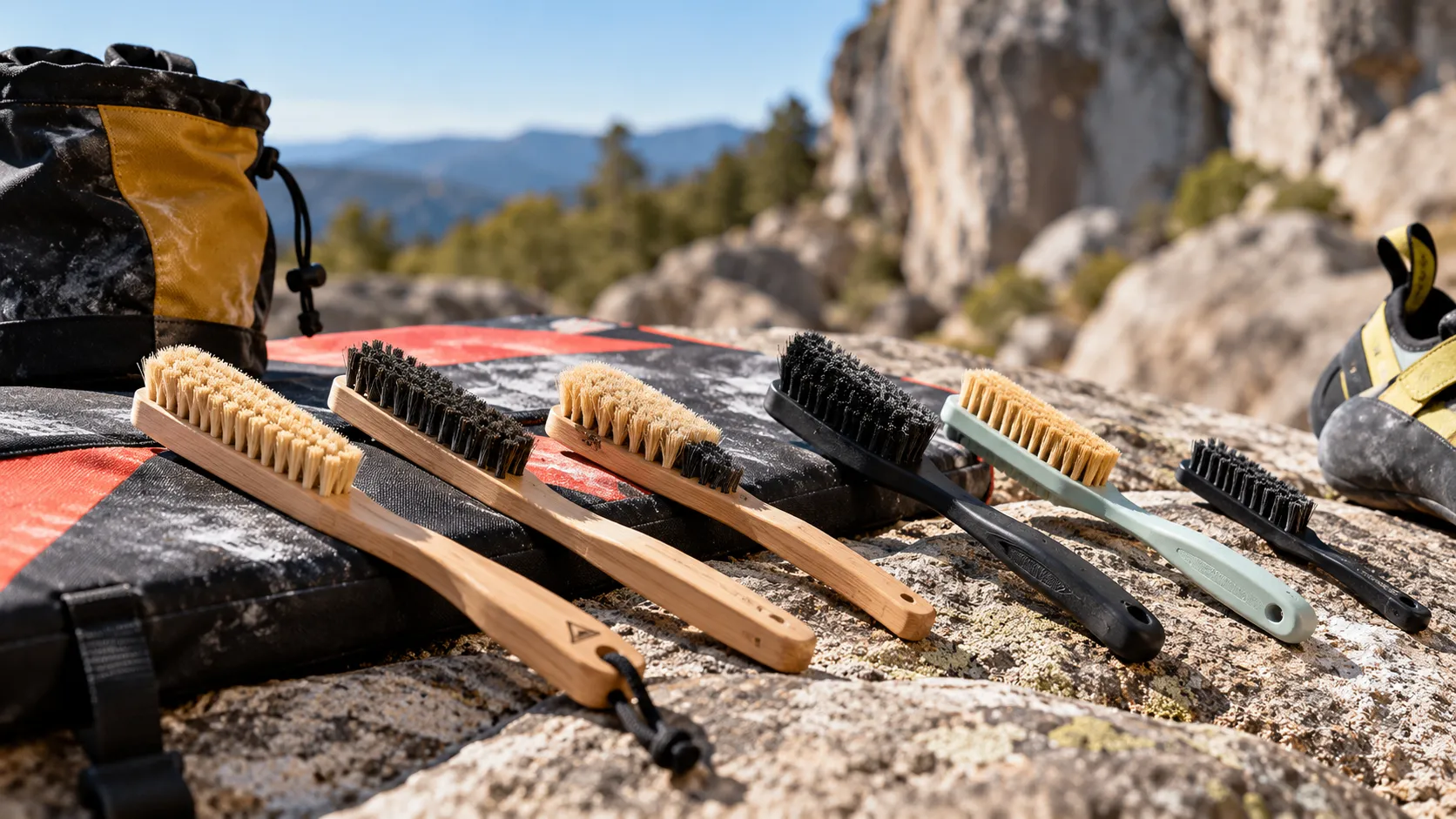
Comparison of the best climbing brushes
On the first of June 2026, the FFME announces 120,717 licensed drivers, This is a sign of an increasingly dense practice on the same holds and the same blocks. In this context, a well-chosen brush is not a gimmick: it is what gives you friction, limits the accumulation of magnetite and extends the lifespan of the surfaces. In this brush comparison, you will understand what to buy based on your holds, terrain (rock face or wall) and climbing style. To identify other useful accessories to complement them, take a look at Our selection of accessories.
The essentials in thirty seconds
There is no “perfect” brush: choose first according to the hardness of the bristles and the type of attachments (tweezers, flat heads, volume heads, holes).
For the room, prioritize surface area and efficiency; for the wall, prioritize softness, precision, and brushwork ethics.
The real criterion for the terrain: effectiveness from the first pass without “scratching” the texture, even on compact magnesium and rubber from sneakers.
The winning duo often remains the same: a mini that is always clipped + a wide one for volume and express cleaning.
Now that the objective is clear, let’s move on to the criteria that really make the difference between two models.
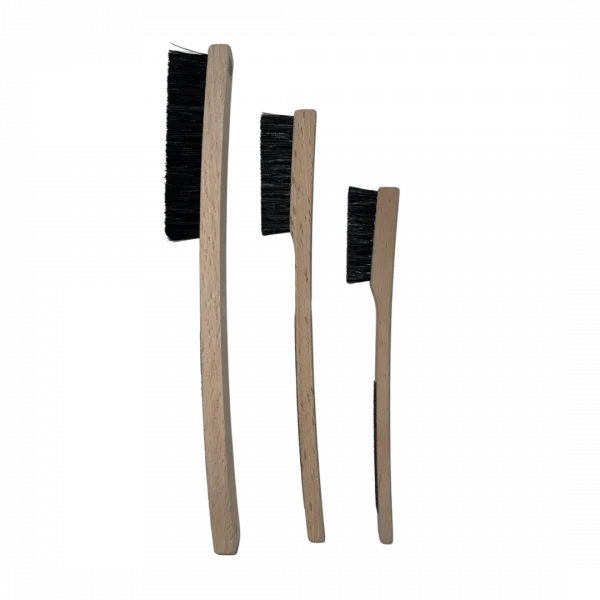
Choosing the right brush: the criteria that change everything
Hair hardness, types of grips and respect for surfaces
The first mistake in brush comparison is to talk about “brand” before talking about the brush itself. hair. Hardness conditions everything: effectiveness, the effort felt, and the risk of marring a fragile texture. In the studio, on resin and plastic surfaces, you can tolerate coarser bristles to remove the compacted magnesite, the traces of gum and dust. In the rock face, especially on soft sandstone, you want control and a gentle attack. Related topic to explore: crimp oil.
Specifically, think of “take” before “brush”:
- Ribbons and micro-edges: rather firm bristles, narrow head, precise brushing without spreading over the skin of the fingers.
- Dishes and slopers: wide head, covering fibers, pressure distributed to regain friction without polishing. (Pluses: if you “rub” too quickly, you heat up the surface and lose grip.)
- Holes and deep grips: fine head, handle that allows a clean working angle. (note: a too thick handle hinders the alignment of the wrist.)
- Volumes Large sweeping area, regular bristles, performance. (Note: on large areas in the room, a large brush saves time between trials.)
In terms of materials, you will see three families: synthetic fibers (often nylon), bearded sheep wool and blends. Suede goats are appreciated for a more “round” brushing and a good compromise on rock, but they behave differently depending on the humidity. Synthetic fibers, on the other hand, retain their shape better and withstand intensive use on resin better. In practice, it’s not “natural versus synthetic”: it’s “High density surface brushing”against“ ”flexibility and control”, depending on your terrain and your frequency.
Last point: magnatism. The goal is not to “whiten” the lens, but to remove the excess and open up the texture. The ONF also reminds us of the simple idea of Gently clean the white traces with a brush after a session on a block, rather than stacked. See ONF – Good climbing practices.
Formats, ergonomics and compatibility: what really saves you time
An effective brush is the one you use. at the right time. That’s where the format counts: mini clipable, large, double-sided, or long handle. One mini is useful right now: you brush between two trials without taking the bag out. A large one is useful for quickly applying a “clean” area, especially in the gym. A double-sided one is useful when you alternate between precision and coverage, but it requires you to accept a more bulky format.
Ergonomics is often underestimated, yet it determines your consistency. Test these situations mentally:
- Gloves, cold, sweat : A too smooth handle rotates. A marked grip remains stable, even if your fingers are saturated with magnetism.
- Pressure control : A too flexible handle encourages you to press harder. You tire the forearm and degrade the friction instead of improving it.
- Transport Clip, carabiner, loop, or simple pocket format. An inaccessible brush ends at the bottom of the bag, therefore unused.
- Perch compatibility Useful in the studio for high-output connections. Check the shape of the handle and the possibility of fixing it without play.
Terrain tip: if you climb long distances, a mini clip on the harness is a simple reflex. In a group, keep a wide clip next to the crash pad for “broom” cleanups between runs.
- Beginner : a versatile brush, medium density, comfortable handle, easy to carry.
- Intermediate Priority is given to control and fatigue over long sessions (intermediate use: look for a shaft that doesn't force you to grip tightly).
- Competitor : performance and speed, wide head for volume, mini always accessible.
- Exigent outdoor : precision, softness on rock, clean brushing after testing, without “scratches”.
First choose the hardness and density of the bristles according to your needs, then only the “style” of the brush.
An accessible brush (clip, pocket, carabiner) is often more useful than a “perfect” model that remains in the bag.
In the rock face, softness and ethics prevail: the goal is friction, not “shaving off” the rock.
Once the criteria are set, a credible comparison requires a clear and reproducible protocol.
Field test protocol: what we measured (and why)
Test scenarios: resin, stoneware, limestone, granite
The same gesture does not produce the same result depending on the surface. A resin sloper “spills out” quickly, but sometimes retains a compact layer of magnesite. Gneiss, on the other hand, can lose micro-texture if you press too hard. Limestone varies greatly: some areas accept vigorous brushing, others mark quickly. Granite, more rough, often requires less force but more precision, because dust settles into the texture.
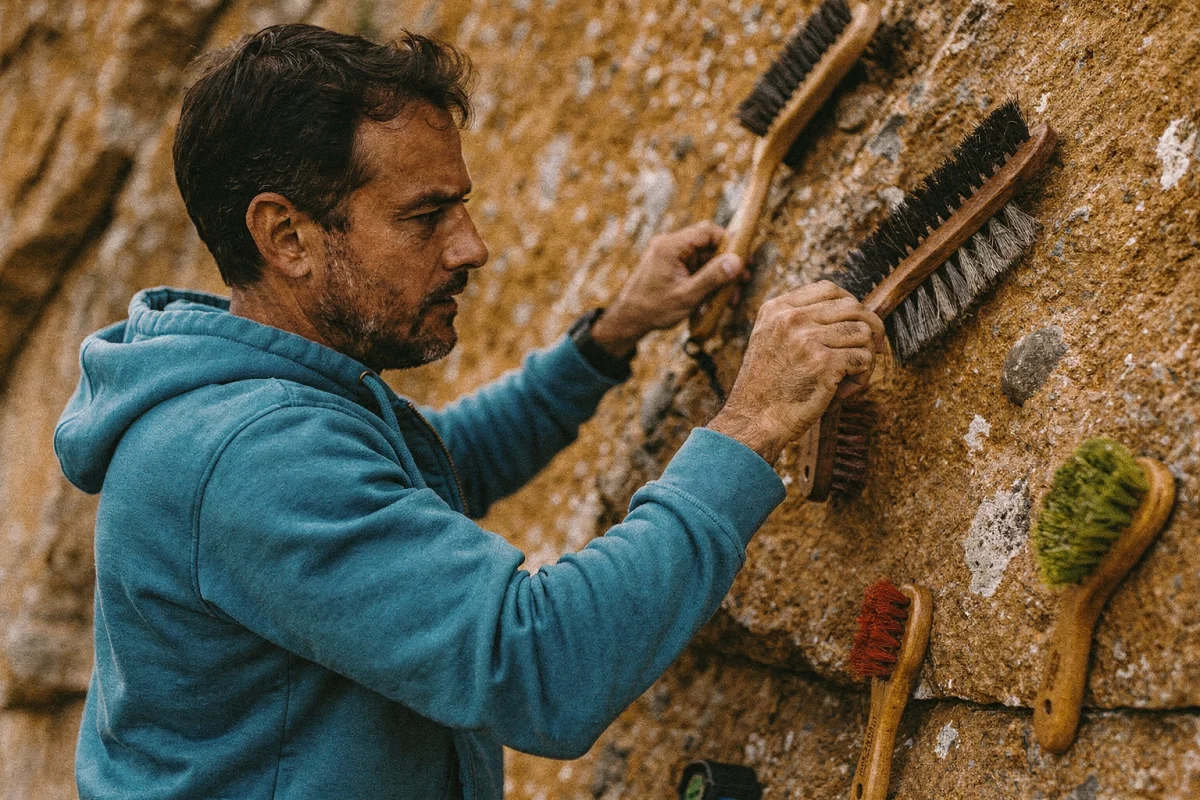
To anchor the reality of the outdoors, keep in mind the scale of practice: the ONF mentions 35,000 blocks of sandstone in Fontainebleau. When an area is over-crowded, a brush that is too aggressive is not a “personal choice”; it is a collective impact.
Our scenarios reproduce what you are actually experiencing:
- Resin in the room: volumes, macro-textured plugs, very textured strips.
- Grès: flat and rounded objects where friction dictates everything.
- Limestone: hollowed-out holes and areas “frozen” by repeated passages.
- Granite: chips, fissures, deep holes where dust accumulates.
A point often forgotten: the link between cleanliness and friction. Tribology applied to climbing shows that the effect of magnetism depends on the conditions (humidity, roughness, level of sweat), and that the practical goal remains a clean and consistent surface rather than an additional layer. For a recent scientific reference, see The effectiveness of chalk as a friction modifier… (Journal of Engineering Tribology). Also discover our article on climbing tape.
Field measures: efficiency, effort, resistance, noise and cleanliness
In real use, a brush is judged on a complete cycle, not on two quick strokes. We have therefore observed:
- Efficiency The take “reverts” on the first pass, or do I have to repeat it? On compact magnets, the difference between models is clear.
- Cleaning time Not on a “marketing” stopwatch, but on a consistent series of tests, when fatigue and sweat set in.
- Effort felt A poorly designed head causes you to compensate by using the forearm. After one session, that counts.
- Resistance Loss of hair, sleeve that gets loose, moisture resistance, and behavior after being transported in a bag.
- Noise and cleanliness A brush that is too “hard” scratches some of the resins and projects dust. Your partner endures it.
A useful economic indicator to understand: when attendance increases, cleanliness deteriorates if the gestures do not follow suit. The Observatory of Escalation, for example, reports a a decline of -5% in the revenue of private cinemas in 2025 compared to 2024, This can lead some sites to optimize maintenance and equipment rotation. An effective brush is one of the “small” equipment that stabilizes the experience, even when the outlets get clogged more quickly.
Flux: visual diagnosis of the take → removal of the excess manganese (light pressure) → targeted brushing (angles and edges) → wide brushing (uniformity) → open hand friction control → final cleaning after passing (falasse note: you leave the outlet “neutral”).
Test a brush on compact magnesite and on shoe polish: that’s where the real effectiveness is seen.
The right model prevents you from pushing too hard: the texture works for you, not your forearm.
Outdoor: The best performance is the one that respects the surface over time.
With this protocol in mind, here’s how the most sought-after models are positioned in 2026.
Pongoose Mini Me: the compact clipable, always on you
For whom, why, and its limitations in practice
The Pongoose Mini Me aims for simple use: to be Ultra accessible. In outdoor settings, this is often what matters most. If the brush is in your pocket or clipped on, you really brush between two applications. The result: you recover friction more quickly and avoid adding more magnesium “on top” of an already saturated brush head.
Its strong point is the targeted brushing Small strips, short edges, small plates, and precise contact areas. On these grips, a too wide head makes it difficult to maintain control. Conversely, a mini allows you to work exactly on the useful surface, without scattering the dust. It is also a good choice for warming up, when you just want to “wake up” a grip without turning it into a magnesium cloud.
Its limitations become apparent as the strokes get larger: slopers, large volumes, macro textures in the studio. You can clean up, but you spend more time there and press harder. This over-effort quickly gets tiring and can degrade the quality of your session. Example terrain: On a very textured volume, you end up “pushing” the dust rather than removing it, because the brush surface is too small.
Indicative price and target: Usually positioned as a compact “spare” brush, ideal for minimalist kits and block outings where every gram and every movement counts.
Action tip: clip your mini onto the bag or harness, and apply a short brushing before putting on more magnésie.
If the mini is your “scalpel”, you sometimes need a wider “raclette” for the volumes.
Pongoose Sloper Doper: Thought for slopers and volumes
Room yield, cleaning speed, and what you lose in precision
The Pongoose Sloper Doper meets a clear need: quickly cleaning a large surface area without having to make multiple trips back and forth. In block circuits, intensive sessions, or in the context of competition, efficiency is key. Slopers and volumes load quickly with magnesium, especially when the room is dry or the catches are already “frozen”. A wide brush provides more grip faster than a small one, because it distributes the effort over a larger area.
Its most obvious advantage is the Quick cleaning of dishes and macro-textures. You “cover” the useful area in just a few moves. This also helps to limit localized traces of gum: instead of rubbing a spot and digging up the texture difference, you homogenize the surface. For some climbers, this is the best way to stabilize the friction from one attempt to the next.
The tradeoff is logical: less precision. On micro-sized surfaces, holes, or deep cuts, a wide head makes access difficult. You also risk knocking dust into areas you didn’t want to touch. Example terrain: on a very short ruler in the middle of a volume, you clean the volume but you don’t get to the edge of the ruler well.
Indicative price and target: the “performance room” segment, to be preferred if your practice is predominantly indoor and focused on performance.
If you are looking for a wide brush but more “versatile in strength”, YY Vertical offers formats that perform well on compact magnets.
YY Vertical InfinityBrush: width and power for large areas
Uniform brushing, compacted magnetism, and limits on clutter
The InfinityBrush stands out for a simple promise: homogeneous cover. In wide stretches of water and in heavily fouled areas, it is often more effective than a small model, because you avoid the “scratches” effect of localized brushing. In the open water, this is noticeable on large fish where the magneton compacts, especially when the surface has already been overused.
Over worn-out shoes and greasy residues, a wide brush allows you to “crack” the surface layer and then evacuate it. This is particularly useful on slopes where friction depends on overall cleanliness. If you climb hard and perform many ascents in succession, this type of brush becomes almost an energy management accessory: fewer movements, less effort, more consistency.
The main limitation is access. On deep slopes, holes, or complex terrain, the complexity becomes a handicap. You lose the working angle and end up pushing against the ground. In transportation, it’s also bulkier: in a bag already filled with boots, magnesium, water, windbreaker, it’s less easy to get it out than a mini clip.
Indicative price and target: often targeted by climbers who want an express clean-up in the room, or by openers who do a lot of brushing in one session.
Conversely, if you only want to own one model, a credible compromise between precision and performance is required.
YY Vertical VerticalBrush: the compromise between the room and the cliff
Real versatility, comfort of the handle, and when it shows its limits
The VerticalBrush plays the card of Versatility. For many climbers, it’s the best “first serious purchase”: a format that’s neither too small nor too wide, capable of handling leads, dishes, and a good portion of standard holds, both in the gym and on the rock face. This type of brush is also easier to lend out, because it doesn’t usually require a specific attachment.
The comfort of brushing here depends on the handle: working angle, pressure control, and stability when your hands are wet or full of magnesium. Over a long session, the difference is noticeable: you brush more often, so you climb on cleaner holds, so you put less magnesium down. The virtuous circle is real, especially for an intermediate climber who seeks consistency rather than “flashy shots”.
The limitation of a multi-purpose brush is that it is not very good at extreme conditions. On giant slopers, a wide brush will work faster. On deep micro-grooves, a mini or fine head will be more precise. Example terrain: On limestone with small grooves, you clean the surface well, but you don’t get into the narrowest reliefs perfectly.
Indicative price and target: an excellent “one-size-fits-all” brush for those who alternate between the studio and the cliffside, and want to avoid buying several models.
If durability of materials and a more “natural” touch are your priority, some options put the neck at the center of the design.
CAMP Bambou: the sustainable and simple option
Durability, natural grip, and things to check before buying
The CAMP Bambou brush stands out primarily for its Bamboo handle. This choice of materials provides a natural grip sensation, often pleasant when your hands are wet or covered in magnesium. In casual use, it’s a real plus: you brush without gripping hard, and you maintain control even as the session stretches out.
On standard brushes, it does its job properly: regular brushing, maintenance of contact areas, and restoring friction without unnecessary movements. It is well suited for those who frequently climb outdoors and want a “sleek” brush that is easy to use. It is also a consistent option if you are looking to limit the omnipresence of plastic in your small equipment without falling into the “all-in-one” approach.
Limitations rarely come from brute efficiency, but from fixing options and accessories that vary depending on the versions and series. Before buying, check how you plan to transport it: clip, carabiner hole, cord, or simple pocket. Example: a brush without a holder often ends up lying at the foot of a block, then forgotten when you change sectors in November or December, when the light gets dim quickly.
Indicative price and target: leisure use, outdoor use, and a more eco-responsible approach, as long as you accept the assumed simplicity.
When the catches are really tough, the density of the hair becomes your accelerator… with a possible downside in the cliff.
KruxBrush Grande: dense hair and powerful cleaning
Performance on dirty catches, caution on fragile rocks, and recommended uses
The KruxBrush Grande is for those who want a sensation of High density surface brushing : lots of fibers, a clear attack, and energetic cleaning. On very heavy clay courts, it is effective. You quickly remove the superficial layer and you get a more consistent texture, especially on courts that are “polished” by frequent use.
It is also useful on old traces of gum, where a softer brush “soaks in” without tearing. For openers, or for climbers who spend long sessions on the same area, this efficiency avoids losing time between attempts. Example: you are working on a compression movement on slabs, you brush wide and dense, then you immediately test the friction without reloading with magnesite.
The potential drawback appears in the cliff, on fragile or very soft rock. A very dense and too firm brush can accelerate the polishing if you insist, especially if you brush dirty on dirty. The good practice is simple: less pressure, more short passes, and a final clean up. (Cliff note: if the grip becomes visibly smoother over the course of the session, it’s not the “rock,” it’s your protocol.)
Indicative price and target: intensive use, heavy brushing, bathroom, or robust outdoor use, provided that brushing is kept under control.
After these field visits, it's time for a synthetic overview to help you decide quickly, without getting confused about the format.
Summary table: which brush for your usage
Comparison by terrain, choice matrices, and purchase traps to avoid
| Model | Best terrain | Strengths | Typical limits |
|---|---|---|---|
| Pongoose Mini Me | Outdoor block, minimalist kit | Always accessible, precision on small catches | Slow on volumes, limited coverage |
| Pongoose Sloper Doper | Hallways, volumes, slopers | Quick cleaning, homogeneous brushing | Less precise for micro-businesses |
| YY Vertical InfinityBrush | Room, big catches | Yield, compact magnesite, gum | Clutter, access to deep sockets |
| YY Vertical VerticalBrush | Mixed room and cliff | Compromise, control, comfort | Less “specialist” on the extremes |
| CAMP Bambou | Outdoor, regular leisure | Bamboo handle, natural grip, simplicity | Fixation and transport to be checked |
| KruxBrush Grande | Hallway, intensive use | Density, energetic cleansing | May be too aggressive on soft rock |
| Climber profile | Recommended brush | Why |
|---|---|---|
| Beginner | YY Vertical VerticalBrush or CAMP Bamboo | One versatile model, easy to master |
| Intermediate | VerticalBrush + mini clipable | Regularity per session, more frequent and cleaner brushing |
| Competitor | Sloper Doper or InfinityBrush | Speed and efficiency for volumes, flat surfaces, macro-textures |
| Exigent outdoor | Mini Me or CAMP Bambou (depending on the rock's sensitivity) | Precision, softness, simple transport |
| Types of plugs | Recommended hair hardness | Example |
|---|---|---|
| Ribbons and fringes | Firm, fine head | Remove compact magnésium without overflowing |
| Dishes and slopers | Average, wide head | Re-establishing friction without polishing |
| Deep holes and sockets | Average to firm, narrow head | Clean the internal contact areas |
| Volumes | Average, large surface | Express cleaning between tests |
Frequent buying traps:
- False versatility : A “medium everywhere” brush can be frustrating on slopers and ineffective in holes.
- Poorly chosen size Too small in the room, you waste time; too wide in the cliff, you lose precision.
- Hair that is too aggressive With gravel, you gain an advantage in the short term but lose a site in the long term.
- Neglected transportation If you can’t clip it, you use it less, even if it’s “better”.
A useful reminder from the field: Laurence (the indoor court player) often summarizes the right method as follows: “Brush less often, but more often”. This is exactly what prevents the accumulation of magnetite and the drift towards “salty” spots.
First decide whether you are “always on you” or “large for performance”; then choose the model.
A brush that is too hard may seem effective, but it can damage the surface of the cliff.
The best brush is the one that makes your brushing regular and clean, not the one that makes the most noise.
The final decision remains to be made: here is a concrete verdict, profile by profile, to buy without hesitation.
Final verdict: the best choice according to your climbing profile
Direct recommendations and final check before buying
- Beginner : Use a multi-purpose brush (VerticalBrush or Bambou). You learn the right techniques and cover most of the areas.
- Intermediate Look for comfort and efficiency over a long session. A “multi-purpose + mini clipable” duo changes the consistency, especially when magnesium accumulates.
- Competitor : prioritize speed and optimized transport. A wide dedicated to volume applications (Sloper Doper or InfinityBrush) avoids losing energy before the test.
- Exigent outdoor : prioritize precision, robustness and proper handling. Mini clip on + softer brush depending on the rock, and a final cleaning system.
Check final (before validating your cart):
- Is your majority terrain a plain, a cliff, or a mixed terrain?
- Are your dominant features ribs, plates, volumes or holes?
- Do you want a brush that is always accessible (clip) or a “performance” brush placed on the ground?
- Are your favorite materials more synthetic (stability) or natural (touch, control)?
- Does your brushing leave the teeth cleaner, or just whiter from the magnet?
Action advice: adopt a simple ritual: brush your teeth, test the friction, and only add magnesium if necessary.
FAQ about climbing brushes
What hardness of bristles to choose for resin in the room?
Rather firm, but controllable. Resin and plastic tolerate more pressure from brushing, especially when removing compact magnets and traces of gum. The key is to clean the surface with just one pass without over-tightening the brush, and not need to “scrape” too hard. If you need to apply a lot of pressure, it’s often a problem of density or format.
Which brush to choose for sandstone and ethical guidelines?
A softer brush, with a light and frequent motion. On granite, the goal is to remove excess magnetite and restore friction without polishing the surface. Avoid violent movements and “angry” brushing. Finish with a clean cleaning after your tests: it’s the details that make a difference, especially in highly frequented areas.
Does a wide brush replace a precision brush?
No, they don’t meet the same need. A wide brush is unbeatable for quick and even brushing. A precise brush is superior for small areas and deep crevices. The duo is often the most effective: wide for cleaning the area thoroughly, mini for the details that make the difference when holding the brush.
How to avoid damaging plants and rocks when brushing?
Lower the pressure and increase the regularity. Work on the useful surface, not the entire brushstroke to keep it clean. Brush in the texture axis when possible, and avoid rubbing too long in the same spot. If you see a smoother area appear, stop: change the angle, reduce the intensity, and prioritize several short passes.
When should I replace my brush to maintain its effectiveness, and how long does it last?
Replace when the bristles wear down permanently, when the density no longer opens the texture, or when the handle starts to wear. In practice, the duration depends on your frequency, the magnetism, and the materials of the bristles. If you climb a lot in the gym in the winter, the brush wears out faster. If you climb outside, humidity and dust count more.
A good brush means better friction, less unnecessary magnetism, and more consistent testing. Keep it simple: choose the format that suits your dominant grips, then validate ergonomics and portability, because that’s what will make you actually use it. If you’re unsure, go for a versatile comfort brush, then supplement later with a mini clipable or a wide one dedicated to volume. Your climbing will benefit from it from the next session on, without changing your technique.
 Français
 English (UK)