
Sports climbing shoes: choosing the right pair without making a mistake
You climb in the gym and on the cliff, but your feet give way before your forearms? In France, they counted 300 private rooms in 2024, And a discipline that is rapidly diversifying requires a more thoughtful choice of footwear than just a «model in fashion.» This guide provides a clear method for selecting footwear for sports climbing based on your terrain, tolerance level, and actual goal. To lay the groundwork before diving into the details, start with this guide for slippers.
The essentials in 30 seconds
First choose the shape and volume that fit your foot: the brand comes later.
Adjust the size according to the material: leather stretches, synthetic holds its shape better over time.
In athletic climbing, aim for a balance of comfort/precision: a too «aggressive» shoe reduces the useful range of your moves.
Consider rotation and realignment: your sensations improve faster when your feet remain available.
Once the goal is set, the first step is to prepare the purchase as a session: with benchmarks, measurements, and criteria.
Preparing to buy: what you need to check before even trying
Measuring your foot with the right reference points (and the right sock)
Before talking about cramp or gum, you need to know how your foot fills a shoe. Take a sheet of paper, a wall, a fine-tip pencil. Measure length and width while standing. Do it at the end of the day, when the foot is a little more voluminous.
Then, prepare the realistic «test configuration»: a thin sock if you always climb with it, otherwise bare feet. In sport climbing, most climbers choose bare feet to gain sensitivity, but this is not a moral rule. Your skin, your nails, and your sessions decide.
Also note your heel: a «high» heel can make a model that is otherwise the right length unusable. Finally, look at the natural orientation of your toes. A «Egyptian» (larger toe length) foot does not fit like a «Greek» foot. This affects tolerance to asymmetry and precision on the front.
Identifying your dominant terrain: room, cliff, and types of paths
Sport climbing covers opposing realities: technical rock, physical overhangs, holds on limestone, columns, bags, and quickdraws. In the gym, volumes often require flat supports, and changes are rapid. In the rock face, you can go from «it sticks» to «it zips» depending on temperature, humidity, and polishing.
In doubt, choose what you do most often, not what you dream of doing elsewhere. If you climb mostly in the gym, opt for a versatile, stable, and quick-to-remove pair of shoes. If your week often ends in the rock face, the heel cushioning and the rigidity in the straps take on more importance.
To explore the related case in more detail, see also: Footwear for the block: choosing the right pair, without unnecessary pain.
Fixing your framework: time, budget, level, and target difficulty
A failed stair climbing purchase rarely costs «just» money. It mostly costs motivation, because the pain shortens your attempts and makes you stop the ascent. Set your frame of reference: frequency, type of sessions, and current level.
If you alternate endurance and crux work, you need a compromise. If you mainly work on small pitches, you need precision and a stable front foot. If you often climb long routes, comfort and managing pressure points take priority, even if you climb hard.
Finally, decide whether to buy a single multipurpose pair or a rotation. A simple rotation of «training + performance» changes everything, without requiring a crazy budget, especially if you plan to remodel.
Checklist: data to be collected before comparing models
- Your length, width, volume, and heel (notes and feel).
- Your main terrain: room, cliff, or balanced mix.
- Your dominant styles: flat, vertical, light sloping, heavy sloping.
- Your tolerance to pain, and your need for comfort over the long term.
- Return policy and availability of sizes (especially if you order).
- Repositioning options and acceptable timeframe in your schedule.
- Do I want to climb for longer, or press harder on the small holds?
- Do I mainly do quick transitions (hall) or long runs (wall)?
- Does my foot tolerate a moderate form, or do I need a neutral form?
- Am I ready for an adaptation phase, or do I want to be effective right away?
- Did I plan the realignment before destroying the tip?
Choosing begins before the trial: measurements, terrain, and actual use.
Your foot dictates the shape; fashion mostly dictates mistakes.
Sport climbing rewards balance: sufficient comfort, sufficient precision, over time.
With this preparation, you can define your needs without being trapped by an «impressive» but unsuitable model.
Clarifying your needs: comfort, precision and the style of sporty climbing
Arbitrate comfort and precision according to your sessions
The good shoe is not the one that hurts the most. It is the one that allows you the most attempts of quality. In climbing, your progress is determined by the repetition of proper placements. If the pain makes you come off the wall too early, you lose valuable attempts.
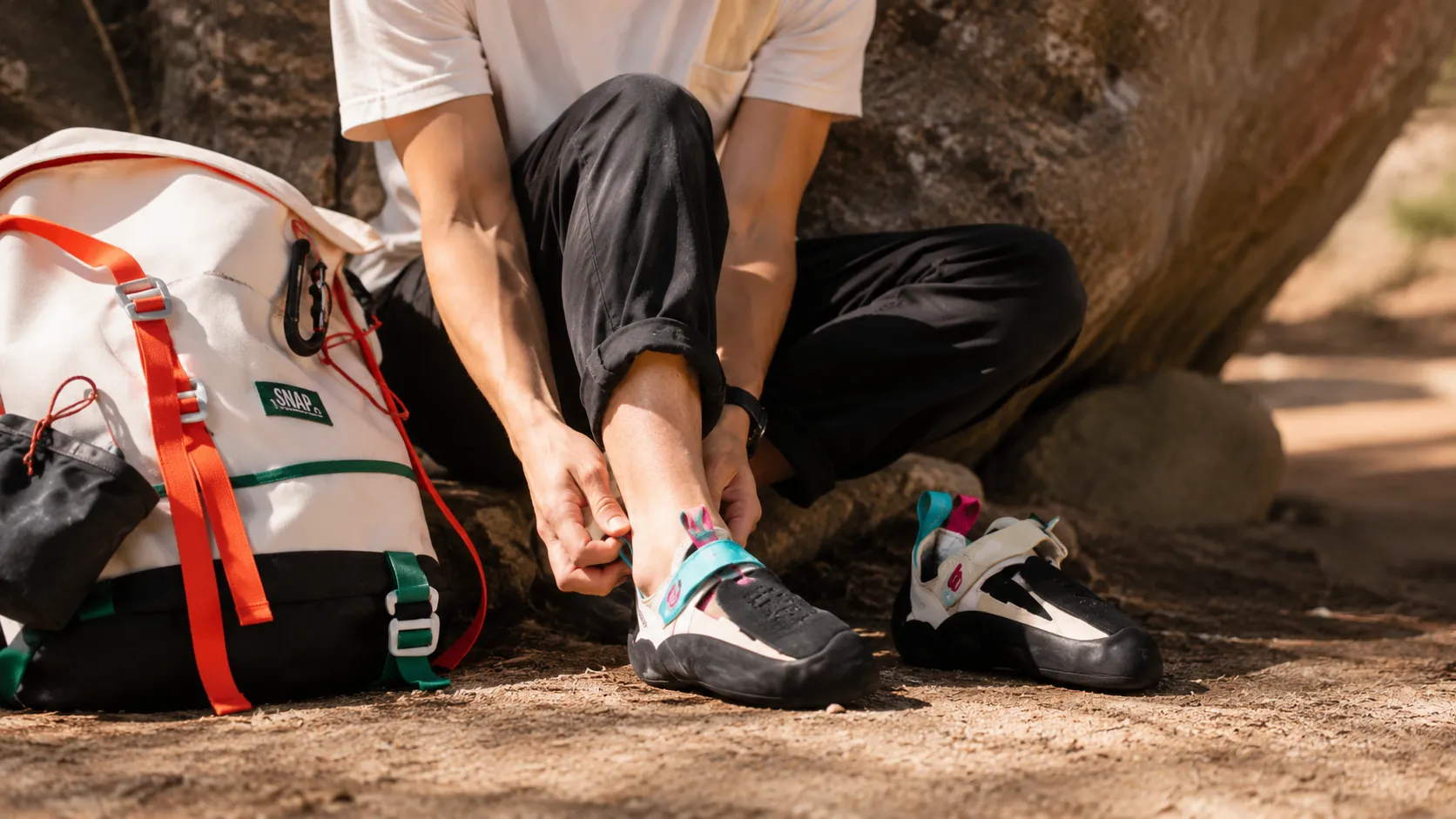
Decide where you place the cursor. For long sessions, opt for a comfortable model with enough support to push without snapping your toes. For short «performance» sessions, you can accept a tighter fit if the shape conforms to your foot.
A remark often repeated by Cyprien Garnier: form takes precedence over the brand. Keep the operational idea in mind: if the form doesn’t fit, you’ll compensate by twisting your foot, and your precision will collapse at the crucial moment.
Mapping of dales, slopes and ridges (and how it changes)
With a chisel, you need friction grip, good grain reading, and a point that doesn’t crush too much. Too rigid, you «ski» on the supports. Too aggressive, you lose the useful contact surface.
When bent, the tension of the sole helps to pull on the tip and stabilize the hooks. A more curved shape may be more relevant, especially if you toe-hook often. In rods, the important thing is the hold in the grip. A front that is too flexible will bend, and you lose grip on small fish.
This is not a simple opposition. Many sport climbing climbers climb on technical vertical routes with block-like footfalls. They need a pair that holds on even in the most difficult routes without punishing them after a few routes.
Flux: If you are starting out or returning to neutral form, comfort, volume-tolerant. If you are looking for versatility → moderate shape, support, precise tip. If you mainly work on the heel drop → more taut profile, locked heel, effective toe hook.
Take into account frequency of use and humidity
Your frequency changes the wear rate and the stability of the sensations. If you climb often, you «make» the new pair faster, but you also wear the rubber out faster. In the gym, the tread and certain grips wear out quickly, and the grip becomes irregular if the sole gets dirty.
Moisture matters more than many people think. A sock that seems perfect in dry weather can become slippery if the sweat gets inside. Materials and linings change how moisture is managed, so your confidence is at stake.
If you alternate between the indoor and outdoor courts, anticipate a pair that dries quickly and another that retains its shape. Synthetic surfaces retain their size better, which stabilizes the fit when conditions change.
Defining your pain tolerance (and your adaptation phase)
Useful pain is rare. «Structural» pain is a signal: bone compression, friction on a tendon, irritated tendon, a nail that pricks. In sports, it cuts you off from your momentum. You climb less, recover less well, and you associate the cliff with punishment.
Set a simple rule: you must be able to load the big toe without grimacing, and bend it a little without cramping. You can accept moderate discomfort, especially in the front, if it diminishes after a few minutes. However, if you lose sensitivity because the foot falls asleep, you also lose precision.
Cyprien Garnier often emphasizes this point: copying an aggressive model of a proven climber is a classic trap. Practical translation: buy for your real practice, not for your image.
Your need is described in three words: duration, inclination, takes.
A good fit increases precision without taking away your sessions.
Pain tolerance is a personal variable, not a rite of passage.
Once your needs are established, you can choose the construction: this is where the stability on the tracks, the friction, and the lifespan are decided.
Understanding construction and materials: what really changes on the rock
Flexibility, stiffness and the midsole: the trio that provides support
Flexibility determines your ability to «feel» the grip. The more flexible a shoe is, the more you perceive the relief, and the more you can exploit the friction on a plate. In return, the front folds more, so edging on the strips requires more foot force.
The stiffness, on the other hand, stabilizes the push. On long sections of small pitches, it saves your toes. The interspace (the layer between your foot and the rubber) is often the real culprit of that «skateboard» or «sock» feeling. Two models with the same rubber can be opposed simply by their internal structure.
Don’t look for the «best». Look for what suits your profile. In sports, an intermediate level of stiffness is often the best starting point, especially if you climb as much in the gym as you do in the rock face.
Cambrure, asymmetry, and pointed shape: precision without cheating
The camber places the power in front. The asymmetry aligns the force towards the big toe. The more these parameters increase, the more the tip becomes a tool. But the more the foot is constrained, the less comfortable you are if the shape does not match.
A neutral form is very suitable for learning and chaining, especially in long routes or long sessions. A moderate form covers a wide range of sport climbing: it helps on light descents while remaining tolerable over several attempts. A very aggressive form may make sense for an expert climber, especially if he is looking for advanced hookwork and maximum precision on integrated block steps in the routes.
If you hesitate, choose stability. A tip that is too fine but poorly filled becomes inaccurate. Your foot moves, and you lose the reading.
Rubber: adhesion, edging, durability… and physical reality
Gummy material is not just about «sticking». A tribological study on climbing grips shows that performance depends on a complex mix: hardness, roughness, viscoelasticity and adhesion, and not just on one magic parameter. Sticky feet: a tribological study of climbing shoe rubber.
Terrain translation: a very soft rubber can excel in friction, but wears out more quickly if your footing is still rough. A firmer rubber holds the cleats better and resists abrasion better, but sometimes requires more precise pressure to «stick» on a smooth surface.
Don’t choose the gum as a marketing argument. Choose it according to your dominant pitches. If you often climb on flat and volume pitches, you want surface and feel. If you often climb on small pitches, you want a front that doesn’t collapse too much.
Leather or synthetic: long-lasting and stable fit
The material of the upper influences the fit. A leather model can stretch over time, while a synthetic model often retains its shape better. This changes your sizing strategy and your tolerance to the adaptation phase.
If you aim for very precise fit, stability is your friend. The synthetic ensures the fit over time. If you’re looking for comfort that improves over time, leather may be suitable, but you need to anticipate this movement when buying.
This point explains many classic stories: «at the store it was perfect; a month later I’m floating.» It’s not necessarily the model’s fault. It’s often a lack of anticipation for the material.
Talon, coating, toe-hook: the areas that betray a bad choice
In modern sports, hook shots are no longer reserved for the block. A poorly locked heel ruins your free throws. A poorly protected toe-hook ends up damaging the front area, especially in gyms with high volume play.
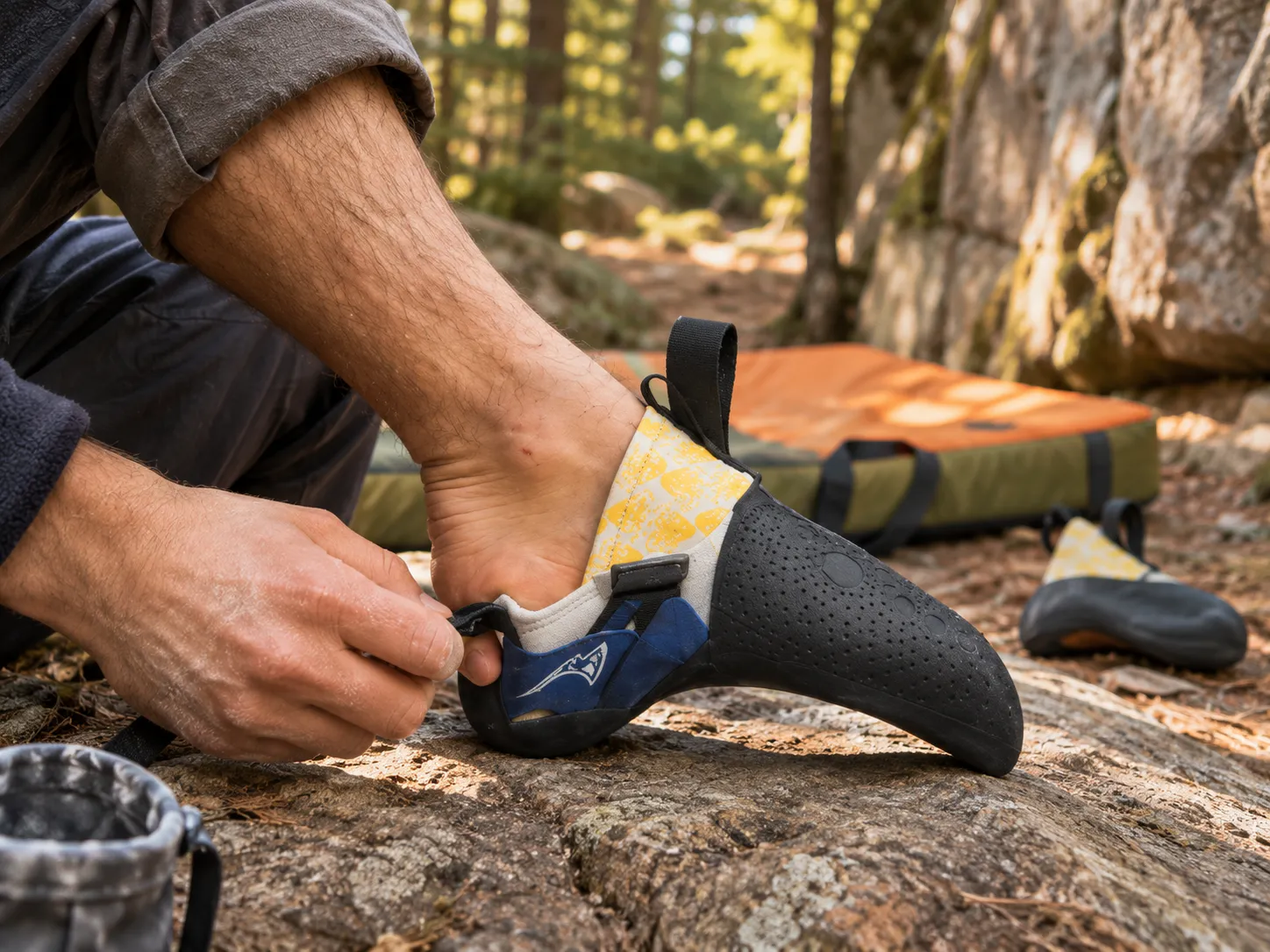
Test the heel as a piece of equipment, not as a vague sensation. The foot must be «held» without air pockets and without pressure that cuts in. At the front, check that the toe-hook area is sufficiently wrapped if you crochet often. Otherwise, you will quickly wear out the new pair in the wrong place.
For more information on wear and repairs, see also: Repairing worn climbing shoes: tips and advice.
The structure (flexibility/rigidity) dictates the support as much as the rubber.
The material (leather or synthetic) determines the size over time.
Talon and toe-hook are «weak points» that need to be addressed during the fitting process.
You have the technical criteria; the most tricky point remains: the shape and the size, down to the millimetre.
Achieving the right shape and size: the adjustment that makes the difference
Measuring length, width, volume and heel height (without lying)
Length isn’t enough. Two feet of the same length can require opposing volumes. In the store, many climbers «win» a size by crushing the toes, then lose all precision because the foot rotates.
Your goal: that the foot does not move, that the big toe is under control, and that the heel does not float. The sock should conform, not squeeze. If you have a slender foot, look for a shape that fits the midfoot. If you have a wide foot, avoid too pointed models that force a twisting motion.
A simple rule of thumb: if you can pinch a large area of material at the heel or on the sides, it’s often too big. If you can’t load the front without severe pain, it’s often too small or poorly shaped.
Anticipate relaxation and internal tension according to the material
The fit changes over time. The insole shrinks, the sole «thickens,» and the upper changes according to the material. This is where choosing between leather or synthetic becomes strategic. If you buy very tight shoes thinking «it’s going to fit,» you risk damaging your feet and shortening your sessions.
Conversely, if you buy something too comfortable from the first try, you risk losing precision after a few weeks. The ideal for a sports watch: a fit that becomes quickly bearable while still maintaining a clear line of sight on small targets.
Also keep the temperature in mind. One foot swells at the end of the day, and a bit in the hot cliff. You want a margin of functional comfort, not a variable ordeal.
Choosing your target tightening: performance or versatility
Set a clear intention. Performance: You accept a higher constraint to gain immediate precision. Versatility: You accept a little less laser power to climb for longer.
In competitive climbing, versatility often wins on paper, because you can do more attempts in a row. But if you are working on a project route with very precise steps, a dedicated pair may become relevant.
You don’t need to imitate an expert. You need a consistent system. That’s exactly where many go wrong: they buy a competition tool, then do endurance work with it. Result: pain, loss of sensitivity, and less progress.
Testing heel and toe: controlled hooks, not acrobatic ones
For the heel, don't jump. Simulate a heel hook by pulling slightly, then turning. If the heel comes off, you'll have some surprises when you step down. For the toe, try a heel hook on a furniture edge, or a small walk in a store, without overdoing it.
Your test should be controlled, not spectacular. What you’re looking for: no air pocket, no sharp pain, and uniform hold. If a seam cuts you, it’s not an «adaptation.» It’s a weak spot that will come back.
If you are unsure between two sizes, prioritize the overall shape. A half-size can change the pain, but it will not correct an asymmetry that you feel uncomfortable with.
- Put on your shoes, close them, take a little walk: look for abnormal points of impact.
- Get on a small ledge or edge: load the big toe, then release.
- Test a wedge support: the foot must remain stable, without twisting in the shoe.
- Simulate a heel crochet: light traction, then rotation, without tearing.
- Take it off, put it back on: if it’s a total fight, you won’t dare to do it on the cliff.
- Note three words: pain, grip, precision. Compare with the other size.
The size is never «universal»: it depends on your volume and the material.
Good fit = no air pockets, no point of shearing, precision maintained.
Test the heel and toe control while actually climbing.
When the shape is validated, the choice of closure becomes a multiplier of efficiency, especially in the hall and in quick transitions.
Choosing the closure: comfort of use, precision, and health of sensitive areas
Laces: the fine adjustment for long sessions
Laces remain the most precise closure. You can tighten the front, the midfoot, and the upper differently. In the canyon, when you leave the boots on longer, this fine adjustment limits the points of pressure.
Another advantage: precision on «atypical» feet. If you have a pronounced heel or a thin heel, you can compensate by using areas. This avoids buying a model that is too small just to «lock» the heel in place.
Also think about the knot. A well-made self-locking knot limits the gradual loosening. It’s a small detail, but in sports, details make for effective testing.
Velcro: quick transitions and training
Velcro is king in the gym and during split sessions. When you take it off, you rest, and you recover. You can climb for longer, and you protect your skin. In sports, it’s also useful when you alternate between training and rest, especially in cold weather.
The compromise: the adjustment is less fine than the laces. Depending on the model, the tightening can create a point of pressure on the top of the foot. If you have a sensitive area, test it in a flexed position, not just standing up.
Velcro can also wear out. If you keep your slippers for a long time, check the durability of the closure, because a worn-out velcro ruins the overall look.
Slipper: sensations, compactness and toe-hook
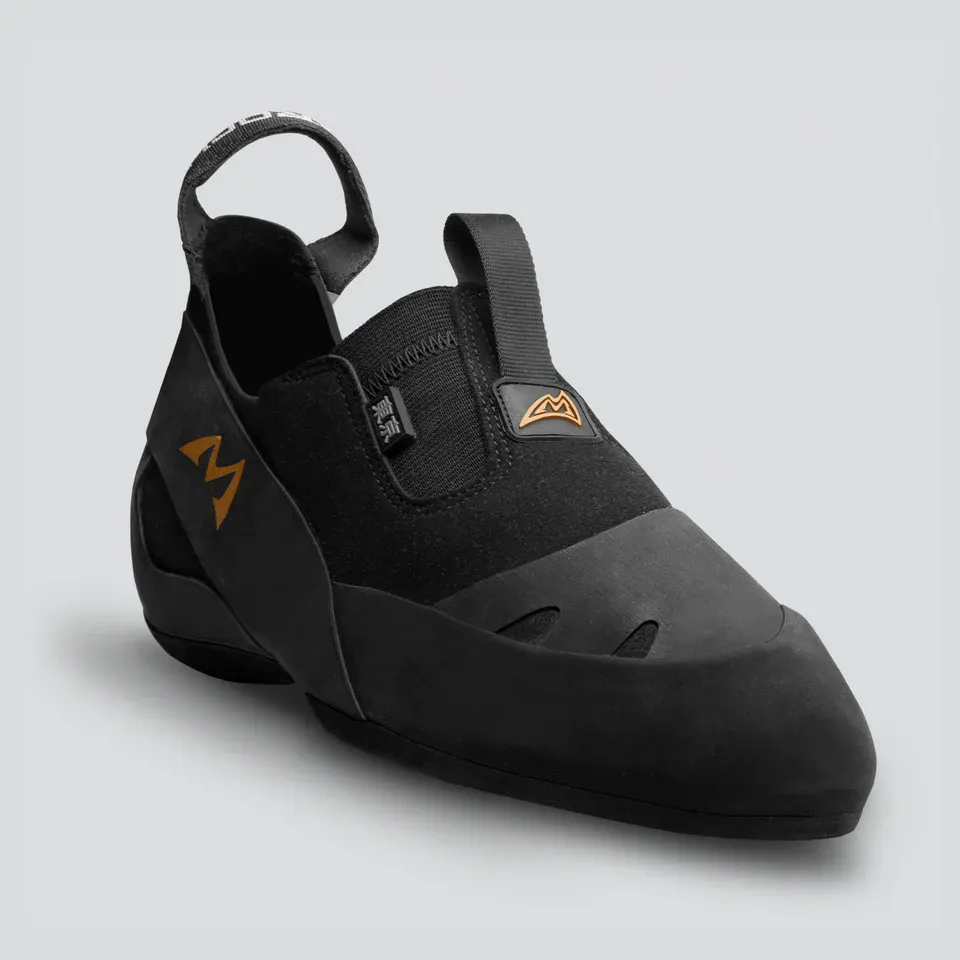
The slipper provides direct contact. Minimal thickness, minimal elements, so plenty of sensitivity. On volumes and fine placements, it’s pleasant. On toe-hook, some slippers are excellent, because the upper well wraps around the foot.
The risk: if the volume does not match perfectly, your foot moves. And in sports, a moving foot costs precision, and therefore energy. The slipper is rarely chosen «at random». It is chosen when you know exactly what you are looking for.
If you sweat a lot, watch for stability. A slipper that is too flexible can deteriorate more quickly and become inaccurate when it stretches.
Restricting the pressure: Achilles tendon and malleoli
Your sports climbing can be perfect, if your feet don’t sabotage you. Watch out for two areas: the back (tendon) and the sides (malleolus). Abnormal pressure here is not a «good grip.» It’s a friction that becomes an injury.
Also adapt the closure to your needs. If you take it off often, Velcro is logical. If you keep it on for a long time, the laces reduce the points of contact. If you're looking for a sense of comfort, the slipper can work, but only if the size is correct.
| Closure | Ideal for | Frequent limits | Typical profile |
|---|---|---|---|
| Laces | Long paths, precision tailored to the needs of the user, difficult footing | Slower transitions | Directional climber control and lasting comfort |
| Velcro | Hallway, alternating testing/rest periods, efficiency | Less fine adjustment, possible pressure on the top | Mixed practice, dynamic sessions |
| Slipper | Feelings, compactness, some toe-hooks | Requires perfect volume, varying hold depending on perspiration | Experienced practitioner who knows what he wants |
Laces = fine adjustment, velcro = efficiency, slipper = sensations but demanding.
The best closure is the one you use without fighting.
If an area hurts you in the test, it will hurt you in the cliff.
At this point, you know what to choose; the only thing left is to align it with your level and progress, without skipping any steps.
Adapt your shoes to your level: progress without getting bored
Beginner: Tolerance, comfort, and foot-laying bases
When you learn, your foot is not «precise». It is discovering. You scratch, you turn, you correct. A too technical shoe will not make you better. It will mostly make you more tired and painful.
Aim for a neutral or moderate shape, a volume that respects your toes, and a simple closure. Your goal: climb often, for long periods, and properly. Technique comes with repetition, not with pain.
If you’re buying your first pair of real shoes, prioritize trying them on and a reliable return policy. See also: Where to buy climbing shoes for beginners (without a size error).
Intermediate: Maintaining, edging, and controlled precision
As you start to string them together regularly and work on different lines, the requirements change. You need a boot that holds on to the ground, locks down the heel better, and keeps a stable point on small landings.
Moderated form often becomes the best option. It provides real precision, without turning every session into punishment. You can accept a more strict constraint, but you must remain able to repeat quality attempts.
At this level, rotation becomes profitable. A pair that is more comfortable for the majority of sessions, and a pair that is more precise for the days planned. You progress without getting hurt.
Expert: aggressiveness, sensitivity and advanced hook shots
If you climb very hard, you already know what you are looking for: a tool. The more aggressive profile can become logical, especially in descents and on intense moves. You will exploit a peak tension, a sculpted heel, and a robust toe-hook zone.
But expert doesn't mean masochist. Uncontrolled pain costs you attempts. And in sports, your best performances come when you can start over, analyze, and correct.
Also keep a model that is more tolerant for warm-up and training. This protects your tendons and maintains a high climbing volume.
Plan to scale up: avoid injury and setbacks
Upgrading your range doesn’t mean changing everything at once. The simplest method: increase precision gradually. First, stabilize the shape and volume. Then, work on stiffness and edging. Finally, if your terrain demands it, increase tension and aggressiveness.
If you jump straight into a very demanding model, you risk reducing your sessions. You lose level, then you blame the shoe. The shoe is not the problem. The progress has been burned out.
A useful guideline: your performance pair should remain usable for more than one route. If you remove it after each movement, you have probably exceeded your current tolerance.
| Level | Priority characteristics | Typical mistakes |
|---|---|---|
| Beginner | Comfort, neutral or moderate form, tolerance | Too tight, too aggressive, sessions abandoned |
| Intermediate | Maintien, edging, stable point, reliable heel | Too flexible on the skates, heel floating |
| Expert | Tension, hookings, high targeted sensitivity | Confusing constraint with performance, neglecting rotation |
Beginner: Climbing a lot and properly is better than suffering.
Intermediate: The moderate form is often the best accelerator.
Expert: the tool should serve performance, not reduce the volume of tests.
Are you hesitating between versatility and performance? The article Why choose rigid climbing shoes? it helps you to make decisions based on your dominant instincts.
Once your level is aligned, you can optimize the purchase: budget, rotation, and reselling strategy are all part of the choice.
Optimizing the purchase: budget, pair rotation, and mistakes to avoid
Budgeting with renovation and maintenance (not just the label)
The real cost is «purchase + maintenance + unavailability». If you climb regularly, you will wear out the equipment. And relining is often the best economic decision, provided you plan ahead.
For example, Decathlon indicates price ranges of 30 to 35 € per pair for a simple resealing. The same page also announces 45 to 50 € per pair for a relining with a coating.
Your strategy: line up before the hole. Otherwise, the repair becomes more difficult, sometimes uncertain, and your sensations change.
Store, order, try on at home: choose according to your risk
If you already know a model, ordering can be convenient. If you are exploring a new shape, the store remains the most reliable route, because you can test volume, heel, and pressure points. Sizes vary, and a half-size can make a model from «perfect» to «unwearable.».
Our guide on the subject details the method: Why trying on your shoes in-store remains essential.
If you try it at home, do it under controlled conditions: a warm footbed, simulated movements, and written notes. Without notes, you quickly confuse «tight» and «well-fitting.».
Rotation strategy: a training pair and a performance pair
Rotation is not a luxury. It’s a way to preserve your feet and increase your repetitions. A comfortable pair for most sessions, a more precise pair for the days when you want to give it your all.
This duo also reduces the stress of resetting the shoes. When one pair goes to the workshop, the other takes over. You avoid climbing with a dead sole, which impairs your foot positioning.
If you only want one pair, choose the most versatile one possible. In climbing, it’s often the most rational decision.
Avoiding over-sizing and under-sizing: the two classic pitfalls
Over-size: you are comfortable, but the foot moves. Result: loss of precision, excessive energy consumption, heel that jumps. Under-size: you are stuck, you compensate, you climb less for longer, and you lose sensitivity.
A simple indicator: if you can't focus on the trail because you're thinking about your feet, the size is wrong. Sports climbing requires mental commitment. A hiking boot should be liberating, not a burden.
Finally, take into account the material. Synthetic material moves little, so you need to aim for just the right fit right from the start. Leather can change over time, so you need to plan ahead without going overboard.
| Scenario for the year | Relative cost | Advantage | Limit |
|---|---|---|---|
| One single versatile pair | Average | Simple, consistent, steady progress | Inability to work during the rearrangement |
| Rotation training + performance | Medium to high | Well-maintained feet, quality testing, continuity | Request to organize use and maintenance |
| Systematic replacement without relubrication | High school graduate | Always «new» | Cost and waste, sensations that often need to be recreated |
The useful budget includes the realignment and the time without your pair.
Rotation protects your feet and stabilizes your progress.
Over- and under-sizing sabotage precision, each in its own way.
For these choices to remain true over time, maintenance becomes your best ally: grip, odors, and timing of the re-lubrication are all taken care of.
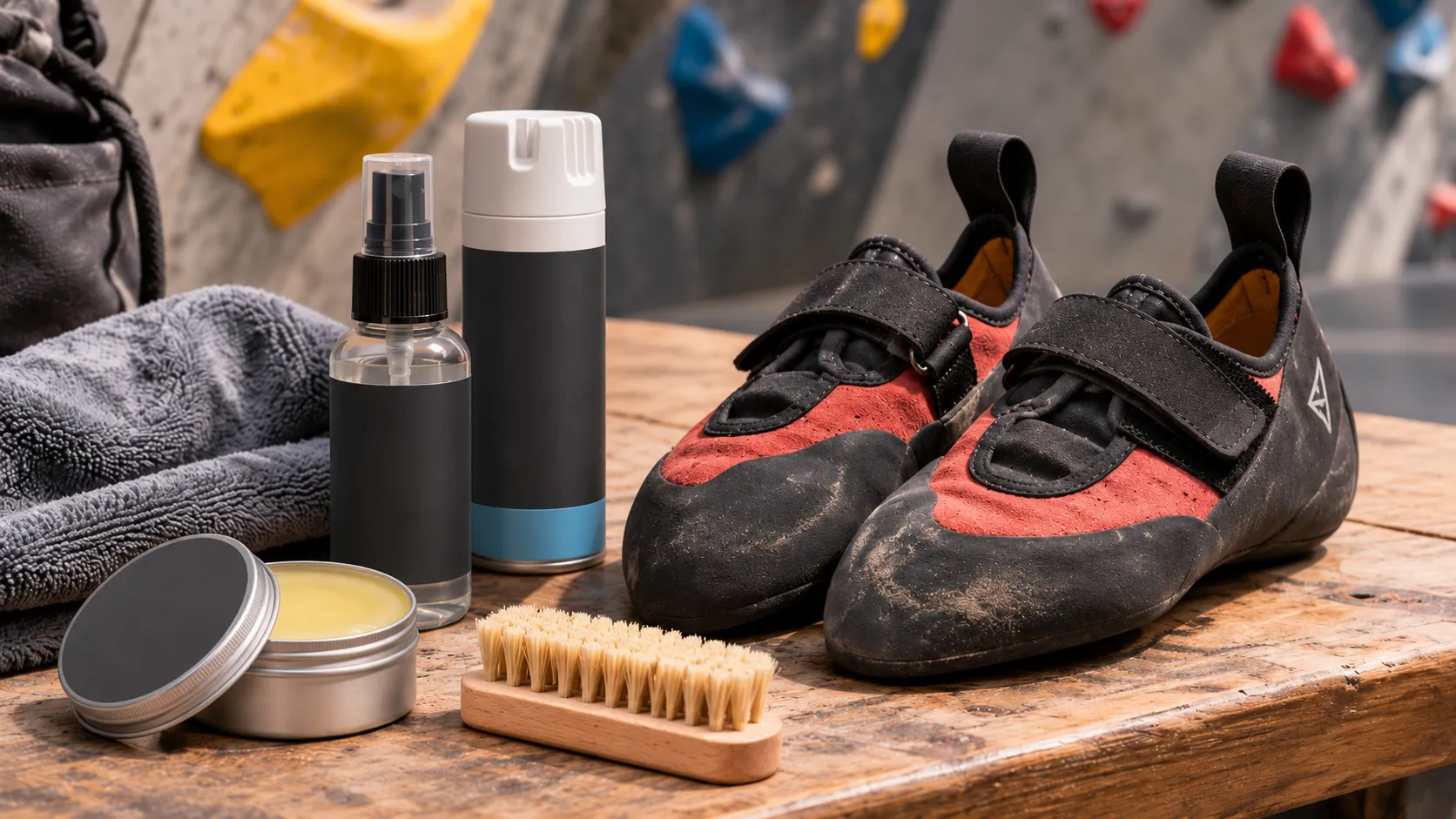
Maintain your slippers: keep the grip and extend the lifespan
Interior cleaning: gentle, regular, without killing the rubber
Your goal is not to have a sock that looks as good as new. Your goal is to avoid bacterial saturation and loss of grip due to deposits. Aggressive cleaning can damage the adhesive and harden certain materials.
A simple approach: airing after a session, cleaning where necessary, and drying in the air. Decathlon advises against using a machine and recommends using a soft sponge or brush, clear water or soapy water, then drying in a sheltered place away from the sun. maintenance and resetting tips.
If you climb a lot, this ritual also prevents the internal «slippery feeling» when the foot slides slightly in the sweat.
Post-session drying: reducing odors and deformations
After the session, remove them from the bag. Leaving a wet sock compressed is the best recipe for odors and the degradation of materials. The drying process should remain gentle: no burning radiator, no direct sunlight, otherwise you will weaken the adhesives and the rubber.
A dry sock retains its shape better. And a stable shape preserves your precision better. It’s as simple as that.
If you sweat a lot, alternating between two pairs helps to let each pair dry completely, especially when you climb in the gym several times a week.
Storage: maintaining shape, adhesion and tension
Storage is underestimated. A sock crushed at the bottom of a bag ends up deformed. And a deformation means a loss of precision. Store them flat, without twisting, in a ventilated place.
If you store it for a long time, avoid heat and humidity. The gum ages, and collages do not like extreme conditions. For a detailed method: Long-term storage of climbing shoes: the reliable, step-by-step method.
Recognizing wear and tear: toe, heel, and signs of delamination
Watch the tip. As the coating thins, you are close to the point of no return. Decathlon specifies that in the event of a hole, repair depends on the size, with a threshold of 5 mm to determine whether the repair is lasting over time.
On the heel, look for the appearance of creases and smooth areas. If the heel is slipping, it’s not just a technical problem; it may also be due to wear or a deformation of the shape.
Finally, watch for delamination: peeling edges, soft areas, microcracks. The sooner you intervene, the better you can preserve the original sensations.
Planning the realignment: before the hole, and with the right timeframe
Useful information for organizing: Decathlon indicates that a shoe sole wears out on average after 6 months, With wear sometimes being faster in the room.
Regarding the deadline, the same page states 3 to 5 weeks depending on the activity of the climber, this justifies rotating if you climb frequently.
And if you’re hesitating between repairing and replacing, keep the overall impact in mind: Hardloop evokes 280,000 pairs sold each year in France, Representative 140 tons of waste.
Airing and drying after each session protects the shape and grip.
Plan the re-alignment before the hole, otherwise you lose precision and options.
A simple rotation makes maintenance easier and stabilizes your sensations.
After the purchase and maintenance, the truth comes to light: you must validate in real conditions, using a mini-protocol that avoids hasty conclusions.
Validating on the rock: turning the experiment into certainty
Test over several sessions and inclinations (without changing ten parameters)
The first session often goes wrong. Your feet are not used to it, the new pair is stiff, and your perception is biased by excitement or frustration. Do a progressive validation: a gym session, a cliff session, then a project-oriented session.
Variate the incline. On the slopes, assess the friction and confidence. On the vertical, assess the edging and stability. On the descents, assess the heel and toe hook. Do not change everything else on the same day. Keep the same warm-up routes, the same socks if you wear them, and similar transitions.
Your goal: distinguish «normal discomfort from adaptation» and «structural dysfunction». The latter does not disappear; it gets worse.
Indicators: heel hold, pain, precision and confidence
Four indicators are enough. Heel hold: no slipping in the hook. Pain: no sharp point that forces you to take your shoes off. Accuracy: the ability to aim at a target without trembling. Confidence: you engage with the support without hesitation.
If one of the indicators is poor, do not compensate by changing your technique in the wrong place. A poorly fitted boot creates compensations, then injuries. Sport climbing requires proper repetition, not survival.
If you feel a rapid loss of sensitivity, check the compression on the top of the foot. Sometimes, the closure creates an invisible pressure point in static, but evident in flexion.
| Common problem | Probable cause | Immediate solution |
|---|---|---|
| Flying Talon | Inappropriate heel size, too large a size | Try another form, check the closure, avoid over-sizing |
| Localized pain on a seam | Structural turning point | Changing the model, without hoping for a magical «adaptation» |
| Imprecision on the front | Foot that moves, toe that is poorly filled in | Adjust the volume/shape, try a half-size different |
| Gliding on the slab | Too rigid or unsuitable rubber for the style | Choose a more flexible shoe, work on your foot position, and clean the sole |
Validate over several sessions: the first impression is often misleading.
Tonality, pain, precision, confidence: four indicators are enough.
Poor form creates compensations; correct the equipment, not your anatomy.
After this validation, the questions always come back: size, socks, fit, and resizing. Here are clear answers, without any unnecessary talk.
FAQ sports climbing slippers
Which size should I choose depending on the brands and models?
Choose the shape and size first, then adjust the size. The same «city» size doesn’t mean anything from one brand to another. Aim for a steady foot, a full heel, a heel without air pockets. Anticipate the material: a synthetic model moves little, a leather model can stretch. If you’re unsure, opt for a fit that doesn’t cause sharp pain.
Socks: useful or not recommended for sports activities?
They are useful if they increase your comfort without moving your foot. They can reduce friction and odors, especially during long sessions. They are not recommended if they create internal slipping, as you lose precision and sensitivity. The right test: If your big toe «floats» on a ruler, remove them or change the thickness.
How long does it take to properly soften them?
It depends on the construction and material. A flexible pair «takes» longer to “set” than a rigid model, but it can also deform more quickly if your foot placement is approximate. Don’t force it too tight beyond your tolerance: you risk reducing your sessions, and therefore your progress. Instead, take gradual steps and note your sensations.
Why does a pair of stairs not always equal a pair of stairs?
Because wear and tear, temperature and traction do not all act in the same way. In the gym, volumes and certain textures can wear out quickly, and transitions are frequent. In the rock face, you often need more traction in the heel, and the heel becomes critical in the descent. If you climb a lot, a dedicated rotation prevents having a «medium everywhere» shoe that is excellent nowhere.
What is the main risk if I choose a too tight fit to perform well?
The risk is losing the volume of climbing, and therefore the level. Excessive pain shortens your sessions, reduces your ability to repeat proper attempts, and can irritate tendons and skin. You can also lose sensitivity, and therefore precision, which is the opposite of the goal. In sports, performance often comes from a lasting compromise, not from maximum strain.
When to replace rather than replace?
Smooth the material as soon as the front part thins out, before the coating is pierced. You keep your «made» boot and your sensations. To help you organise, Decathlon indicates indicative prices as follows: 30 to 35 € per pair for a simple resealing, and a possible delay of 3 to 5 weeks. Replace if the stem is too damaged or if the fit has become unstable.
You don’t need the «perfect» boot. You need a boot that fits your foot, your terrain, and your climbing volume. By defining your needs, validating the fit, then adjusting the closure and material, you gain precision without sacrificing your sessions. Then, maintenance and resembling protect your investment and your sensations. The next step is simple: try with method, note your indicators, and choose the pair that lets you climb more, better, and longer.
 Français
 English (UK)