

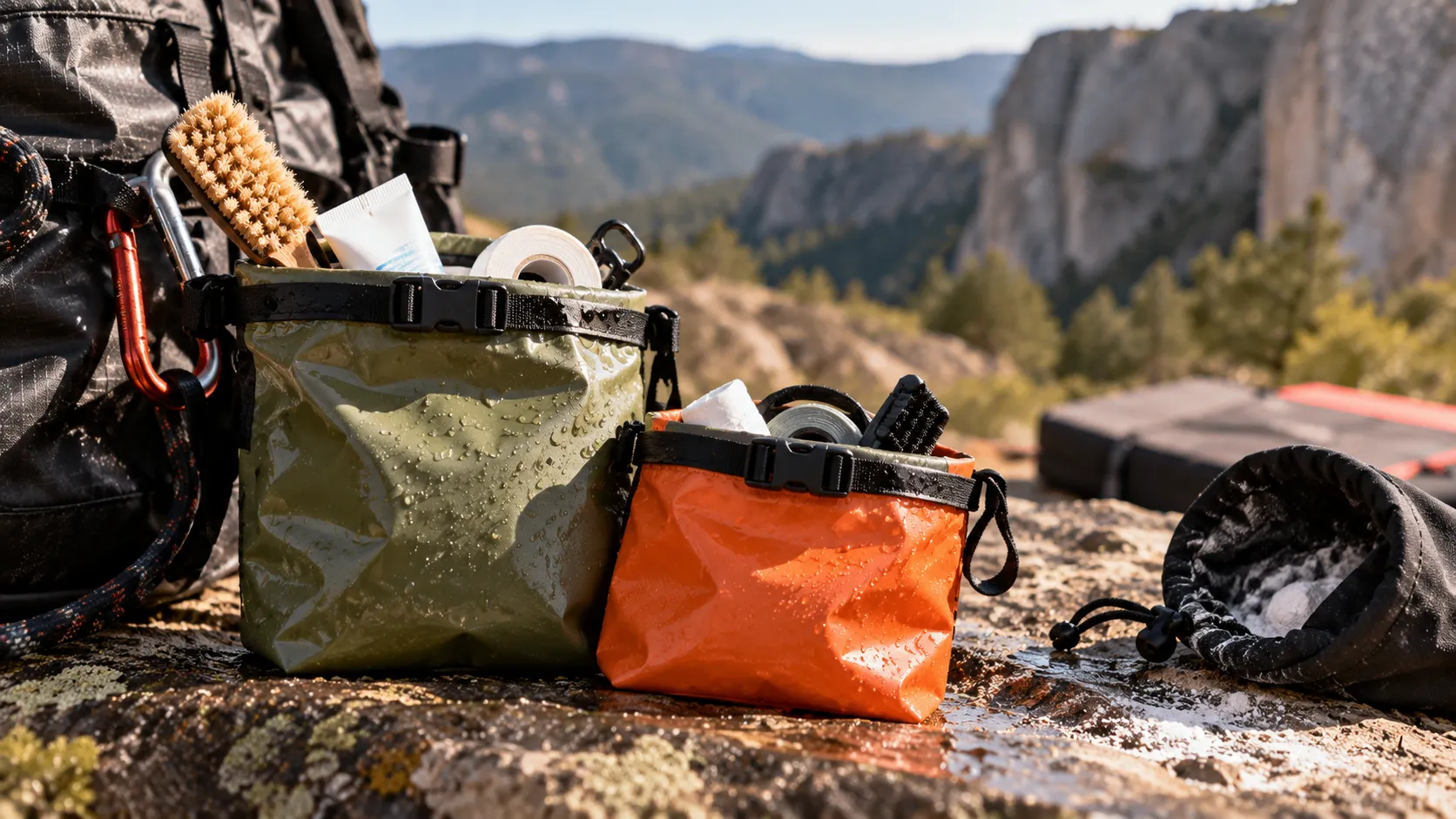
Waterproof pouches: the simple protection for your accessories
In France, the damage caused by water represents 44 % of disastrous housing and 30 % of the burden, according to France Assurances. In real outdoor life, a splash of water, a bag placed in wet sand, a leaking water bottle or a downpour are enough to ruin a phone, papers or a battery.
This guide helps you choose the right waterproof bag, understand the limitations of the indicators, and set up a simple testing routine. To complement your equipment organization, also find our useful climbing accessories at Snap Climbing, a French brand born in Chamonix in the 1990s.
The essentials in thirty seconds
A waterproof case protects mainly against rain, spray, wet sand and short immersion, but not against all scenarios.
Closing is the number one weak point: choose it based on your actions, not on a marketing promise.
Test before use (paper + brief immersion) and rinse with salt water or chlorine to prevent premature wear.
For batch purchases, first validate a sample, then lock the size, printing, and welding tolerances.
After these benchmarks, we move from “it looks waterproof” to controlled protection.

Waterproof pouches: protect what matters, at the right level
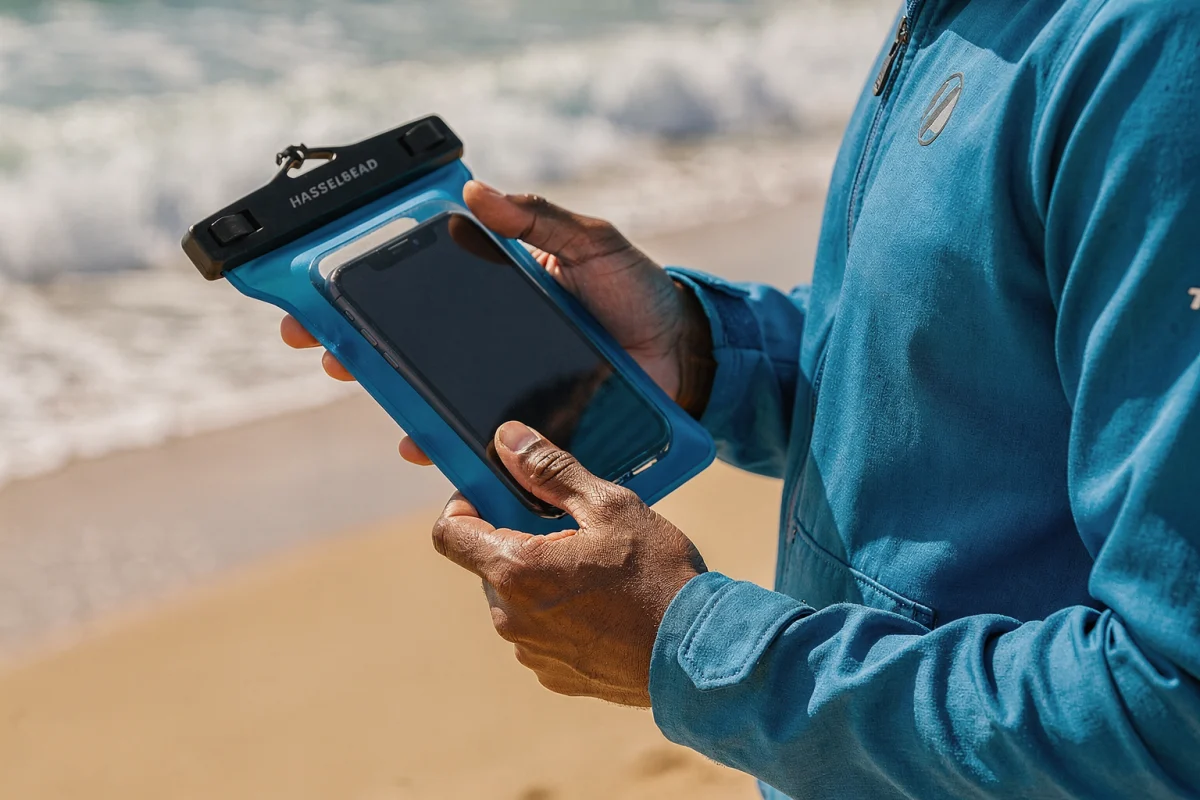
Protecting a smartphone at the beach, in the rain, and in short immersion
The typical scene: you take out your phone to take a photo, a wave catches you off guard, or the rain comes crashing down on the cliff. A waterproof case serves first to create a continuous barrier, even when your hands are wet. It especially prevents infiltration through ports, grates, and gaps.
On the field, the best practice is to limit manipulation. Prepare the screen before exposing the phone. Turn on airplane mode if you don’t need the network. Adjust the brightness and the screen lock. This reduces the openings, and therefore the errors.
Keep in mind that the sea is a trap. The salty water accelerates corrosion and leaves residues. The risk does not only come from the moment. It also comes from what remains after drying, especially around connectors and buttons, as explained in the work on the effects of water on electronics described by ScienceDirect (e-Prime).
For a rock climbing outing, think “barrier + discipline”. A waterproof bag does not replace your vigilance. It reduces exposure during a pitch or relay in the rain.
Secure papers, cards, bills and passports
Documents deteriorate quickly, even without immersion. Moisture is enough to smudge, erase some inks, or stick the sheets together. A waterproof pouch dedicated to paper also serves as a barrier against fine dust, which is very present in the cliff bags and on the beaches.
The most effective way is to separate the categories. One pocket for identity and payment methods. Another for printed itineraries. This separation avoids having to open the “critical” pocket ten times a day. It also allows for quick control at every change of location.
A detail that changes everything: add a textile tab or a colorful corner to identify the pouch at the bottom of the bag. The loss often comes from a bad placement, not a bad product.
Preserve keys, headphones, batteries and small tools
Not all small objects are equally afraid of water. Keys oxidize and block the mechanisms. Headphones suffer from condensation. Batteries and charging cases are sensitive to residual moisture, even without immersion.
The waterproof pouch here functions as a “sash.” It prevents direct contact with the bottom of the wet bag, a soaked jacket, or a can that has been punctured. It also serves as a stable storage compartment, which limits micro-shocks.
If you’re going on a mixed day, also slip in a mini “at-risk” accessory that doesn’t like water: a folding knife, a lighter, a set of matches, or a car key. The goal is simple: isolate what’s blocking you if it comes loose.
The real risks: salt water, sand, steam and shocks
“Wild” infiltrations rarely come from a spectacular immersion. They come from a grain of sand stuck in the closure, from a pouch folded in the wrong place, or from hot steam that then condenses.
The sand acts as an abrasive. It scratches the transparent films and creates micro-paths at the level of the compressed areas. The steam, on the other hand, creates fog inside. This fog can be mistaken for a leak. It can also trigger real problems on the contacts if it comes back frequently.
Finally, impact counts just as much as water. A pouch can remain “waterproof” while allowing your phone to take a direct impact. Look for a compromise between rigidity, thickness, and flexibility, especially if you climb with a compressed backpack.
Frequent limits: prolonged immersion, pressure and heat
A waterproof case is not a photo case. The more prolonged immersion, the greater the pressure exerted on the weak areas. The warmer the water, the more certain plastics soften and lose their firmness. And the more the closure is handled, the greater the likelihood of error.
A useful distinction: distinguish between “water protection” and “usage protection”. On some devices, manufacturers remind that damage caused by liquids is not covered by the warranty, even if the product is presented as water-resistant, as indicated. Apple Support.
The consequence is direct: if your outing involves a risk of repeated immersion, the pouch must be tested, controlled, and considered a consumable item.
Choose a case for a specific scenario (rain, mist, short immersion), not for “doing everything”.
Sand and steam cause just as much damage as visible water.
Closure is your priority of choice and control.
Do you want to apply this method? Create a simple test routine before each outing, then standardize it for your team.
Once the usage is clarified, the right purchase involves reading the indicators and understanding the concepts.
Sealing and design indices: read what is actually tested
Understanding IPX: conditions, duration, environment
When a package displays an IPX type index, it refers to a testing protocol, not to a universal promise. The key point is to read the exact condition: immersion or projection, fresh water or not, temperature, handling before testing.
Beware of a common trap: good performance in immersion does not automatically translate into good performance in the water, and vice versa. Tests are not always hierarchical. Industrial manufacturers remind this in their explanations about the test standard, as well as on the page’ABB which summarizes the IEC EN framework related to intrusion indices.
Field translation: If you kayak in rough seas and with strong gusts of wind, don’t just choose a product based on the word “immersion”. If you climb in the rain, choose a harness that you can quickly lock with cold hands.
Locking systems: zipper, double locking, rolled, loops
There are several major families. The zipper closure can be quick, but it depends heavily on the cleanliness of the lips. The double locking adds security, at the cost of a longer process. The rolled closure (type “mini sea bag”) tolerates dust better, but requires rigorous folding. The loops and clips are convenient, but they concentrate the effort on specific points.
Your main criterion is not “the technology”. It is the repeatability of the gesture. If you are unable to close the door properly three times in a row without looking, you will eventually have a leak.
A good in-store test consists of simulating the exit. Wet your fingers slightly. Close, open, close again. Look for a lock that feels “right,” not one that feels “obvious.”.
Thermal welds, seams and weak areas
On a package, sealing does not depend solely on the closure. It depends on the welding lines, the angles, and the areas where the film is folded. Regular thermal welds are often more uniform than seams, but they can become fragile if you always fold in the same place.
Angles are a critical area. They concentrate the stresses when you place a rigid object. If you force it, you create a permanent tension. In use, this can open a micro-crack.
Also look at the material transitions. For example, an area reinforced around a neckline can create a hard point, therefore a breaking point.
Tactile, photo, biometrics, calls: real compatibility
Touch sensitivity depends on the film and the pressure. With thick films, the screen responds less well. With flexible films, the screen responds better, but the pouch marks more quickly. Photographing with transparent film is possible, but the quality drops if the film is scratched, dirty, or wrinkled.
Biometrics and facial recognition are inconsistent depending on the models. Don’t buy it for that reason. Buy it to protect, then adapt your use: code, pattern, or unlocking before taking it off.
For calls, the sound is muted, but it is muffled. The simple solution is to use short messages and avoid long calls when the pouch is closed.
DIAGRAM: Water path and critical points
Flux: surface water → accumulation at the top fold → possible entry if the closure is not aligned properly → capillary migration along a grain of sand → micro-infiltration towards an angle → moisture trapped behind the object → corrosion and traces after drying.
An IPX index describes an experiment, not your entire day.
Closure is a choice: choose the one you succeed in without thinking.
Angles, repeated folds and material transitions are the critical points.
Now that you know where the leak is, you can choose a cover that is truly suited to your equipment and your practice.
Choosing an waterproof cover: the quick method that avoids mistakes
Measuring without making mistakes: margin, thickness, accessories
Poor sizing is the first cause of indirect leakage. Too small, you force the seams and you bend the closure. Too large, the object floats, rattles, and creates folds that interfere with the closure.
Measure your phone with its case, then add a functional margin. Also consider the accessories you always carry with you: card, ticket, key, cable. The goal is to close the case without tension, and to keep the screen relatively flat.
Avoid saying “it will pass”. If you are at the limit, take the size above, then organize the contents to avoid everything getting messy. Protection is also a matter of internal organization.
In this guide, you will only see the word "device" once, because in the field, you are primarily protecting a function: communicating, paying, navigating, and keeping track.
Sizes, formats, neck circumference, wristband: choose according to the gesture
The neckloop is ideal for keeping the phone accessible, but it increases the frequency of handling. If you open it ten times, you multiply the risks. The armband is suitable for walking, but it adds sweat and therefore internal condensation.
The “flat wallet” format is suitable for papers and cards. The “volumetric wallet” format is suitable for irregular objects, but it creates more folds. If your priority is the photo, look for a film that is stiffer and more transparent. If your priority is robustness, look for a thicker film and a protected closure area.
A good criterion is the opening move in a real situation. If you are on a ledge, you want to open quickly and close quickly. If you are in a bivouac, you can take more time, but you suffer more dust.
Materials: TPU, PVC, laminated, transparent
TPU is appreciated for its flexibility and resistance to abrasion. PVC is often more economical, but it can harden and mark over time, especially if left in the sun. Multilayer laminates seek a compromise, but they can create delaminations on repeated folds.
Your arbitration is based on three specific points: stable transparency (photo and reading), flexibility in the cold (gestures with numb fingers), and pliability when folded (no rapid cracking).
If you practice with strong sunlight exposure, choose a material that does not fade quickly. If you practice in salt water, choose a material that rinses off well and does not retain deposits.
Adapt the level of protection to the activity and the season
A dry canyoning outing does not have the same requirements as a canyon. A day of initiation in a classroom does not have the same requirements as a weekend camping trip in the rain. Your pack should be suitable for the worst possible situation, not the best possible situation.
In cold weather, plastics become rigid and gestures become less precise. In hot weather, the evaporation and sweat increase, especially with a brassard. At sea, the salt requires systematic rinsing. In the river, the shocks and friction increase.
If you were to remember only one rule: over-protect when access to a replacement is difficult. In an insulated wall, a phone outage is not an inconvenience. It is a logistical risk.
Quick list of criteria before buying
- A closure that you can lock properly without looking.
- Enough volume to avoid any stress on the welds.
- The film is quite flat enough to use the screen without forcing it.
- Reinforced coins if you are transporting rigid objects.
- Reliable attachment option if the object falling is likely.
| Scenario | Design priority | What makes the difference |
|---|---|---|
| Rain and rock | Simple closure, dust-resistant | “Touch-on” locking and easy rinsing |
| Beach and mists | Anti-sand protection, film that rinses well | Solid coins and surfaces that do not retain deposits |
| Pain and wristband | Condensation management, comfort | Less fog and film that retains the touch |
| Short immersion repeated | Double security at closing | Tight closing and testing before leaving |
The right size prevents wrinkles and tension, therefore leakage.
Choose according to the gesture (necklace, armband, pocket), not according to a promise.
Material and transparency are judged by use, especially after scratches and rinses.
When you equip a club, a hall or an event, buying in batches changes the criteria: you ensure consistency and repeatable quality.

Customization and bulk purchases: obtain regular quality without surprises
Marking: logo, text, printing areas
Personalization is useful if it serves identification purposes. For a club, it avoids unintentional exchanges and speeds up the return to the right owner. For a venue, it strengthens the consistency of the range, especially with the smaller accessories.
Choose an area for printing that does not interfere with screen reading. Avoid printing on an area that will be folded. The fold is a mechanical constraint. Ink on a fold often ends up marking.
Request a sample validation. You check the ink’s consistency, readability, and actual effect in a wet condition. This is also when you set the positioning tolerance.
Colours and assortments: consistency of the range, identifying the terrain
Color is not just a detail. It serves to quickly identify what is inside a bag. It also serves to assign a category. One color for paper. Another for electronics. Another for a minimal kit.
For collective use, avoid colors that are too close together. The goal is to avoid a visitor or partner taking the “wrong bag” at the time of departure, especially when everyone is packing quickly.
If you practice outdoor activities, a bright color also helps you find the object on the ground. This is especially useful in the evening or in areas with dark rocks.
Quantities, tiers, deadlines and resupply
In general, the main risk is variation between batches. A slightly tighter closure, a slightly thinner film, a slightly different seam. These are small differences, but they change the experience.
Anticipate the reorder by keeping a stable reference. Keep a “standard” copy of the validated series. You compare it with the next shipment. This ensures regularity.
If you have to manage an initiation session, plan for a margin of error. Pocket watches are especially vulnerable to beginner’s mistakes, not expert ones.
Price list: what varies the unit cost and the setup costs
Not to mention the numbers: consider the variables that influence the price: the thickness of the film, the type of closure, the presence of accessories (neck strap, wristband), the number of colors to be printed, and the level of control required.
The setup cost often comes from the printing settings and validations. It makes sense if you want to ensure the final result is secure. To optimize it, set up a simple and stable workflow. The fewer settings you change, the more controlled it is.
A useful e-commerce detail: when ordering online, make sure that your cookie and tracking preferences do not block the display of mockups or validations, especially on B2B platforms.
Pre-production controls: sample, tolerances, non-negotiable points
Before launching a series, test a sample as you would test a piece of equipment. Check the closure, welds, transparency after rubbing, and the strength of the attachments. A minor defect on one piece becomes a major problem on a batch.
Set your tolerances: print position, perceived color, proper welds, no bubbles, and closure consistency. Keep it simple. The shorter the list, the more it will be applied.
| Decisions to purchase in bulk | Risk if you ignore it | Simple control |
|---|---|---|
| Validation of a sample | Invaluable series on the field | Paper test + closing manipulation |
| Printing tolerances | Unreadable logo, screen obscured | Screen reading in humid conditions |
| Color choice by use | Confusion and losses | Simple color-based sorting rule |
| Reassort plan | Variations between series | Maintaining a “standard” piece” |
In lots, you buy regularity: sample first, series later.
Color serves the purpose of usage and sorting, not just style.
Set simple tolerances, and always check the closure.
A well-chosen purchase only holds true if you test it and maintain it. The difference lies in the repeated actions.
Field testing, maintenance and lifespan: the routine that prevents breakdowns
Simple protocol: paper test, inflation, short immersion
The paper test is the most cost-effective. Place a dry paper inside, close it, then briefly immerse it. Dry the outside before opening. If the paper has any damp marks, the pouch is not reliable for electronics.
The “inflating” test is used to detect a slow leak. You seal off a small amount of air, press gently, and then observe whether the air escapes through the closure or an angle. This does not replace water, but it detects serious defects.
Repeat this protocol after a shock, a fall, or a day of sandstorms. Wear and tear is often invisible to the naked eye.
Touch, photo, audio, fog and condensation verification
Test the touch with the gestures you actually use: unlocking, taking a photo, zooming. If you have to press hard, you’ll bend the film and wear out the pouch faster.
For the photo, clean the outside before each shot. A drop or a greasy film ruins the contrast. For the audio, don’t expect “normal” quality. Look for “understandable” quality.
Fog is managed in advance. Avoid locking a hot object in a cold bag. If you must do it, allow a minute of equilibration. Condensation is normal. Infiltration is not.
Maintenance: rinsing with fresh water, drying, storage
After using salt or chlorinated water, rinse with fresh water. The salt and chlorine leave residues that harden and damage the fold areas. Dry in the open air, away from a direct source of heat.
Store flat or with a wide fold. Avoid repeated tight folds. This is where micro-cracks form. Do not leave a pouch in the sun behind a window. Heat accelerates aging.
If you manage a collective park, establish a simple rule: systematic rinsing and drying after “water” outings. A well-treated bag lasts much longer than a “wet bag thrown in the bag”.
Aging: UV, salt, chlorine, abrasion and wrinkles
UV rays weaken films and make them more fragile. Salt attracts moisture and promotes deposits. Chlorine damages certain surfaces. Sand abrasion scratches and thinens the transparency. Repeated folds create lines of weakness.
Your most reliable indicator is the condition of the closure. If it becomes erratic, if it closes “once in two,” or if the lips appear marked, it’s time to downgrade the pouch to less critical use.
End of life: reparability, sorting, replacement
A waterproof case rarely repairs reliably. A patch sometimes holds, but it becomes a new snag. The good strategy is rotation: the newest cases for electronics, the oldest for objects tolerant of moisture.
Label the uses. You avoid a “tired” bag from returning to protect a sensitive object. For sorting, check with your municipality and the accepted flexible plastic recycling program. The most important thing is to limit the amount of waste at source through your testing.
Paper test before release, and re-test after shock or sand.
Rinsing with fresh water after the sea or pool, then complete drying.
Discard a pouch as soon as the closure becomes uncertain.
Once the routine is established, you can evaluate the results objectively and quickly decide what to keep and what to replace.
Validation of the results: decide quickly after the results are released
Success criteria: tightness, comfort, visibility
A “successful” pouch is not just waterproof. It must also be usable. If you can’t read the screen, if the pouch slips from your hands, or if it opens too hard, you’ll end up closing it poorly.
Evaluate three points after each wet run: seal condition, presence of internal traces, and film deformation. A film that bends strongly becomes more difficult to clean and use.
Visibility also counts for operational safety. If you need to quickly access a card, a flashlight, or a means of communication, you don’t want to have to fumble around. The right wallet grabs, identifies, and closes without hesitation.
Verification method: traces, humidity, cold control
After the exhibition, dry the outside. Open the door above a dry surface. Touch the inner walls with your finger. Look for a “liquid” moisture, not just a simple cool sensation.
Then, leave the pouch open for a few minutes and check again. If the humidity returns, it is often a sign of condensation. If it is localized near an angle, it is more suspicious.
For critical uses, keep a dry wipe in your bag. It serves as a marker. If the wipe comes out wet, you have a clear problem.
Tolerances: acceptable condensation versus infiltration
Condensation is a diffuse film. It appears on large areas, especially after a change in temperature. The infiltration is often localized, with a clear trace or a drop.
Do not confuse things. If you confuse things, you replace them too early, or you trust them for too long. The solution is the same: regular paper testing and observation of critical areas.
In park management, note the type of problem. You identify whether the series has a recurring defect, or whether it is a problem of use (wrong closing, sand, folding).
MATRIX: common problems → solutions
| Problem observed | The most likely cause | Immediate action | Prevention |
|---|---|---|---|
| Localized humidity near an angle | Internal tension, micro-crack, hard fold | Declassify it; no more electronics in it | Choose a larger size, avoid sharp edges and rigid objects. |
| Buée spreads after effort | Condensation due to sweat and heat | Ventilate, wipe, close the door at a near-temperature of | Avoid prolonged wristband use, limit temperature variations |
| Difficult closure, “clinging” | Sand, salt deposit, marked lips | Rinse, clean, re-test the paper | Rinsing after the sea, closing handled only with clean hands |
| Very scratched film, blurry photo | Repeated abrasions, sac rubbing | Book on paper or with keys | Use a photo-specific pouch, store flat |
Checklist before each use
- Check the cleanliness of the closing lips, free of any grain or deposit.
- Check the angles and marks on the folds, especially if the pouch has been compressed.
- Conduct a paper test if the outing involves the sea, river, or prolonged rain.
- Avoid overloading: the object must enter without forcing it.
- After use, rinse if necessary, dry completely, store without tightly folded.
You validate a design based on observable signs, not on an impression.
The condensation is diffuse; the infiltration is localized.
A pre-use checklist avoids the majority of failures.
Do you want to industrialize this control for a group? Standardize a paper test and a “critical use/secondary use” triage.
You have the method. The remaining task is to answer the practical questions that come up most frequently.
FAQ: waterproof covers and waterproof pouches
What is the difference between rain protection and full immersion?
Rain mainly imposes runoff and drops, therefore a reliable and tolerant closure to manipulation. Immersion imposes continuous pressure on the folds and angles, therefore a more secure design and a preliminary test. On the field, immersion also increases the likelihood of a shock and improper manipulation when opening.
How do I choose the size if my phone has a thick case?
Choose the size first, including the cover. Otherwise you create a permanent tension on the seams. Then add a margin to close the area without folding it. If you are between two sizes, take the larger one, then stabilize the contents with a flat card or sheet of paper. The goal is to avoid “bubbles” that distort the film.
Does the touch function with all screens?
No, not in the same way. Touch sensitivity depends on the flexibility of the film, pressure, and humidity. With stiffer films, you press harder and tire the case. Test your actual gestures before relying on them. If you often need to write, choose a case with a flatter, more transparent front.
Can we take clear photos underwater?
Yes, but not in all cases. Clarity decreases if the film is scratched, wrinkled, or dirty. It also decreases if a fine film of water remains between the film and the lens. To maximize quality, use a dedicated photo pouch, keep the outer surface clean, and avoid compressing the lens against the film. In salty water, rinse quickly after use.
What signs indicate an immediate replacement?
Replace if the closure becomes uncertain, if you observe localized moisture recurring, or if a seam shows a micro-opening. Also replace if the film becomes brittle, very marked at the fold, or if the corners turn very white. A “tired” pouch may still be fine for paper products, but it is no longer reliable for electronics.
How long can a waterproof bag last in intensive use?
It depends mainly on handling, sand, UV rays and salty water. In intensive use, consider it a consumable that must be monitored. The actual lifespan is judged by regular testing, not by a date. A pouch that has not been handled much can last a long time, whereas an open and constantly closed pouch deteriorates quickly, even if it “appears” intact.
Finally, here is an actionable summary, designed for your outings and purchases.
Summary: Choose quickly, avoid infiltrations, and last longer
Summary of key criteria
You are looking for a waterproof case for a scenario, not for a slogan. The closure must be controlled without effort. The size must avoid any tension. The film must remain legible and usable, even when wet. The welds and corners must inspire confidence, especially if you are transporting rigid objects.
Golden rules against infiltrations
Always close on a clean surface, without sand. Limit openings. Test paper before a risky outing. Rinse after sea or pool. Dry completely before storage. Discard as soon as the closure becomes erratic.
Quick selection based on activity and risk
Rain and climbing: simple, tolerant closure, quick access. Beach: anti-sand and easy rinsing. Effort with harness: fog management and comfort. Short immersion repeated: double safety and regular testing. If your goal is to ensure logistical safety, overprotect when replacement is far away.
Routine testing and maintenance to last
Adopt a “before/after” routine. Before: visual inspection, closing, paper test if necessary. After: rinsing, drying, storage without a tight fold. These are the gestures that make the difference, far more than marketing.
Priorities for buying in bulk: color, customization, budget
In batch production, the priority is regularity: sample, tolerances, closing control. Use color to sort the uses. Customize to identify, not to decorate. And keep a “standard” series to secure the reorder.
A waterproof pouch is a small object, but it protects against major consequences. Choose it according to your scenario, test it before handing it over your electronics, and maintain it like a technical accessory. In the Snap Climbing universe, we love simple, durable, and effective equipment: a good pouch follows the same logic. It prevents a breakdown, stress, and sometimes a real logistical problem when you leave.
For your information, here is a frequently forgotten mini-kit that you can isolate in the dry: emergency kit, survival box, survival cover, survival food, fishing kit, insect repellent, whistle signaling, solar energy, self-treatment, sleeping bag, sleeping mat, camping gear, essential equipment, and a little bit of method. A simple pouch makes these items truly available.
One final word about the history of your accessories: the more you standardize your gestures, the longer your items will last, and the less you will throw away. That’s also modern and responsible practice.
 Français
 English (UK)


