

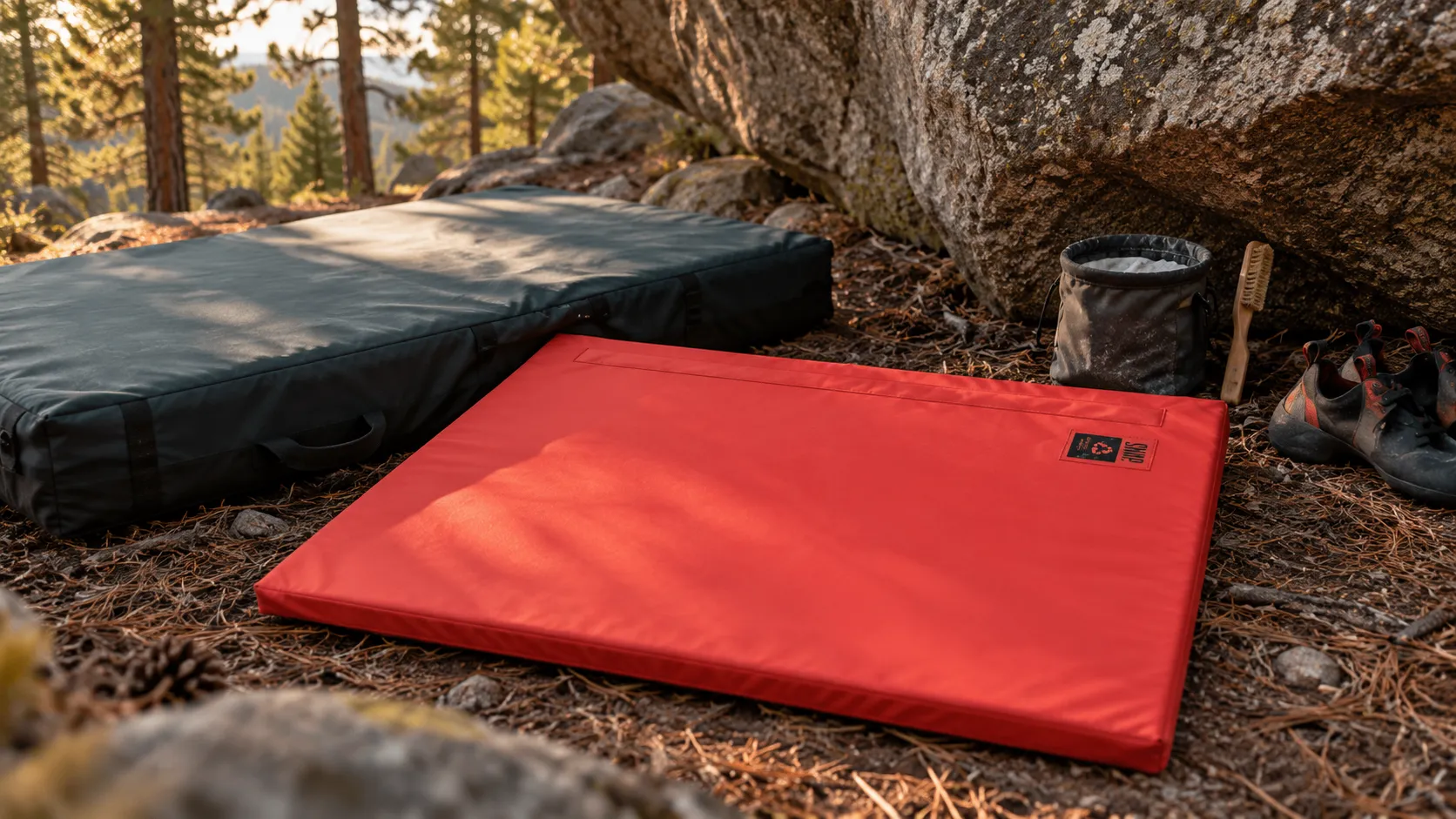
Premium crash pads: are they really worth their price?
A premium crash pad is not a «comfort» feature: it is often what allows you to attempt an engaged movement with clarity. The FFME had 120,717 licensed members as of June 1, 2026, a volume that illustrates how deeply the practice of bloc has established itself in France. The more practitioners there are, the more profiles, terrains, and different types of falls are seen.
In this article, you will understand what really makes the difference between a high-end carpet and a good «normal» model, how to evaluate its value (not just its price), and what points to check before buying. To compare the available sizes and find your way around the ranges, start by browsing The selection of crash pads.
The essentials in a minute
A premium crash pad is judged first of all by its continuous support to the ground, then by its quality of absorption over time.
The «good price» depends mainly on your frequency of outings, the terrain, and your tolerance to carrying a load.
Large formats are reassuring, but they require logistics (transport, wind, storage) that many underestimate.
To buy the right one, test the hinges, zipper, carry handle and rigidity; as if you were going to walk long distances with it.
Before comparing specific models, set your method: a crash pad is chosen as a receiving area, not as a technical specification.
Choosing a premium crash pad without making a mistake
Usable size: What matters is your true reception area
The advertised size is not enough. What interests you is the actual usable area once the pad is placed, stabilized, and combined with your terrain. A very wide pad can lose value if its edges rise, if the ground is bumpy, or if you have to «level» it to the point of reducing the usable area. Related topic to explore: How to choose the best crash pad.
Think in concrete scenarios. On a takeoff with a side exit, your receiving area is not centered. On a landing, your receiving can shift unpredictably. And on a high block, the main issue is not «big» or «small»; it’s «am I sure I’ll land on a flat, continuous area without a hole?» See also: discover the Guts Air Technology crash pad.
A very actionable criterion: visualize your worst possible reception, not your best fall. Then, place the crash pad as you would on the rock, then walk on it. If you feel a shift, a break, or instability, the size will not compensate for the imperfect support. Related topic to explore: the characteristics of the Bounce crash pad.
Thickness, densities, multi-foam: the cushioning must remain legible
The high-end product is not «more flexible». It must absorb impact without causing you to bounce or crash to the ground. In practice, a good premium crash pad combines layers with different behaviors: a layer that stabilizes the impact (avoiding the «heel-through effect») and a layer that dissipates the energy (avoiding the trampoline effect). Related topic to explore: Explore the Grand Stamina crash pad.
Your ground test is simple: let yourself fall down standing up, then on a controlled leg, then on a very light knee (without injuring yourself). You are looking for a gradual deceleration. If the impact is dry, the upper layer is too firm or too thin. If you rebound, the entire system sends back too much energy. If you feel the ground, the cushioning reserve is insufficient for your use. This topic is detailed in the benefits of the Grand Guts Air Technology.
The premium is also noticeable after several seasons. A foam that shrinks becomes treacherous: it remains «comfortable» when walking, but it loses its ability to absorb impact concentrated on one spot. This is often where the price difference becomes meaningful. You can also find our complete analysis: Discover the Air Shock 1 crash pad.
Locking mechanism, hinges, anti-folding: the continuity of support is a safety criterion
The classic weakness of a crash pad is the discontinuity: a fold in the middle, a hinge that is too pronounced, or a junction that creates a «V». On uneven terrain, this defect becomes a ramp that causes you to slide towards the hole. On a slightly long shot, it can also create an angle that returns the ball to the ground. See also: Explore the Air Shock 1 model with pump.
A premium crash pad must manage this problem through its design (type of fold, foam consistency, geometry) and its way of locking onto the ground. Look for «immediate» stability: you put it down, you mount on it, and the pad doesn’t try to find its place. If you have to reposition it constantly, that’s not only annoying; it’s a sign. Recommended supplementary reading: the crashpad Grand Wham Air Technology.
Finally, inspect the sensitive areas. A poorly placed or exposed zip can become a hard spot. A strap that goes under the receiving area can create a bulge. And a hinge that is too flexible ends up bending where you don’t want it to. Go deeper with the Stamina crash pad for better safety.
Carry-on: straps, belt and comfort over long distances
The premium often pays off in terms of carrying comfort… but it can also prevent you from having to «suffer» the approach. A good carrying system distributes the weight, keeps the pad close to your back and limits the balling. The ideal: shoulder straps that don’t collapse, a useful (not decorative) waist belt, and adjustments that stay in place without loosening. You can also find our full review: Big Phatty, a high-end foldable crash pad.
Test the carry-on as in real conditions. Load it with your bag, your slippers, your water, and walk for a few minutes. If the pad pulls back, your lower back will pay the price. If the shoulder straps slip, you’ll spend your time adjusting them. And if the straps are difficult to handle, you’ll end up having trouble closing them, and therefore carrying them poorly. Recommended supplementary reading: Discover the high-end crash pad.
A detail that counts: cleanliness. Some systems are designed to avoid dragging on the ground. This is a real advantage on wet or sandy terrain, because dirty straps wear out faster and become uncomfortable. Our dedicated article covers this issue: Discover the Hip crash pad.
Weight, size, modularity: think of a «pad system», not an isolated pad
A premium crash pad must fit into a multi-pad logic. You rarely go out alone all year, and you rarely climb on perfectly flat ground. Your question is therefore not just «which pad to buy?», but «how does my pad add up with a second, a small addition, or the pad of a partner?» You can also find our complete analysis: Discover the Grand Guts crash pad.
Modularity is judged on three points: ease of stacking (without creating a gap), lateral stability (it doesn't slip), and portability (the ability to attach a second pad without any tinkering). A very large format can be excellent… provided you have the logistics to move it and place it precisely. More details in our guide on Discover the giant additional pad.
If you’re torn between a large single pad and two complementary ones, keep a simple rule in mind: two well-placed «medium» pads cover more complex terrain better than a single oversized pad that isn’t properly positioned. The premium here is your ability to build a clean, repeatable, and quick receiving zone to set up. See also: How to choose your magnesium bag.
Prioritize continuity of support and stability on the ground before size matters on paper.
Test the damping by looking for a gradual deceleration, without rebound, and especially without any hard spots.
Buy a system: portability, modularity and compatibility with a second pad are just as important as the foam.
Once the criteria are set, the question becomes simple: the premium is more expensive, but how much does a crash pad really cost over the year? You can also find our complete analysis: Discover the different types of holds.
Price of a premium crash pad: is it a real value or a luxury?
Price benchmarks: understanding the differences rather than chasing a number
Price differences rarely stem from a single factor. Foam (quality, assembly, and performance over time) is a significant factor, but so is the fabric: resistance to abrasion, coating, and the strength of the seams; the quality of the reinforcements. Add in the carrying system (straps, belt, and buckles) and the finish (handle, zipper, and protection of sensitive areas). Recommended supplementary reading: Discover our magnésium powder.

To give you a concrete benchmark in the high-end segment, a list of recommended public prices indicates, among others, the Incubator FTS at €489.95, the Dominator FTS at €349.95, the Moonwalk FTS at €299.95, and the Top Mat at €149.95. You can also find our complete analysis: Magnets bag adapted for climbing.
This guide doesn't tell you which model you should buy. It helps you to place your budget in a clear hierarchy: small supplement, standard pad, large format, very large format. Then, your terrain and frequency will do the rest. This topic is detailed in Discover our selection of crash pads.
Cost per output: the calculation that avoids regrets
Good reasoning isn’t about «cheap or expensive»; it’s about «how much each outing costs me, once resale and wear and tear are factored in.» If you go out often, a more durable pad may come in cheaper in the long run. If you go out less often, a premium model may be oversized… unless your practice is intense. You can also find our full analysis here: The essential equipment for climbing.
Use a simple formula that you can write down on your phone before buying: To learn more about this topic, see our article on The ideal knee pad for climbing.
- Cost per output = (purchase price + accessories) − (estimated resale price), all divided by your number of outputs.
- Add a «safety bonus» if you climb high, on slippery ground, or if you are often alone.
Two common mistakes distort the calculation. First, forgetting about resale: a well-maintained, well-known model sells better. Second, underestimating wear and tear: a stock crash pad that is wet, folded tightly, and transported dirty quickly loses value. For further analysis, read transport bag for your equipment.
What you really pay: a logical distribution of the budget
Flux: foam (impact behavior and durability over time) → fabric and lining (abrasion, moisture) → wearability (comfort, stability) → finish (handles, zipper, reinforcements) → distribution and warranty.
This diagram helps you ask a key question in-store: «where did the budget go?». If the fabric is fine and the basic fit is good, but the price is high, you may be paying mostly for a size or a brand. On the other hand, a model that seems «simple» can be excellent if the foam, the cover, and the stitching are up to par.
Usable value: safety, comfort, durability, resale value
A premium crash pad is worth its price when it transforms your session. In practice: you place yourself more quickly, hesitate less, fall better, and finish the day less fatigued. This energy savings is a real performance factor, because lucidity decreases when you are flushed.
Longevity is the other lever. A foam that retains its progressivity, a cover that doesn’t open at the corners, and straps that hold tightly – this avoids the «buying too early» cycle. Finally, resale is often better on recognized models, especially if you document the condition (photos of the foam, zip, seams, bottom).
Reasoning in terms of cost per output protects you from «emotional» purchases.
The price is mainly due to the foam, the cover, the stitching and the carrying handle, not just the surface area.
Re-selling is part of the calculation: buy as if you were going to sell it properly.
A useful little trigger: note your usual terrain and approach distance, then choose a format that gives you a stable area in less than a minute.
Now that you know what to look for and how to reason, let’s move on to a typical case: the large reception area designed for high-rise blocks.
Mammut King Size: large reception area, heavier approach
Advantages: reassuring surface and structured cushioning
The King Size is a consistent choice if your priority is to secure movements involving a large receiving area. This type of pad provides real peace of mind at the end of a session, when accuracy declines. It is also very useful in a group setting: the more people there are, the more the pad is moved, which makes a large stable area profitable.
Its main interest is psychological as well as mechanical. You are more likely to commit yourself because the «likely» area of reception remains covered. And when reception does drift a little, the margin of safety still exists.
Finally, this format simplifies the multi-pad strategy: you create a wide base, then you supplement with a small pad to seal a hole, cover a stone, or protect a slope. This is often more effective than the opposite approach.
Disadvantages: weight, volume, logistics of transport
The drawback is classic: bigger means more bulky. In a car, this is not neutral. On foot, it’s even truer: a large pad exposes you to wind, bumps, and the fatigue of carrying it, especially if you add a backpack.
The practical consequence is that you might end up «less out and about» with this pad on long approaches. And an excellent pad that stays in the trunk doesn’t protect anyone. So the real question is: are you prepared to carry it often, not just on the day you’re motivated?
Another point: placement. A large format may be more difficult to fit in narrow areas, between blocks, roots, or slopes. Sometimes, a slightly more compact format works better and provides more security.
Price and target: for high blocks and long sessions
On the Mammut website, the King Size Crash Pad is listed at €300, with a thickness of 12 cm, a receiving area of 130 x 110 cm and a weight of 8100 g.
This positioning makes sense if you are often on blocs where the quality of reception conditions your commitment. It also makes sense if you often go out with other climbers, because the carrying constraint is shared and the surface is fully exploited.
Conversely, if you mainly work on short outings, scattered spots, or areas where the pad has to be moved constantly between trees and chaos, you may prefer a more manageable format.
Things to check before buying: hinges, cover and the rigidity of the carry handle
Check the continuity at the center and the tightness of the edges. Walk diagonally, jump slightly, and look for the area that «folds». Also inspect the cover at the corners: these are the first points of wear, especially if the terrain is granite, abrasive, or wet.
When it comes to carrying, test the rigidity: a large pad must remain stable on your back. If the carrying system allows the pad to sag or twist, you will lose comfort and efficiency. Finally, look at the logic of the straps: can you attach a small pad over it without creating an unstable package?
If you are interested in large format but are looking for a solution designed to remain stable on uneven terrain, the following case is instructive.
Ocun Incubator FTS: cover wide, stay stable on difficult terrain
Advantages: coverage and stable reception when the ground is not perfect
The FTS Incubator is typically sought after by climbers who want to maximize coverage without having to add pads. Its appeal is evident on «dirty» terrain: roots, rocks, micro-angles, and areas where you need to set up quickly. In these conditions, stability counts just as much as cushioning.
Another advantage: you can create a real «receiving area» to work on a passage over a long period of time. As you repeat, fatigue increases and placements become less precise. A wide and stable area limits the pad's drift and reduces mental stress.
Finally, this kind of format makes the strategy in duo easier: a large pad serves as the base, and the second one is used to correct the holes. You spend less time moving the entire set.
Disadvantages: bulky, prone to wind noise, difficult to store
A large surface remains a large surface: in transportation, storage, and when moving it to the venue. In some sectors, you will have to cross narrow passages. A bulky pad can become a constraint, especially if you also bring something to drink, eat, and cover yourself with.
Wind resistance is often underestimated. As soon as the trail is exposed, a wide pad can throw you off balance. The result: you arrive more tired, and therefore less precise in your throws. This is an indirect but real cost.
Finally, storage at home matters. A pad that is poorly stored, tucked away in a corner, will shrink more quickly. High-end pads also boast simple hygiene: dry, ventilated, and without prolonged compression.
Price and target: committed efforts, uneven terrain, long repetition
This model is aimed at climbers who want a real working area, not just a «just in case» mat. It is consistent if you do multiple attempts in an area where reception varies, or if you often climb on uneven terrain.
However, if you’re looking for a first-rate all-purpose pad, you might end up paying for a feature that you won’t always use. In that case, a more versatile duo might be smarter: a sturdy standard pad plus a lightweight add-on.
Things to check: seams, loops, resistance to rubbing
On large formats, inspect the traction areas in particular: handles, loops, attachments, seams that take on the load when you drag the pad. These points absorb much greater forces than on a small format.
Also check the bottom’s resistance. This is the area that rubs, absorbs moisture, and can crack if the coating is weak. Finally, check the ease of installation: if the pad takes a long time to open, lock, or stabilize, you will lose the «premium» advantage on the field.
After the large sizes, let’s return to the other extreme: the crash pad that fades into the background as you approach, but which requires greater precision when receiving the ball.
Snap Hip: mobility, simplicity, and accepted compromises
Advantages: lightweight, quick to install, ideal when you move around a lot
Hip corresponds to a very clear logic: you want to climb mobile, without turning the approach into a carrying session. On a circuit where you change your blocks frequently, speed counts. You set up, you try, you fold, you get back on. In this context, a simple and lightweight model can be more effective than a large pad, because you really use it.
This type of crash pad also requires you to position yourself better. It’s not a flaw; it’s a discipline: identifying the trajectory of the fall, cleaning up the area, and learning to orient the landing. With the right method, a compact pad can be sufficient in many situations.
Finally, a small pad is an excellent addition to a premium strategy. Even if you already have a large format pad, a Hip is used to fill a hole, protect a step, or cover a hard angle.
Disadvantages: reduced surface area, narrower margin, more limited cushioning
The tradeoff is obvious: less surface area, therefore less tolerance to late arrivals. On dynamic movements, or on a ground that traps, you will have to be more demanding regarding placement. This also requires an attentive spotter when possible.
On high blocks, a small size quickly becomes insufficient on its own. Not because it «absorbs poorly» by nature, but because the probability of receiving outside the zone increases. From a certain distance, size becomes a factor of safety, not just comfort.
Another limitation: the management of the hard areas around. A small pad placed on a rough terrain leaves more space for rocks, roots, and steps. Again, this is not a prohibitive requirement, but it requires a more strict placement method.
Price and target: long approach, mobile climb, solo practice
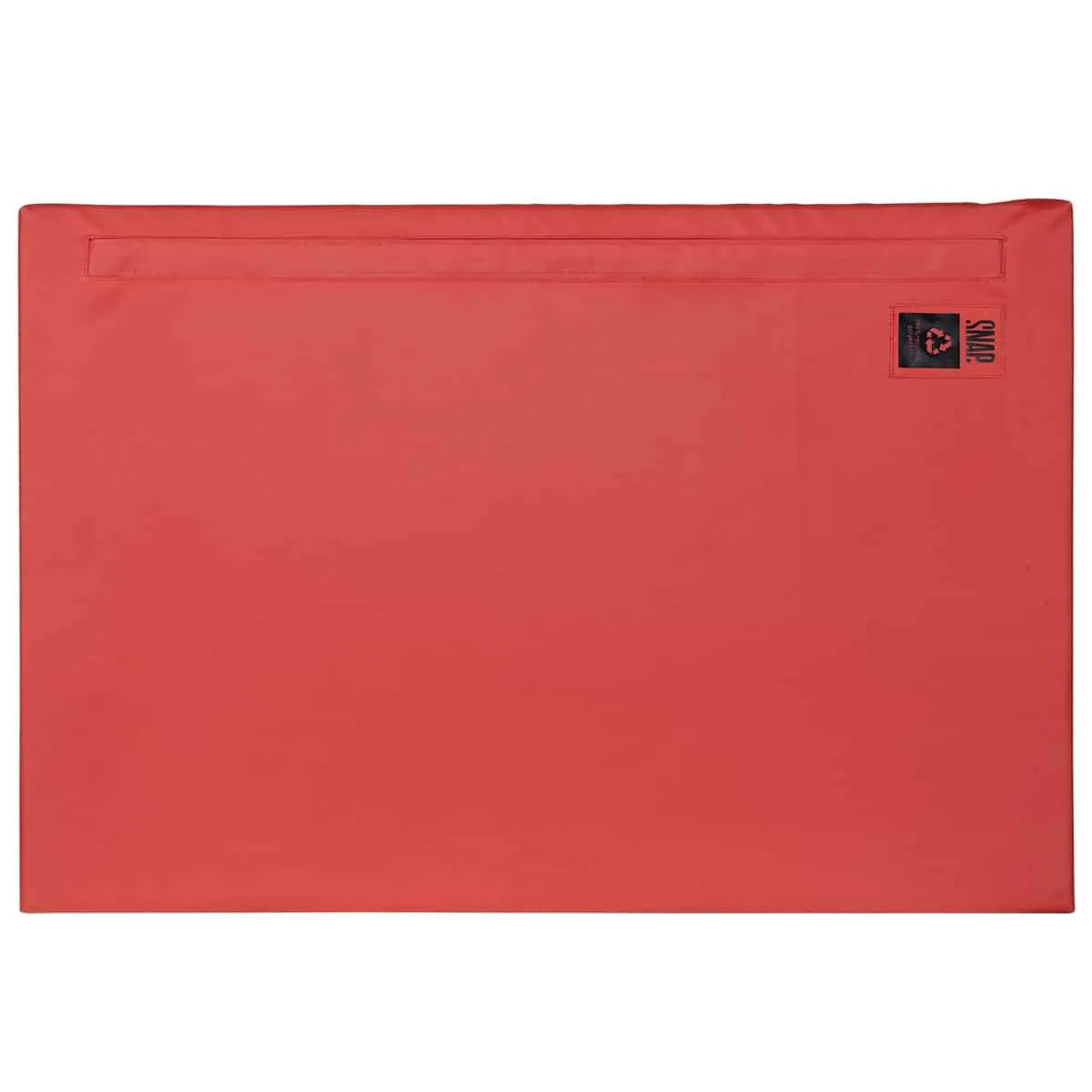
The Snap Climbing Hip is priced at €179.00 including VAT, with an open format of 120 x 100 x 10 cm, a folded format of 100 x 60 x 22 cm and a weight of 4 kg.
The ideal profile: you walk a lot, you move a lot, and you agree to supplement with a second pad when the terrain gets complicated. It’s also a worthwhile purchase if you want a first pad without being «trapped» in a too heavy format, then later build a more complete duo.
Things to check: straps, reinforcements, folding and closure
On this format, first check the quality of the cover and the corner reinforcements. A small pad is often dragged along, placed, and moved. It suffers repeated abrasion. Then check the shoulder straps: they must remain comfortable despite the load (shoes, water, jacket).
Finally, test the folding and the hold of the loops. If the closure is painful, you will hurt yourself. And if you hurt yourself, the carrying becomes unstable. The premium version, even in a small format, is easy and repeatable to use.
A premium, durable crash pad is a crash pad that you maintain like protective equipment, not like a mat that you forget in a trunk.
Durability: maintenance, repair and resale
Wear of the foam: compaction, rebound, «dead» areas»
The foam ages even though the cover appears impeccable. The most important signal is not comfort when walking, but consistency in impact absorption. A tired foam can become paradoxical: pleasant underfoot, but dry on a concentrated impact. Conversely, a foam that rebounds too much can increase the risk of going out of control.

Watch out for typical impact zones: the center, the edge of the attack (where you often jump), and areas near the creases. If you feel a distinct difference between two zones, you have localized wear. In this case, the solution may be to rotate the pad regularly on the spot, or to change your placement method.
If you are buying used, ask for a photo of the flat foam, then a photo of the «loaded» pad (someone standing). Foam that collapses too quickly or in an asymmetrical manner should alert you.
Cover and seams: abrasion, moisture, UV rays, tears
The cover protects the foam, but it also protects your grip. A weakened bottom allows moisture and dirt to enter, which accelerates aging. The seams, on the other hand, absorb the tension: carrying weight, pulling, quick squeezes with the handles.
Inspect the corner areas and the anchor points of the straps. This is often where the first threads loosen. Also look at the areas of friction on the ground: if the coating disappears, the cover absorbs moisture and becomes fragile.
Finally, think UV. A crash pad left in the sun for a long time loses its fabric strength. Storing it in a sheltered place increases its lifespan, and therefore its resale value.
Simple maintenance: drying, storage, cleaning, transportation
Rule number one: dry. After a wet outing, open the bag and let it air out. The ideal storage position is flat and open, to avoid prolonged compression of the folding areas. If you don’t have the space, alternate the storage positions so that you don’t always pack everything in the same place.
For cleaning, be gentle. Use a soft brush to remove sand and dirt, a damp cloth for very dirty areas, and allow it to dry completely. Avoid aggressive products that damage the finishes or harden the fabric.
When transporting, protect the bottom. Always place the «floor» side against hard objects, or rub it against steps to prevent wear and tear. A simple habit: wear rather than drag when possible.
Repair instead of replacing: patches, straps, zips, reinforcements
Many damages are repairable at reasonable cost. A small tear is treated early, before it opens. A worn strap is replaced. An angle reinforcement can be sewn back on. The right time to act is when the defect is minor, not when it becomes structural.
Repair is not only economical; it also protects resale value. A buyer prefers a clean and documented repair, rather than a «perfect» pad that hides a flaw. Keep photos and a simple history: date, nature of the repair, area affected.
| Observed symptom | Probable cause | Recommended action |
|---|---|---|
| Heavy impact in the center, sensation of «board» | Localized foam deposit | Spin the pad, complete with a small pad, consider resale before escalation |
| Significant rebound, instability at the receiving end | Upper layer too firm or aging | Testing in conditions, limiting high falls, prioritizing a more dissipating supplement |
| Edges that rise, support that «rolls» | Deformation, compressed storage | Store flat, rest for a long time before leaving, check the continuity of support on the ground |
| Quick wear of the underpart, fabric thinning | Repeated abrasion, worn coating | Preventive patch: limit the drag, clean the sand after exiting |
| Stitches that blanch, threads that come out | Strong traction on handles and straps | Resume sewing, local reinforcement, avoid firing at a single loaded handle |
The foam can be «dead» before the cover shows it: test the impact, not just the comfort.
Drying and storing flatly extends the shelf life more than any «treatment».
Early repair protects safety and resale.
After sustainability, it remains to be decided according to your actual profile: frequency, terrain, style, and logistics.
Summary table: choose according to your profile
Useful comparison: what you feel on the ground
| Criterion | Mammut King Size | Ocun Incubator FTS | Snap Hip |
|---|---|---|---|
| Cover | Very reassuring | Very spacious, designed as a reception area« | Targeted, to be completed if necessary |
| Stability on uneven terrain | Good if so well fitted | Very interesting when the soil traps moisture | It depends a lot on the placement |
| Portability and mobility | Lighter logistics | Heavy to manage | Very mobile |
| Multi-pad logic | Large base + accessories | Very wide base + corrections | Ideal supplement or first pad |
| Best context | High blocks, long sessions, group | Unstable terrain, repeated attempts | Long approaches, mobile circuit, solo |
Profile matrix: which pad for which use
| Your profile | Recommended choice | Why | Warning point |
|---|---|---|---|
| You often climb high and you get involved | Premium large format base, plus an additional supplement | The receiving margin increases security and confidence | Transport and placement on a narrow terrain |
| You move a lot on various blocks | Mobile pad + additional end piece for the holes | You really use your pad, without having to take the approach | More demanding placement, need for method |
| You go out as a group regularly | One large «base» pad + one or two medium pads | Quick coverage, stable area, time saving | Coordination of placement and management of junctions |
| You mostly climb on uneven terrain | Large stable format + additional support for alignment | Reduces twisting and out-of-zone movements | Obstructive and wind-driven |
Common purchase errors and store check
The number one mistake is overestimating the size and underestimating the terrain. A huge crash pad that is poorly fitted is less safe than a good placement with two pads. Second mistake: buying a «comfortable» pad while walking, but inconsistent in impact. Third mistake: neglecting the carry, then avoiding taking it off.
Simple checklist to be completed in store or at reception:
- Place it on the ground and walk diagonally: look for folds, slumps, holes.
- Open and close: is it quick, logical, without any obvious weak points?
- Test the loaded carry: shoulder straps, waist belt, stability, swinging.
- Inspect the corners, the underside, the stitching of the handles and the anchor points.
- Simulate a duo: can you assemble it with a second pad without having to tinker?
For readers who like optimizing their searches and comparing opinions, here are some phrases you will often see in search engines: test shoes, shoe comparison tool, search for a comparison tool, search for a shoe comparison tool, guide for climbing, guide for shoes, brands of shoes, ranges of shoes, testing equipment, matos testing, results, search for results, climbing results, brands of climbing equipment, brands of climbing equipment, country sites, departments sites, blocks sites, cliffs sites, list of sites, as well as associated categories such as harnesses and ferrata.
If you are still hesitating, write down your riskiest scenario (delayed reception, sloping ground, fatigue) and choose the pad that makes this scenario acceptable.
You have the method and the guidelines; the remaining task is to answer the questions that arise before purchase.
FAQ: high-end reception carpet
Premium or standard: does the difference in damping really feel noticeable?
Yes, especially in terms of consistency. A premium model is distinguished by a more gradual deceleration and better performance over time. At the moment, a standard model may seem adequate. After months of crashes, a high-end model often maintains a readable behavior, with fewer hard spots and less instability in the center.
One large crash pad or two additional ones: which to choose?
Two additional pieces often work well on uneven terrain because you «build» a clean area. A large pad is great for quick set-up and long work sessions, especially in a group. If you climb alone and on the move, a manageable pad complete with a small corrective is often more realistic, and therefore more used.
What maximum weight can I accept in approach?
The right threshold is the one that does not impair your clarity upon arrival. If you arrive exhausted, tense, or irritated by the carrying, you climb less cleanly and place the pads less well. Test it at home, loaded, on a fake «trail»: if it moves, pull back or compress your shoulders; change the format or system.
How to stack pads without creating a hole in the middle?
Start by stabilizing the base pad on the ground, then place the second one to cover the junction, not to «randomly enlarge it.» Avoid aligning fold after fold. Cross the orientations and use a small supplement for the micro-holes. Then, walk on it: if you feel a weak line, reposition it before climbing.
When should I replace the foam or change the crash pad?
Change when the impact becomes dry, when you feel a distinct difference between zones, or when stability deteriorates to the point of creating apprehension. A worn cover often repairs itself, but a «dead» foam changes safety. If your pad makes you hesitate when you step forward, you already have your answer.
Last step: decide without telling you a story, based on your actual commitment and frequency.
Verdict: Which premium crash pad is right for you?
Choose the high-end model if you climb regularly and intensively.
Premium is worth its price when it brings you repeatable safety: ground stability, consistent cushioning, acceptable carry, and durability. If your practice involves high blocks, late receptions, or tricky terrains, you’re paying mostly to reduce uncertainty. That’s where the premium becomes rational.
Stick with a good mid-range model if your usage is occasional.
If you rarely go out and ride on simple terrains, you can prioritize a solid, well-designed model without aiming for the very high end. In this case, the best optimization is often a recent purchase: you save on price without sacrificing safety, provided you control the foam, underlay, and seams.
The most robust strategy: a complementary duo
For many climbers, the best investment is not the «largest pad», but a duo: a stable base and a mobile supplement. You cover more holes, you adapt to more spots, and you can share the carrying load as a group. It’s also a resale strategy: you can adjust your equipment without having to replace everything.
Smart purchase: think strict control and resale from the outset
Before buying, imagine the resale. A clean pad, stored dry, with an intact cover and a functional carrying handle retains value. Take photos at the time of purchase, keep the proof, and maintain the sensitive areas. You buy better because you buy «finished»: use, maintenance, and then resale.
A premium crash pad is worth its price when it improves your safety and consistency, not when it overloads your equipment. Start with your terrain and your way of falling, then choose a format that sets you up quickly and stays stable. If you climb frequently, invest in continuous support and durability. If you climb less often, opt for a modular solution, or even a recently controlled occasion, and build your duo gradually.
 Français
 English (UK)


