

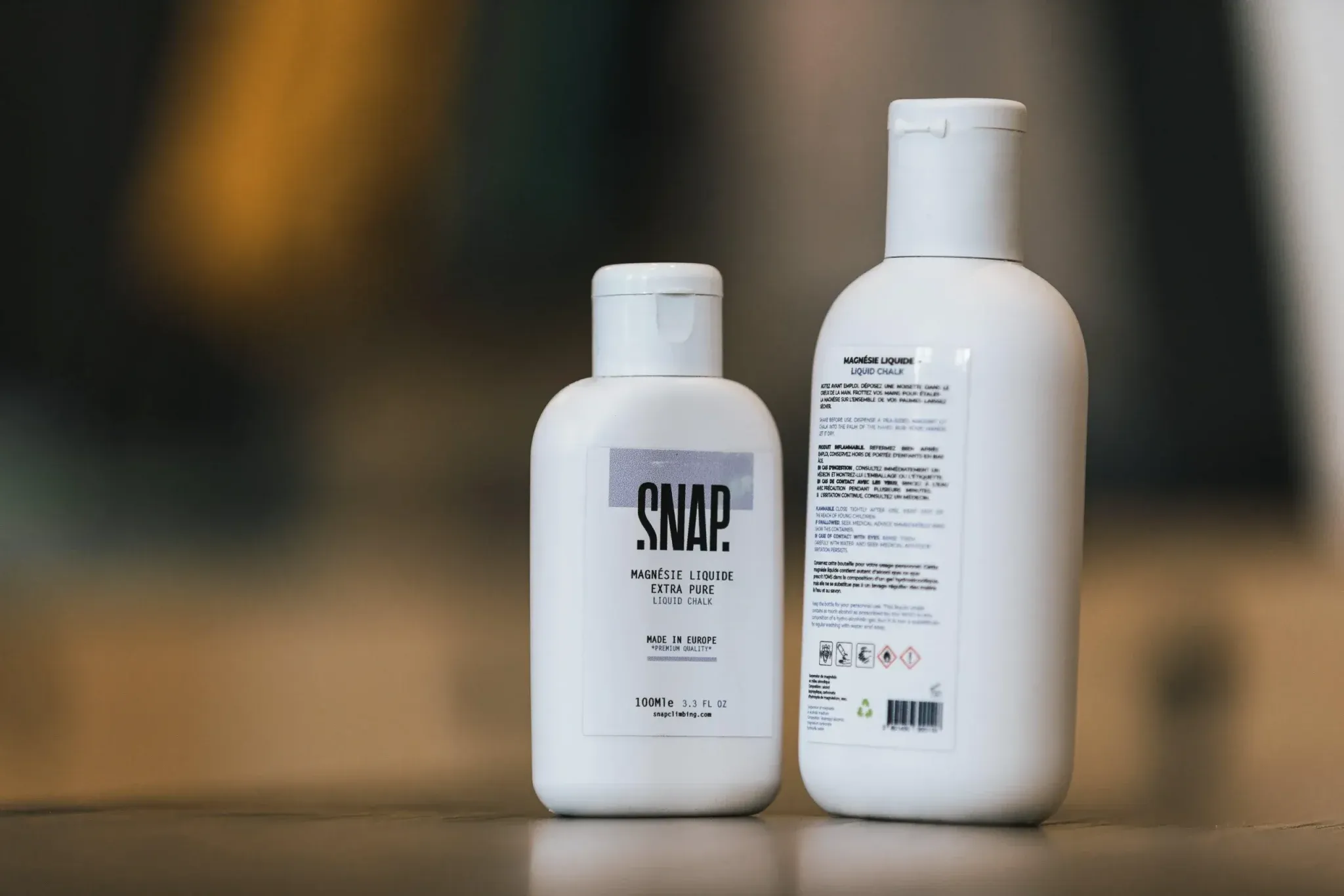
Liquid Magnets: How to choose the ideal one for climbing
In France, the FFME counted 120,061 licensed drivers In 2024, a good sign of a practice that is becoming more common… and of catches that quickly become cluttered. FFME In this context, liquid magnesia is no longer just a detail: it is a setting that improves performance, skin comfort, and cleanliness in the room.
In this article, you will build your choice as a diagnosis: your hands, your sweating, your shots, your weather, then the formula and texture. To equip your kit without getting distracted, you can also browse the Snap climbing accessories before validating your routine.
The essentials in thirty seconds
The best liquid magnesium is the one that corresponds to your level of sweating and the actual condition of your skin, not to a brand's reputation.
In the theater, aim for a film that is finished, clean, easy to brush, and compatible with cleaning requirements.
The formula (alcohol, non-alcohol, hybrid) mainly regulates drying, odor, and the risk of irritation.
Validate your choice over several varied sessions, then adjust the amount, texture, and recharge time.
You have the context and the general methodology: we start by locking down the prerequisites, to avoid “easy” mistakes that cost whole sessions.
Prerequisites: clarify your objectives and constraints before buying
Grip angle according to your climbing style
Your goal is not “more grip” in general. It’s grip stable in your dominant style. In short, intense blocks, you seek immediate impact and a solid performance in close sprints. On the other hand, you primarily seek consistency, with a skin that doesn’t break down during sprints.
Ask yourself a simple question: are you losing grip? slipping (oxidation, humidity, too-greasy film), or by pain (too dry skin, fissures, overheating)? Liquid magnesium can help with both, but not with the same setting.
Finally, think about “type of grip” before thinking about “type of product”. On macro levels, volumes and smooth grip, a film that is too thick marks and accumulates. On very textured grips, you can tolerate a slightly drier deposit, because the friction is already high.
Room constraints and cleaning requirements
Modern rooms often favor liquid magnésium because it limits cloud formation and flying deposits. But not all of them like the same traces. Some tolerate a thin film, others punish “chalky” hands that bleach the volumes.
The subject becomes massive as soon as there is a lot of traffic. In North America, it was estimated more than eight hundred rooms according to a market report published in 2024. Climbing Business Journal The more rooms there are, the more the standards of cleanliness and maintenance become normalized.
Before buying, read the regulations posted at the desk and observe the cleaning of the outlets. If the room is often brushed and regularly washed, a more “dry” formula works better. If volumes are sensitive to traces, opt for a product that forms a discreet film, and learn to dose correctly.
Target budget and weekly training frequency
The budget is not “the price of the bottle”. It is the cost of your consistency. If you climb little, a very effective but a bit aggressive product can be acceptable, because the skin recovers between sessions. If you climb often, your priority becomes tolerance and repeatability.
The right approach: Define your frequency, then estimate your consumption, then compare the performance. A product that forces you to recharge constantly may seem good at first, but it costs money and disrupts your rhythm.
Skin tolerance and sensitivity to solvents
Liquid magnymium almost always contains a solvent (often an alcohol) and texture agents. The risk is not just “dryness”. It is also the sensation of tingling, irritation on micro-cracks, or a too stripping effect that triggers a spiral: you put on more magnymium, then the skin breaks, then you put on more.
If you have reactive skin, aim for milder formulas and compensate with a simple skincare routine (see the dedicated section). And keep in mind that a thinner film is often more effective than a thick layer.
Checklist before climbing
- Skin Cracks, hot spots, calluses that stick out.
- Weather : humid air, heat, dry cold, rock that “sucks”.
- Room Rules regarding traces, volumes, brushing, cleaning.
- Bag : well-closed bottle, cloth, small waterproof bag if needed.
- Brush : Clean brush, suitable bristles, gentle motion.
Set a clear goal (instantaneous catch or lasting comfort), otherwise you will choose randomly.
Room constraints matter as much as your skin.
Dosage is a skill: it is better to have a fine film that is well positioned than a thick deposit.
Once your constraints are set, you can do what most climbers do: a real assessment of your hands, through effort.
Diagnose your hands and sweating patterns to avoid making bad choices
Test your sweat in real effort
Do not test the liquid magnesium in a calm environment, in the locker room, or on an “easy” machine. Test it when you are at your limit, on movements where you usually slide. The useful sweating to measure is the one that occurs after the warm-up, when the heart rate rises, and your hands get warm.
Simple procedure: apply a thin film, wait for the complete drying, then perform a series of continuous movements. If you feel that the film becomes “soap-like”, this is often a sign of too thick product or a residue that does not like moisture.
Identify dominant dry skin, fissures, and calluses
Look at your hands like an opener looks at a volume: loading zones, torsion zones, zones that tear. A very dry skin can “stick” at first, then peel off. A too-wet skin gives an irregular grip, with repeated micro-glides that tire the forearm.
Calluses are not the problem. The problem is the callus that rises up, creates a border, and forces you to compensate. Liquid magnesium helps if it stabilizes the friction. It worsens if it hardens the surface too much.
Identifying the triggers that trigger the slide
Note the “triggers”: smooth, flat, volume sockets, new sockets, very tight macros. Conversely, on very rough sockets, the liquid magnet can become secondary, because the texture does the work. You are then especially looking to maintain a clear contact without over-coating.
In the rock face, the trigger can be the rock itself: polished limestone, clay susceptible to moisture, abrasive granite. Your liquid magnetism must match this interaction; otherwise you will brush more than you climb.
Decision-making tree skin and sweating
Flux: your hands become wet very quickly → opt for quick drying and a fine film → test the hold on smooth surfaces → if white marks appear, reduce the amount or change the texture.
Flux: your hands are already dry and they easily mark → opt for a milder formula or a less stripping film → protect the cracks before the session → if tingling occurs, change the solvent or space the refills.
Flux: Average hydration but spreads over volumes → look for a “adherent” and uniform film → avoid thick layers → brush lightly and evenly.
Flux: good hold but skin breaks → priority becomes skin comfort → adjust care, amount, and frequency of application.
Defining your priority: maximum grip or skin comfort
Choosing is giving up part of the spectrum. A very aggressive product can give spectacular grip, but it will cost you a week of skin. A soft product may be perfect on the course, but insufficient in very modern blocks, on smooth volumes.
Decide your priority for the coming weeks. Only then can you compare the formulas. Without this decision, you change product every session, and you never learn to dose properly.
Test in real effort, not in cold weather.
The “good” product depends on the shots that make you slide, not on the average of your sensations.
Set a temporary priority, then iterate.
With this diagnosis, you can now choose a liquid magnésium formula that adheres to your reality, not to a marketing brochure.
Choosing a liquid magnate by formula: alcohol, non-alcohol or hybrid
Comparing base alcohol, non-alcoholic and hybrid
The major difference between the formulas is the behavior of the solvent and what it leaves behind. An alcohol-based base dries quickly, “tightens” the skin, and leaves a rather clear film. An alcohol-free base often aims for tolerance, but can leave a more “emollient” sensation depending on the added agents.
Hybrids seek a compromise: correct drying, more acceptable odor, more supple film. In practice, it is often a question of skin and context. In a closed room, smell and evaporation count. In cold outdoor conditions, the effect can be different, as drying slows down and the skin reacts differently.
Evaluate drying speed and initial firmness
The drying speed should suit your rhythm. If you climb in close trials, a drying time that is too long breaks your tempo. If you are in the early stages, a slightly more gradual drying can be comfortable, as it avoids the immediate “paper” feeling.
The initial fit is judged by two criteria: do you have a uniform grip across the entire palm, and does the liquid magnet avoid “slippery” areas around the fingers? Uneven grip often results from applying too quickly or from an unsuitable texture.
Understanding residual film and sensation on shots
The residual film can be an ally or an enemy. A uniform film increases friction. A film that forms micro-packets reduces the contact surface and leaves marks on the volumes. You often see this on black plugs or very smooth plates.
If you feel a “soap-like” sensation on plastic brushes, suspect a too thick film or a product too loaded with texture agents. Your first step is not to change brands. It’s to reduce the amount and apply it for longer.
Check for irritants and thickening agents
Before buying, check the composition. The goal is not to become a chemist. The goal is to identify what irritates you. Some references clearly indicate an alcohol base and the type of magnesium used, for example a product mentioning Isopropyl alcohol and a magnesium carbonate/hydroxide. Petzl
If you have sensitive skin, avoid formulas that consistently sting you at the slightest touch. A slight initial sensation may occur. A clear, repeated burn should prompt you to change formulas, not “tighten up.”.
Quick selection according to three hand profiles
Very wet hand profile Choose a formula that dries quickly, applies sparingly, and is suitable for both small and large areas.
Mixed hand profile Look for a uniform film, rather fine, that holds without compulsive reapplications.
Dry and reactive hand profile : prioritize tolerance, reduce the frequency of application, and compensate with a skincare routine.
Comparative table: what to expect according to the formula
| Formula | Drying | Skin sensation | Traces on volumes | When to choose it |
|---|---|---|---|---|
| Alcohol base | Quick | Can dry out | If overdose | Intense sweat, hands are wet, the room is warm |
| Alcohol-free | Often more progressive | More tolerant | Films sometimes more “visible” | Reactive skin, long sessions, priority comfort |
| Hybrid | Intermediate | Balanced | Generally moderate | Versatile use in the room and outdoors |
The formula mainly deals with drying, odor, and tolerance; it doesn’t take into account your level of “talent.”.
A smooth and uniform film is better than a thick layer, even with an excellent product.
Read the composition to avoid irritants that trigger itching.
Micro-action: note your current preference (maximum grip or skin comfort) before your next purchase, then stick with it for a few weeks.
You have chosen a formula family: there are still three parameters to be settled that often make the difference between “it works” and “I hate it”.

Eliminate alcohol, drying and odor for pleasant use in the room as well as in the cliff
Choose express or progressive drying according to your pace
Express drying helps if you perform quick tests in a row, or if you work on a pan with little rest. But it can give a feeling of “pulling” skin if you are already dry. Progressive drying is often more comfortable, but it requires waiting for the evaporation to actually end; otherwise you will get residues on the catches.
Simple test: apply, spread, then rub palm to palm. If you feel a wet area, you’re not ready. You’ll waste product and get the outlets dirty.
Anticipating the smell and evaporation in confined spaces
In the room, the smell builds up. If you share a line of clothes with several people, a very strong smell quickly becomes unpleasant. In a small space, the feeling is even stronger, especially if you re-apply it frequently.
The right approach: reduce the amount per application. The smell follows the amount of solvent that evaporates. Many climbers complain about the product, even though they are overusing it.
Managing the cooling effect and the tingling sensation
Cooling is standard with volatile solvents. This is not serious in itself. The problem is when it turns into tingling on the cracks. In this case, your priority becomes skin protection, not clinging to everything at all costs.
If it itches, check the condition of your hands. An “open” skin reacts to everything. You can also change the texture, as some textures concentrate more in the folds and accentuate the sensation.
Adapt to cold, heat and humidity
In cold weather, the skin can become hard and brittle. A liquid magnesium that is too aggressive accelerates the breakdown. In humid heat, on the other hand, you may need a more thorough drying process, because the sweat quickly evaporates.
On wet or wicking rock, liquid magnesium is not magic. It can stabilize the friction, but it does not replace line choice, brushing, and timing. Your strategy becomes “keeping a clean film,” not “adding more.”.
Warning: excessive skin dryness
Over-drying is tricky. On the first day, you love it. On the third, your skin feels tight. Then the micro-cracks appear, and you miss the next session. If you climb regularly, aim for lasting performance, not the peak of friction on a single run.
The most effective setting is often the simplest: less product, better spread, and fewer unnecessary re-applications.
The drying process should follow your own rhythm; otherwise you’ll overdose.
A strong odor is often an indicator of excessive quantity, not just of formula.
If your skin breaks, reduce the frequency of application before changing everything else.
The next level of adjustment is texture. This is where you gain in cleanliness, uniformity, and feel on modern lenses.
Adjust texture, charge and hook for modern grips
Choosing between fluid, cream, gel and thick paste
A fluid texture spreads quickly, forms a thin film, and often leaves less trace if you apply it in a controlled manner. A cream or gel may better “stick” if your hands are wet, because the film builds up more easily. A thick paste can give a strong grip sensation, but it marks more, and can form lumps.
Your hand must remain “readable”. If you feel a layer separating from friction, you lose precision. On a plate, this can turn a proper hold into slipping.
Evaluate the covering power and uniformity of the film
Useful covering power is not “white”. It is “uniform”. Good liquid magnatism covers key areas without overloading the folds. Apply it for a long time until you feel a homogeneous surface. Don’t look for opacity. Look for uniformity.
Field tip: after drying, run your finger over the palm. If you feel very dry areas and others that are more oily, you haven’t applied it evenly, or the texture isn’t suitable.
Limit packets and white traces on volumes
The volumes indicate an overdose. They show everything. To limit the traces, use less product and wait for the complete drying. If you put your hands on the plug too soon, you transfer white mud instead of a dry film.
And brush lightly. An aggressive brush on a volume can spread the magnet on the hair instead of removing it. Choose short, clean, repeated movements.
Optimizing friction on plastic or rock
On plastic, liquid magnatism must avoid the “soap” effect. A too thick film reduces the useful surface area. On rock, the subject becomes compatible with the natural texture. On abrasive granite, you already have friction, so aim for skin protection and stability. On polished limestone, you are primarily looking for a clear film that holds up in the ambient humidity.
Do not confuse friction and glue. Liquid Magnets are not a resin. If you are looking for a sticky feel, you will overload and get dirty.
Defining the need for recharging between tests
A good product doesn't require constant recharging. If you recharge frequently, there is often a simpler cause: too little initial charge, uneven application, lack of brushing, or hands washed too often during the session.
Your goal: find the minimum of load that keeps the feeling stable. This setting is what makes the difference in consistency, especially when riding in a group.
Texture mainly determines the uniformity and cleanliness of volumes.
Visible white is not a reliable indicator of performance.
If you recharge too much, suspect the application technique first.
Once the texture is mastered, you can make a rational choice regarding yield, without falling into the trap of choosing the “cheapest” option that evaporates or is wasted.
Estimate the yield and cost per session without making mistakes
Calculate your average consumption per typical session
Your consumption depends on your style and your skin. In general, you tend to apply more often, especially if you perform close-range tests in succession. On the other hand, you apply it less frequently, but you sometimes sweat more over time.
Measure without numbers: over several sessions, observe when you feel the need to reapply. If it is systematic and very frequent, your film is not stable, or your product is too volatile for your context.
Compare formats and refills without being misled
The right size isn’t always the biggest one. A compact bottle is easier to carry, less likely to leak, and encourages you to measure your dose. A larger size makes sense if you climb often, or if you share it with a partner.
Rechargeable systems become interesting if you have a stable routine. They reduce waste and simplify logistics, provided that you have a reliable charger and clean transportation.
Evaluating the waste associated with too rapid drying
A product that dries too quickly can cause you to lose yield, because you apply more to “feel something”. That’s a bias. The right benchmark is uniformity, not the immediate sensation.
Another common waste: applying and touching up the paint before it has completely dried. You transfer wet product, you get a mess, then you reapply. The cycle is perfect… and expensive.
Predicting the duration according to block, route, panel and campus
Pan and campus often require a stable grip, as the grips are repetitive and the load on the hand is heavy. If your liquid magnesium hardens too much, you lose comfort and compensate. On the track, the problem is often moisture and managing the effort.
Choose a routine per discipline. You can keep the same product, but change the amount and the time of application.
Define your acceptable price threshold based on performance achieved
Your threshold is not moral. It is practical. If a product allows you to get more tests without damaging your skin, it often costs more than its price. If a product ruins your hands, it is expensive even if it costs little.
Decide what you are willing to pay for a stable sensation, then always test over several sessions before “validating”.
The yield depends first of all on overdosage and incomplete drying.
Adjust the amount and timing to the discipline, even with the same bottle.
Your “good price” is one of stable performance without skin irritation.
Micro-action: For the next session, impose only one “clean” application initially, then observe if the need for recharging decreases.
After yield, there is one point that is often overlooked: its suitability to the site, the rock and the weather, because these are the factors that dictate its cleanliness and real effectiveness.
Check the usage: room, rock and weather, without dirtying the sockets
Compatibility with room rules and traces on sockets
In the studio, your goal is twofold: to stick and leave the surface clean. Use a minimal amount, and wipe up any excess with a cloth rather than on the surfaces. If the studio is strict about keeping the marks clean, opt for a texture that forms a fine, uniform film.
Brushing is part of the ethics of practice. A well-adjusted liquid magnet reduces encrustation. An over-adjusted liquid magnet makes it more tenacious.
Choose between limestone, stoneware, granite and resin
On limestone, especially polished limestone, the film should remain “dry” and clean. On sandstone, managing moisture is key. If the rock is sensitive and the air is humid, you may experience a feeling of slippage despite the liquid magnesium. In this case, reduce the amount and brush more, rather than stacking layers.
On granite, natural friction is strong. Your priority often becomes skin and hygiene. On resin (joints and volumes), uniformity and cleanliness dominate.
Adapt to wet conditions and porous rock
When the rock is wet, liquid magnesia can help, but it doesn’t compensate for everything. Look for grips that dry in the wind, choose more textured passages, and limit unnecessary contact that wets the hand. A thin film holds better than a layer.
Outdoors, avoid reflexively “recharging” either. First, observe what is actually slipping: the skin, the grip, or the placement technique.
Consider combinations with a magnet ball or powder
You can mix the uses. Liquid magnesia can serve as a stable base, then a ball or a little powder can help at the end of a session, when the skin changes. But the combination must remain clean. If you mix too much, you create a paste on your hand and on the grip.
If you are climbing in a gym, check what is allowed. Some gyms accept liquid base but limit powder.
Reduce plaque build-up and the need for brushing
The best way to reduce the build-up is to reduce the amount and wait for complete drying. Then brush before your key tests, not after you have already washed everything. A clean brush and a clean hand save time and improve grip.
In the theater, liquid magnatism is a compromise between performance and cleanliness.
When outdoors, adjust your amount of fertilizer based primarily on the humidity and texture of the rock.
The more you stack them, the more you brush them: aim for the most effective minimal film.
You can now climb high, but not at the expense of skin. The next section locks in hygiene, tolerance, and the buying patterns that really matter.
Protect your skin, your hygiene and your shopping choices
Prevent cracks with a simple routine
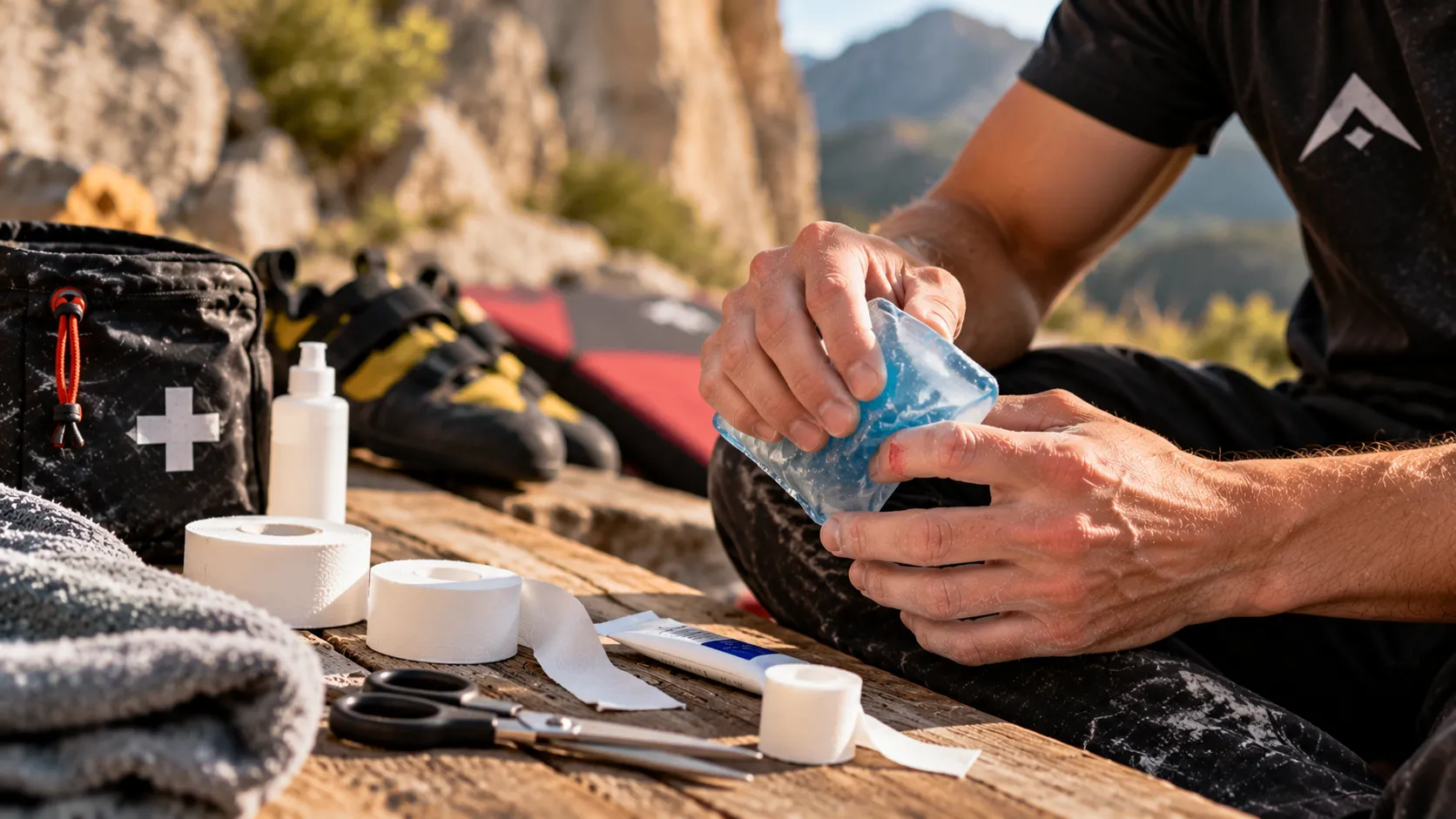
Your skin is a material. It prepares itself, maintains itself, and regenerates. After the session, wash your hands, dry them, then lightly moisturize them. Before the session, avoid greasy creams that reduce friction. If you have fissures, protect them with a thin dressing or an appropriate band, then adjust your liquid magnesium to avoid tingling.
The goal is not to have “soft” hands. The goal is to have a stable surface, without any callused edges, and without open areas.
Reduce skin reactions and irritation
If you do react, do not confuse irritation with “hardening”. A useful fact from a chapter of recommendations on hand hygiene indicates that the undesirable skin reactions observed with alcoholic preparations were uncommon, with an example to illustrate Thirteen cases out of two thousand seven hundred and fifty exposed people. NCBI Bookshelf
In practice, the best prevention for liquid magnyl is: minimal dose, application on dry skin, and aftercare after each session. If a product consistently causes irritation, change it, even if it “works”.
Choosing a low-odor option for co-riders
In the theater, you often have to climb up close. A strong odor is noticeable to others, especially in a closed space. If you’re on the same row or in a group, a discreet approach is a choice of respect. And it’s often more pleasant for you, because you avoid the reflex of over-applying.
Prefer durable packaging and refills
Useful shopping trends are not “the new thing”. They are pure refills, reliable caps, and shock-resistant bottles in a bag. A bottle that leaks ruins your bag, your belongings, and your session.
If you’re looking for consistency, stay in an environment where technology serves the movement. That’s the spirit of Snap Climbing, founded in Chamonix in the 1990s, between design and durability, for indoor and outdoor use.
Anticipate the restrictions and increased cleaning
The rooms often tighten their requirements when the outlets get clogged. Your best defense is a clean application. Place the liquid magnet away from the outlets, let it dry completely, then climb in. Brush before the tests, and avoid “recharging” in the middle of a run.
Transport: closure, leaks and drying out
If possible, transport the vial upright or in a small airtight bag. Wipe the cap before closing. Avoid extreme temperature changes in a car in the sun, as this increases pressure and promotes leakage.
Buying break: what really matters online
If you order your liquid magnesium with other equipment, keep a clear list to avoid inconsistent purchases. The same basket can contain items as diverse as gymnasts, weightlifters, and crossfit enthusiasts, but your climbing needs remain specific. Check your orders before the package is shipped, and check your cookie preferences if you share a device. If you go shopping, stay focused on your use. The rest (swimsuits, swimsuits, combos, hats, bags, back packs, windbreakers, effort drinks, electrostimulation, trail shoes, running shoes, recovery shoes, recovery) only makes sense if it serves your practice, not the impulse. This article should help you decide without getting distracted.
A post-workout routine protects your performance over time.
If a product irritates you, the right choice is to change it, not to “grin and bear it”.
A reliable and portable bottle often costs more than a spectacular grip that only lasts for a single try.
You have chosen, set up, and secured it. The final step is to validate it as a precise climber: on the ground, using a simple protocol, then with targeted adjustments.
Validate your choice and adjust without starting from scratch
Measuring the necessary grip, regularity and recharge cycles
Validation is about comparing your liquid magnésium to yourself, not to others. Over several sessions, note your sensations in three contexts: smooth strokes, very textured strokes, and volumes. Look for consistency: is the hold stable, or does it vary with each application?
If the sensation varies, suspect first the quantity and the drying process. Most failures come from applying too much product too quickly.
Comparing performance over representative sessions
Avoid judging a single “perfect” session. Good validation includes a session where you sweat, a session where the air is dry, and a longer session where the skin heats up. The goal is to know if the product still feels pleasant when you’re tired, because that’s where you lose sales.
Keep only one variable at a time. If you change the magnet, brush, socks, and room at the same time, you won't know what really worked.
Adjustment table: common problems and corrections
| Symptom | Probable cause | Concrete adjustment | Expected effect |
|---|---|---|---|
| White traces on volumes | Overdose or incomplete drying | Apply less, spread it out more, wait for the drying to finish | Finer film, cleaner volumes |
| “Soap-like” sensation on plastic catches | Film too thick or residue too “greasy” | Reduce the amount, choose a smoother texture | More precise contact, less slip |
| Itching and skin pulling | Open skin, too aggressive formula | Spacing out the application, switching to a more tolerant formula | Comfort, less skin irritation |
| Need to recharge very often | Une application inégale, un brossage insuffisant | Apply more uniformly, brush before the tests | More stable grip, fewer interruptions |
| Good grip but skin breaks after use | Excessive drying, insufficient recovery | Reduce the frequency, strengthen care after each session | Sustainable performance over the week |
Validate on varied contexts; otherwise you will over-interpret a session.
Adjust the quantity and drying time first, before changing the product.
A good setting reduces the need to recharge and the dirt on the outlets.
Liquid Magnets FAQ (Liquid Magnet): Short and actionable answers
What amount should be applied for an effective film?
Apply sparingly, then spread for a long time until you achieve an even surface. The useful benchmark is not whiteness, but the absence of wet areas and lumps. If you leave traces on volumes, it is almost always an overdosage or incomplete drying. Start with minimal amounts, then only increase if you still slip on your “triggering” grips.
Is it necessary to supplement with powder during the session?
Yes, sometimes, but only if it serves a specific purpose. Liquid magnolias can make a stable base. A small touch of powder or a ball can help when the skin heats up or the humidity rises. If you mix too much, you create a paste that clogs up and forces you to recharge again. In the studio, also check the rules before adding powder.
How long do I have to wait before climbing after application?
Wait for the drying to finish; otherwise you transfer a wet film onto the clamps. The good test is tactile: rub your palm against your palm. If you still feel a wet or sticky area, wait. With a well-adjusted application, the wait is short, but it changes everything regarding cleanliness and the film’s hold during your tests.
How can I avoid having my hands too dry and irritated?
First reduce the frequency of application and the amount, because overdosing dries out the skin more than it helps. Apply to dry skin, avoid layering, and adopt a post-session skincare routine (washing, drying, light hydration). If a product bites into micro-cracks, change the formula or texture. Your goal is a stable skin, not “ultra dry”.
Which option to choose for very strict rooms on the traces?
Choose a texture that spreads in a thin film and dries properly, then work out your dosage. Apply away from the outlets, wait for the complete drying, and brush before your key tests. Avoid thick layers that bleach the volumes. In these rooms, performance often comes from a minimalist and regular application, not from a “stronger” liquid magnet.
Choosing the ideal liquid magnesium for climbing is about building a stable setup: diagnosis of sweating, skin condition, type of holds, then formula and texture. Then you validate over several sessions and adjust quantity, drying, and care routine. This approach gives you performance without paying in broken skin, and without dirtying the gym. It’s up to you to play: take a variable, test it properly, then lock your routine.
 Français
 English (UK)


